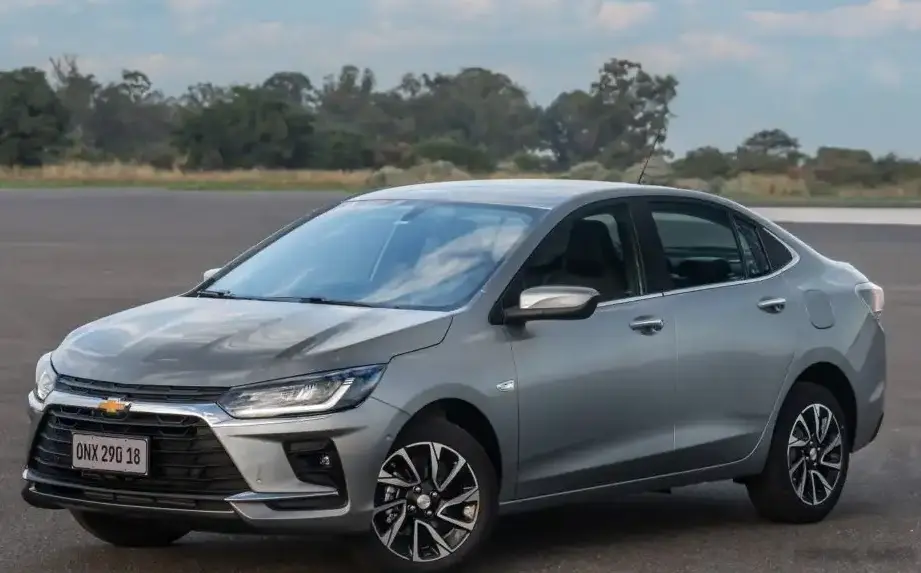
The Chevrolet Onix II Plus, specifically the 1.0-liter (80/82 hp) Ethanol variant introduced with the 2025 facelift, represents an entry-level offering within the broader Onix lineup in the Brazilian market. Launched in July 2025, this model is designed to appeal to cost-conscious buyers seeking fuel efficiency and practicality in a compact sedan package. The Onix II Plus builds upon the success of the original Onix, offering increased space and a more refined interior while maintaining the core values of affordability and reliability. This particular engine and transmission combination is positioned as the base model, offering a balance between price and functionality.
Technical Specifications
| Brand | Chevrolet |
| Model | Onix |
| Generation | Onix II Plus (facelift 2025) |
| Type (Engine) | 1.0 (80/82 Hp) Ethanol |
| Start of production | July, 2025 |
| Powertrain Architecture | Internal Combustion engine |
| Body type | Sedan |
| Seats | 5 |
| Doors | 4 |
| Fuel consumption (economy) – urban | 7.2 l/100 km (32.7 US mpg, 39.2 UK mpg, 13.9 km/l) |
| Fuel consumption (economy) – urban (Ethanol – E100) | 10.2 l/100 km |
| Fuel consumption (economy) – extra urban | 5.8 l/100 km (40.6 US mpg, 48.7 UK mpg, 17.2 km/l) |
| Fuel consumption (economy) – extra urban (Ethanol – E100) | 8.3 l/100 km |
| CO2 emissions | 105 g/km |
| CO2 emissions (Ethanol – E100) | 99 g/km |
| Fuel Type | Petrol / Ethanol – E100 |
| Acceleration 0 – 100 km/h | 12.9 sec |
| Acceleration 0 – 62 mph | 12.9 sec |
| Acceleration 0 – 60 mph | 12.3 sec |
| Maximum speed | 176 km/h (109.36 mph) |
| Weight-to-power ratio | 13.1 kg/Hp, 76.6 Hp/tonne |
| Weight-to-torque ratio | 10.5 kg/Nm, 95.7 Nm/tonne |
| Power | 80 Hp @ 6400 rpm |
| Power per litre | 80.1 Hp/l |
| Power (Ethanol – E100) | 82 Hp @ 6400 rpm |
| Power per litre (Ethanol – E100) | 82.1 Hp/l |
| Torque | 100 Nm @ 4000 rpm (73.76 lb.-ft. @ 4000 rpm) |
| Torque (Ethanol – E100) | 104 Nm @ 4000 rpm |
| Maximum engine speed | 6500 rpm |
| Engine layout | Front, Transverse |
| Engine displacement | 999 cm3 (60.96 cu. in.) |
| Number of cylinders | 3 |
| Engine configuration | Inline |
| Cylinder Bore | 74 mm (2.91 in.) |
| Piston Stroke | 77.49 mm (3.05 in.) |
| Compression ratio | 12.5:1 |
| Number of valves per cylinder | 4 |
| Fuel injection system | Multi-port manifold injection |
| Engine aspiration | Naturally aspirated engine |
| Valvetrain | DOHC |
| Engine oil capacity | 3.75 l (3.96 US qt, 3.3 UK qt) |
| Coolant | 5.4 l (5.71 US qt, 4.75 UK qt) |
| Kerb Weight | 1045 kg (2303.83 lbs.) |
| Max. weight | 1420 kg (3130.56 lbs.) |
| Max load | 375 kg (826.73 lbs.) |
| Trunk (boot) space – minimum | 500 l (17.66 cu. ft.) |
| Fuel tank capacity | 44 l (11.62 US gal, 9.68 UK gal) |
| Length | 4480 mm (176.38 in.) |
| Width | 1746 mm (68.74 in.) |
| Width including mirrors | 2044 mm (80.47 in.) |
| Height | 1473 mm (57.99 in.) |
| Wheelbase | 2600 mm (102.36 in.) |
| Front track | 1500 mm (59.06 in.) |
| Rear (Back) track | 1504 mm (59.21 in.) |
| Front overhang | 888 mm (34.96 in.) |
| Rear overhang | 992 mm (39.06 in.) |
| Ride height (ground clearance) | 157 mm (6.18 in.) |
| Drag coefficient (Cd) | 0.311 |
| Minimum turning circle (turning diameter) | 10.6 m (34.78 ft.) |
| Approach angle | 14° |
| Drivetrain Architecture | The Internal combustion engine (ICE) drives the front wheels of the vehicle. |
| Drive wheel | Front wheel drive |
| Number of gears and type of gearbox | 6 gears, manual transmission |
| Front suspension | Independent, type McPherson with coil spring and anti-roll bar |
| Rear suspension | Semi-independent, coil spring, Torsion |
| Front brakes | Ventilated discs |
| Rear brakes | Drum |
| Assisting systems | ABS (Anti-lock braking system) |
| Steering type | Steering rack and pinion |
| Power steering | Electric Steering |
| Tires size | 185/65 R15 |
| Wheel rims size | 6J x 15 |
Powertrain & Engine Architecture
The heart of this Onix variant is the 1.0-liter inline three-cylinder engine, designated as a flex-fuel engine capable of running on gasoline or ethanol (E100). This engine utilizes a multi-port fuel injection system and a double overhead camshaft (DOHC) valvetrain. The 999cc displacement is maximized through a relatively high compression ratio of 12.5:1. The engine produces 80 horsepower at 6400 rpm when running on gasoline, increasing to 82 horsepower on ethanol. Torque output is 100 Nm (73.76 lb-ft) at 4000 rpm on gasoline, rising to 104 Nm on ethanol. The engine is transversely mounted, driving the front wheels. The standard transmission is a 6-speed manual gearbox. This engine is a member of Chevrolet’s Small Engine Family (SEF), designed for efficiency and affordability.
Driving Characteristics
The 1.0-liter engine, paired with the manual transmission, delivers modest performance. Acceleration from 0 to 100 km/h (0-62 mph) takes approximately 12.9 seconds. The power delivery is relatively linear, but the small displacement means that drivers will need to utilize the full rev range to achieve optimal acceleration. Compared to higher-trim Onix models equipped with 1.2-liter engines or turbocharging, this variant feels noticeably less powerful, particularly when fully loaded or climbing hills. The manual transmission offers precise shifts, but the gear ratios are tuned for fuel economy rather than outright performance. The focus is on providing adequate power for daily commuting and urban driving.
Equipment & Trim Levels
The base-level Onix II Plus 1.0 typically includes standard features such as air conditioning, power steering, electric front windows, and a basic audio system with Bluetooth connectivity. Safety features include dual front airbags and ABS brakes. Interior upholstery is typically cloth, and the dashboard features a simple, functional design. Optional extras, depending on the package selected, could include power rear windows, a more advanced infotainment system with a touchscreen display, and alloy wheels. This trim level is designed to be a value proposition, offering essential features at an accessible price point.
Chassis & Braking
The Onix II Plus utilizes a McPherson strut suspension setup at the front and a semi-independent torsion beam suspension at the rear. This configuration provides a reasonable balance between ride comfort and handling. The front brakes are ventilated discs, while the rear brakes are drums. The electric power steering provides light and easy steering feel, making it well-suited for urban driving. The suspension is tuned for comfort, prioritizing a smooth ride over sporty handling characteristics.
Market Reception & Comparison
The 1.0-liter Onix II Plus is primarily targeted at budget-conscious buyers in Brazil and other South American markets. Critics generally acknowledge its fuel efficiency and affordability but note its lack of outright performance. Compared to the 1.2-liter versions, the 1.0 offers significantly lower running costs but sacrifices acceleration and overall refinement. The ethanol compatibility is a significant advantage in Brazil, where ethanol is widely available and often cheaper than gasoline. Fuel economy figures are competitive within its segment, offering approximately 7.2 l/100km in urban driving and 5.8 l/100km on the highway when running on gasoline.
Legacy
The 1.0-liter engine in the Onix II Plus is expected to be a reliable and durable powertrain, benefiting from Chevrolet’s experience in developing small-displacement engines. While not known for exceptional performance, it is designed for longevity and low maintenance costs. In the used car market, this variant is likely to appeal to buyers seeking an affordable and fuel-efficient compact sedan. Its simplicity and relatively low repair costs should contribute to its long-term appeal.