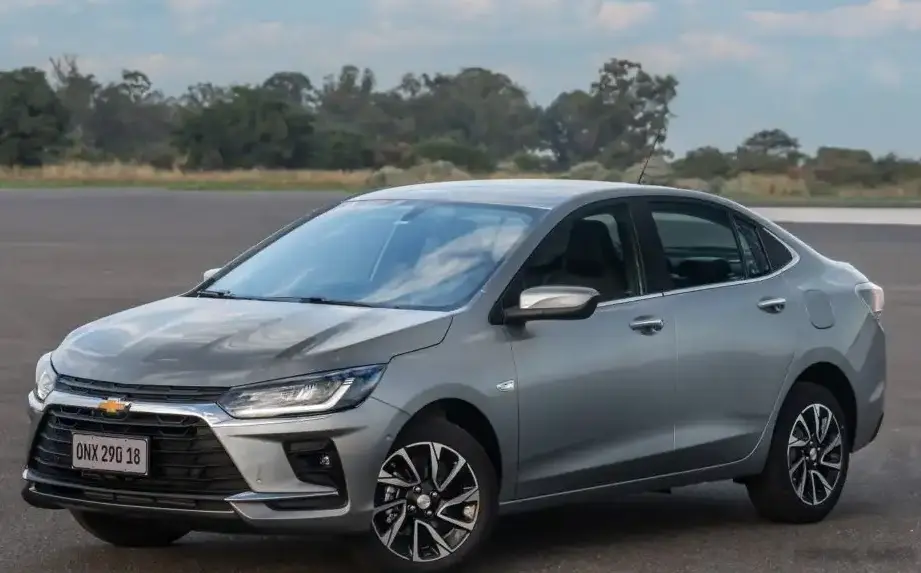
The Chevrolet Onix II Plus, specifically the 1.0T (115 hp) variant introduced with the 2025 facelift, represents a significant offering in the South American subcompact sedan market. Launched in July 2025, this model builds upon the success of the original Onix, aiming to provide a balance of fuel efficiency, modern technology, and affordability. Positioned as a mid-range option within the Onix II Plus lineup, it slots between the base 1.0L naturally aspirated engine and the more powerful 1.2T turbocharged variant. The Onix II Plus is a crucial model for Chevrolet in Brazil and other Latin American countries, competing directly with vehicles like the Fiat Cronos, Volkswagen Virtus, and Hyundai HB20S.
Technical Specifications
| Brand | Chevrolet |
| Model | Onix |
| Generation | Onix II Plus (facelift 2025) |
| Type (Engine) | 1.0T (115 Hp) Ethanol |
| Start of production | July, 2025 |
| Powertrain Architecture | Internal Combustion engine |
| Body type | Sedan |
| Seats | 5 |
| Doors | 4 |
| Fuel consumption (economy) – urban | 7.5 l/100 km (31.4 US mpg, 37.7 UK mpg, 13.3 km/l) |
| Fuel consumption (economy) – urban (Ethanol – E100) | 10.9 l/100 km |
| Fuel consumption (economy) – extra urban | 6 l/100 km (39.2 US mpg, 47.1 UK mpg, 16.7 km/l) |
| Fuel consumption (economy) – extra urban (Ethanol – E100) | 8.1 l/100 km |
| CO2 emissions | 110 g/km |
| CO2 emissions (Ethanol – E100) | 103 g/km |
| Fuel Type | Petrol / Ethanol – E100 |
| Acceleration 0 – 100 km/h | 9.9 sec |
| Acceleration 0 – 62 mph | 9.9 sec |
| Acceleration 0 – 60 mph | 9.4 sec |
| Maximum speed | 180 km/h (111.85 mph) |
| Weight-to-power ratio | 9.3 kg/Hp, 107.2 Hp/tonne |
| Weight-to-torque ratio | 6.7 kg/Nm, 149.1 Nm/tonne |
| Power | 115 Hp @ 5500 rpm |
| Power per litre | 115.1 Hp/l |
| Torque | 160 Nm @ 2000-4500 rpm (118.01 lb.-ft. @ 2000-4500 rpm) |
| Torque (Ethanol – E100) | 165 Nm @ 2000-4500 rpm |
| Maximum engine speed | 6000 rpm |
| Engine layout | Front, Transverse |
| Engine displacement | 999 cm3 (60.96 cu. in.) |
| Number of cylinders | 3 |
| Engine configuration | Inline |
| Cylinder Bore | 74 mm (2.91 in.) |
| Piston Stroke | 77.49 mm (3.05 in.) |
| Compression ratio | 10.5:1 |
| Number of valves per cylinder | 4 |
| Fuel injection system | Multi-port manifold injection |
| Engine aspiration | Turbocharger, Intercooler |
| Valvetrain | DOHC |
| Engine oil capacity | 3.75 l (3.96 US qt, 3.3 UK qt) |
| Coolant | 5.4 l (5.71 US qt, 4.75 UK qt) |
| Kerb Weight | 1073-1079 kg (2365.56 – 2378.79 lbs.) |
| Max. weight | 1448-1454 kg (3192.29 – 3205.52 lbs.) |
| Max load | 375 kg (826.73 lbs.) |
| Trunk (boot) space – minimum | 500 l (17.66 cu. ft.) |
| Fuel tank capacity | 44 l (11.62 US gal, 9.68 UK gal) |
| Length | 4480 mm (176.38 in.) |
| Width | 1746 mm (68.74 in.) |
| Width including mirrors | 2044 mm (80.47 in.) |
| Height | 1473 mm (57.99 in.) |
| Wheelbase | 2600 mm (102.36 in.) |
| Front track | 1500 mm (59.06 in.) |
| Rear (Back) track | 1504 mm (59.21 in.) |
| Front overhang | 888 mm (34.96 in.) |
| Rear overhang | 992 mm (39.06 in.) |
| Ride height (ground clearance) | 157 mm (6.18 in.) |
| Drag coefficient (Cd) | 0.311 |
| Minimum turning circle (turning diameter) | 10.6 m (34.78 ft.) |
| Approach angle | 14° |
| Drivetrain Architecture | The Internal combustion engine (ICE) drives the front wheels of the vehicle. |
| Drive wheel | Front wheel drive |
| Number of gears and type of gearbox | 6 gears, manual transmission |
| Front suspension | Independent, type McPherson with coil spring and anti-roll bar |
| Rear suspension | Semi-independent, coil spring, Torsion |
| Front brakes | Ventilated discs |
| Rear brakes | Drum |
| Assisting systems | ABS (Anti-lock braking system) |
| Steering type | Steering rack and pinion |
| Power steering | Electric Steering |
| Tires size | 185/65 R15 |
| Wheel rims size | 6J x 15 |
Powertrain & Engine Architecture
The heart of this Onix variant is the GM-developed 1.0L turbocharged three-cylinder engine, designated as the SPE/4LE. This engine is flex-fuel capable, meaning it can run on gasoline, ethanol, or any blend of the two. The 1.0T utilizes multi-point fuel injection and a single scroll turbocharger with an intercooler to boost power and efficiency. The engine’s aluminum block and cylinder head contribute to weight reduction. The 115 horsepower and 160 Nm (118 lb-ft) of torque are respectable figures for a vehicle of this size and class. The engine is paired with a 6-speed manual transmission, which is the standard offering for this trim level. While an automatic transmission is available on other Onix II Plus models, it is not offered with the 1.0T engine.
Driving Characteristics
The 1.0T engine provides adequate performance for daily commuting and highway driving. Acceleration from 0 to 100 km/h (0-62 mph) takes approximately 9.9 seconds. The turbocharger provides a noticeable boost in power during acceleration, but there is some degree of turbo lag at lower engine speeds. The 6-speed manual transmission is well-matched to the engine’s powerband, allowing drivers to keep the engine in its optimal torque range. Compared to the naturally aspirated 1.0L engine, the 1.0T offers significantly improved acceleration and passing power. However, it doesn’t deliver the same level of performance as the 1.2T turbocharged engine. The suspension is tuned for comfort, providing a relatively smooth ride over uneven road surfaces. Steering is light and responsive, making it easy to maneuver in urban environments.
Equipment & Trim Levels
The Onix II Plus 1.0T typically comes standard with features such as air conditioning, power windows, power door locks, and a basic audio system with Bluetooth connectivity. Higher trim levels add features like a touchscreen infotainment system with Apple CarPlay and Android Auto compatibility, a rearview camera, parking sensors, and alloy wheels. Safety features generally include dual front airbags, ABS brakes, and electronic stability control. Interior upholstery is typically cloth, with options for upgraded materials on higher trims. The dashboard layout is modern and functional, with a focus on ease of use.
Chassis & Braking
The Onix II Plus utilizes a front-wheel-drive layout with an independent McPherson strut suspension in the front and a semi-independent torsion beam suspension in the rear. The front brakes are ventilated discs, while the rear brakes are drums. This configuration is typical for vehicles in this segment, balancing cost and performance. The electric power steering provides a light and responsive feel. The chassis is designed to provide a comfortable ride while maintaining adequate handling characteristics.
Market Reception & Comparison
The Chevrolet Onix II Plus 1.0T has been well-received in the South American market, praised for its fuel efficiency, modern features, and competitive pricing. Critics have noted that the engine provides a good balance of power and economy, making it a practical choice for everyday driving. Compared to the base 1.0L model, the 1.0T offers a noticeable improvement in performance. However, some reviewers have pointed out that the engine can be somewhat noisy under heavy acceleration. Fuel economy is a strong point, with the 1.0T achieving around 7.5 l/100 km (31.4 mpg) in urban driving and 6 l/100 km (39.2 mpg) on the highway when running on gasoline. When running on ethanol, fuel consumption increases accordingly.
Legacy
The 1.0T engine has proven to be a reliable and durable powertrain in the Onix II Plus. While long-term reliability data is still emerging, early reports suggest that the engine is generally trouble-free. The Onix II Plus, including the 1.0T variant, is expected to remain a popular choice in the South American market for years to come. Its combination of affordability, fuel efficiency, and modern features makes it a compelling option for budget-conscious buyers. The used car market for these models is still developing, but well-maintained examples are expected to hold their value reasonably well.