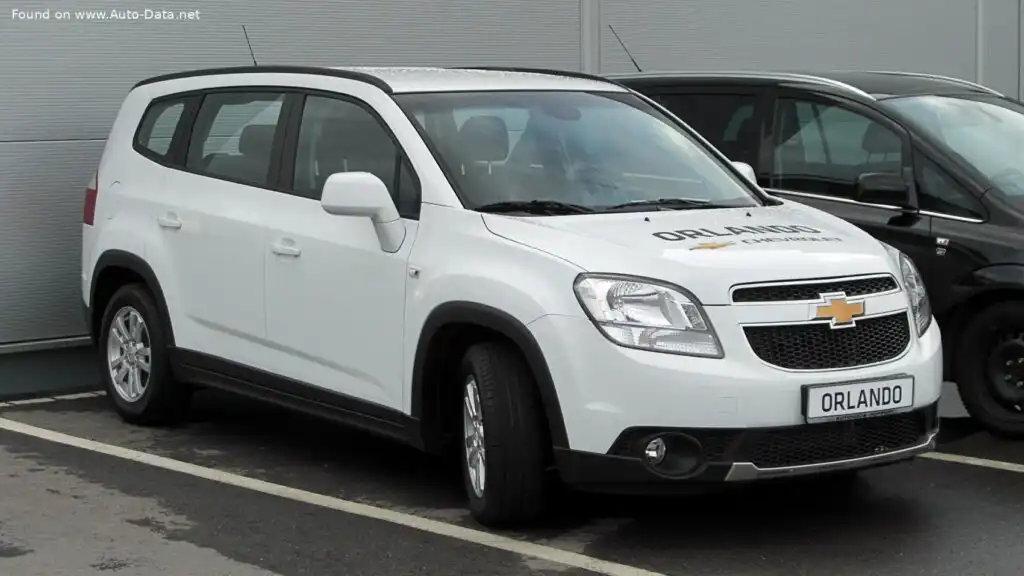
The Chevrolet Orlando 1.8 16V (141 hp) was a front-wheel-drive compact minivan produced by Chevrolet from 2011 to 2018. Positioned as an affordable and practical seven-passenger vehicle, the Orlando aimed to bridge the gap between smaller crossovers and larger, more expensive minivans. This particular variant, equipped with the 1.8-liter gasoline engine and a five-speed manual transmission, represented the entry-level offering in many markets, prioritizing fuel efficiency and accessibility over outright performance. It was primarily sold in Europe, South America, and select Asian markets, and was not officially offered in the United States.
Technical Specifications
| Brand | Chevrolet |
| Model | Orlando |
| Generation | Orlando I |
| Type (Engine) | 1.8 16V (141 Hp) |
| Start of production | 2011 |
| End of production | 2018 |
| Powertrain Architecture | Internal Combustion engine |
| Body type | Minivan |
| Seats | 7 |
| Doors | 5 |
| Fuel consumption (urban) | 8.4 l/100 km (28 US mpg, 33.6 UK mpg, 11.9 km/l) |
| Fuel consumption (extra urban) | 5.3 l/100 km (44.4 US mpg, 53.3 UK mpg, 18.9 km/l) |
| Fuel consumption (combined) | 6.4 l/100 km (36.8 US mpg, 44.1 UK mpg, 15.6 km/l) |
| Fuel Type | Petrol (Gasoline) |
| Acceleration 0 – 100 km/h | 11.6 sec |
| Acceleration 0 – 62 mph | 11.6 sec |
| Acceleration 0 – 60 mph | 11 sec |
| Maximum speed | 185 km/h (114.95 mph) |
| Emission standard | Euro 5 |
| Weight-to-power ratio | 10.8 kg/Hp, 92.3 Hp/tonne |
| Weight-to-torque ratio | 8.7 kg/Nm, 115.2 Nm/tonne |
| Power | 141 Hp @ 6200 rpm |
| Power per litre | 78.5 Hp/l |
| Torque | 176 Nm @ 3800 rpm (129.81 lb.-ft. @ 3800 rpm) |
| Engine layout | Front, Transverse |
| Engine Model/Code | 2H0, F18D4 |
| Engine displacement | 1796 cm3 (109.6 cu. in.) |
| Number of cylinders | 4 |
| Engine configuration | Inline |
| Cylinder Bore | 80.5 mm (3.17 in.) |
| Piston Stroke | 88.2 mm (3.47 in.) |
| Compression ratio | 10.5:1 |
| Number of valves per cylinder | 4 |
| Fuel injection system | Multi-port manifold injection |
| Engine aspiration | Naturally aspirated engine |
| Valvetrain | DOHC |
| Engine oil capacity | 4.5 l (4.76 US qt | 3.96 UK qt) |
| Coolant | 5.6 l (5.92 US qt | 4.93 UK qt) |
| Kerb Weight | 1528 kg (3368.66 lbs.) |
| Max. weight | 2160 kg (4761.98 lbs.) |
| Max load | 632 kg (1393.32 lbs.) |
| Trunk (boot) space – minimum | 89 l (3.14 cu. ft.) |
| Trunk (boot) space – maximum | 458 l (16.17 cu. ft.) |
| Fuel tank capacity | 64 l (16.91 US gal | 14.08 UK gal) |
| Length | 4652 mm (183.15 in.) |
| Width | 1836 mm (72.28 in.) |
| Height | 1633 mm (64.29 in.) |
| Wheelbase | 2760 mm (108.66 in.) |
| Front track | 1584 mm (62.36 in.) |
| Rear (Back) track | 1588 mm (62.52 in.) |
| Minimum turning circle | 11.3 m (37.07 ft.) |
| Drivetrain Architecture | Front wheel drive |
| Number of gears | 5 |
| Gearbox type | Manual transmission |
| Front suspension | Independent type McPherson |
| Rear suspension | Torsion |
| Front brakes | Ventilated discs |
| Rear brakes | Drum |
| Assisting systems | ABS (Anti-lock braking system) |
| Steering type | Steering rack and pinion |
| Power steering | Electric Steering |
| Tires size | 215/R60 R16 |
| Wheel rims size | 16 |
Powertrain & Engine Architecture
The Chevrolet Orlando 1.8 16V utilized the Family 1 engine, specifically the F18D4 variant. This engine, part of the GM Family 1 series, is a naturally aspirated, inline-four cylinder gasoline engine with a displacement of 1796 cc. It features a double overhead camshaft (DOHC) valvetrain with four valves per cylinder, and multi-point fuel injection. The engine code ‘2H0’ often indicates specific calibration or regional variations. The 1.8L engine produced 141 horsepower at 6200 rpm and 176 Nm (129.81 lb-ft) of torque at 3800 rpm. The five-speed manual transmission was a standard offering, providing a relatively direct connection between the engine and the front wheels. This transmission was chosen for its simplicity and cost-effectiveness, contributing to the Orlando’s affordability.
Driving Characteristics
The Orlando 1.8 16V, with its 141 hp and manual transmission, offered adequate, but not exhilarating, performance. Acceleration from 0 to 100 km/h (0-62 mph) took approximately 11.6 seconds. The engine felt somewhat strained when fully loaded with passengers and luggage, particularly on inclines. The five-speed manual transmission provided reasonable control, but the gear ratios were spaced to prioritize fuel economy rather than sporty driving. Compared to higher-output versions of the Orlando (which were not widely available), this variant lacked the punch needed for quick overtaking maneuvers. However, the manual transmission allowed for greater driver engagement and control compared to the optional six-speed automatic.
Equipment & Trim Levels
The 1.8 16V Orlando typically came with a base level of equipment, focusing on practicality and value. Standard features generally included air conditioning, power windows, central locking, and a basic audio system with USB connectivity. Safety features such as ABS and front airbags were also standard. Higher trim levels, available at an extra cost, added features like alloy wheels, fog lamps, a more advanced audio system, and rear parking sensors. Interior upholstery was typically cloth, with a durable and functional design. The dashboard layout was straightforward and user-friendly, prioritizing ease of use over aesthetic flair.
Chassis & Braking
The Orlando’s chassis featured an independent McPherson strut suspension at the front and a torsion beam suspension at the rear. This setup provided a comfortable ride quality, suitable for everyday driving. The front brakes were ventilated discs, offering adequate stopping power, while the rear brakes were drums, a cost-saving measure common in this segment. The steering was rack and pinion with electric power assistance, providing light and easy steering feel. The Orlando’s suspension was tuned for comfort rather than sporty handling, resulting in a noticeable amount of body roll during cornering.
Market Reception & Comparison
The Chevrolet Orlando 1.8 16V was generally well-received as an affordable and practical family vehicle. Critics praised its spacious interior, seven-passenger capacity, and competitive price point. However, the engine was often criticized for being underpowered, especially when the vehicle was fully loaded. Fuel economy was considered reasonable for its class, with combined fuel consumption figures around 6.4 l/100 km (36.8 US mpg). Compared to other compact minivans and crossovers available at the time, the Orlando offered a compelling value proposition, but lacked the refinement and performance of some of its competitors. The 1.8L manual version was often seen as a sensible choice for budget-conscious buyers.
Legacy
The Chevrolet Orlando, while not a sales blockbuster, established a foothold for Chevrolet in the compact minivan segment in several key markets. The 1.8 16V engine, while not known for exceptional performance, proved to be relatively reliable and durable. On the used car market, Orlandos with this engine and manual transmission are generally considered to be affordable and practical options for families. Maintenance costs are typically moderate, and parts availability is generally good. However, potential buyers should be aware of the engine’s limitations when fully loaded and consider the overall condition of the vehicle before making a purchase.