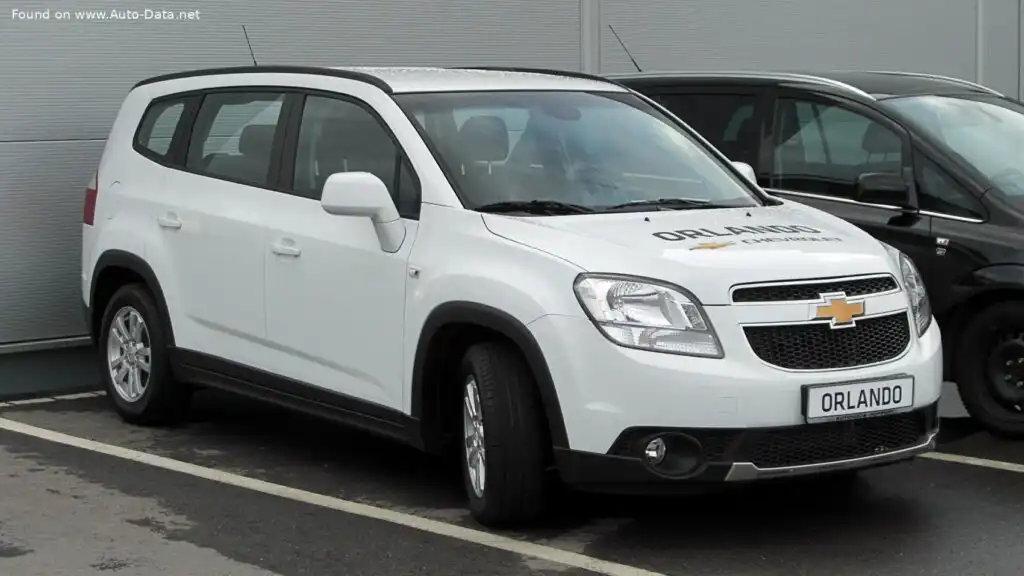
The Chevrolet Orlando 2.0 TD (163 hp) Automatic, produced from 2011 to 2018, was a seven-seat minivan marketed primarily in Europe and select international markets. Positioned as a budget-friendly family vehicle, it offered a practical alternative to smaller hatchbacks and larger, more expensive MPVs. This variant, equipped with the 2.0-liter turbodiesel engine and a six-speed automatic transmission, represented a mid-range offering within the Orlando lineup, balancing fuel efficiency with acceptable performance for everyday driving. It was part of the first generation Orlando (Orlando I), based on the GM Delta platform, shared with models like the Opel Astra and Buick Verano.
Technical Specifications
| Brand | Chevrolet |
| Model | Orlando |
| Generation | Orlando I |
| Type (Engine) | 2.0 TD (163 Hp) Automatic |
| Start of production | 2011 |
| End of production | 2018 |
| Powertrain Architecture | Internal Combustion engine |
| Body type | Minivan |
| Seats | 7 |
| Doors | 5 |
| Fuel consumption (urban) | 9.3 l/100 km (25.3 US mpg) |
| Fuel consumption (extra urban) | 5.7 l/100 km (41.3 US mpg) |
| Fuel consumption (combined) | 7 l/100 km (33.6 US mpg) |
| Fuel Type | Diesel |
| Acceleration 0 – 100 km/h | 11 sec |
| Acceleration 0 – 62 mph | 11 sec |
| Acceleration 0 – 60 mph | 10.5 sec |
| Maximum speed | 195 km/h (121.17 mph) |
| Emission standard | Euro 5 |
| Weight-to-power ratio | 10.2 kg/Hp |
| Weight-to-torque ratio | 4.6 kg/Nm |
| Power | 163 Hp @ 3800 rpm |
| Torque | 360 Nm @ 2000 rpm (265.52 lb.-ft. @ 2000 rpm) |
| Engine layout | Front, Transverse |
| Engine Model/Code | LNP |
| Engine displacement | 1998 cm3 (121.93 cu. in.) |
| Number of cylinders | 4 |
| Engine configuration | Inline |
| Cylinder Bore | 86 mm (3.39 in.) |
| Piston Stroke | 86 mm (3.39 in.) |
| Compression ratio | 16.3:1 |
| Number of valves per cylinder | 4 |
| Fuel injection system | Diesel Commonrail |
| Engine aspiration | Turbocharger, Intercooler |
| Valvetrain | DOHC |
| Engine oil capacity | 5.6 l (5.92 US qt | 4.93 UK qt) |
| Coolant capacity | 7.5 l (7.93 US qt | 6.6 UK qt) |
| Kerb Weight | 1659 kg (3657.47 lbs.) |
| Max. weight | 2291 kg (5050.79 lbs.) |
| Max load | 632 kg (1393.32 lbs.) |
| Trunk (boot) space – minimum | 89 l (3.14 cu. ft.) |
| Trunk (boot) space – maximum | 458 l (16.17 cu. ft.) |
| Fuel tank capacity | 64 l (16.91 US gal | 14.08 UK gal) |
| Length | 4652 mm (183.15 in.) |
| Width | 1836 mm (72.28 in.) |
| Height | 1633 mm (64.29 in.) |
| Wheelbase | 2760 mm (108.66 in.) |
| Front track | 1584 mm (62.36 in.) |
| Rear track | 1588 mm (62.52 in.) |
| Minimum turning circle | 11.3 m (37.07 ft.) |
| Drivetrain | Front wheel drive |
| Number of gears | 6 |
| Gearbox type | Automatic transmission |
| Front suspension | Independent type McPherson |
| Rear suspension | Torsion |
| Front brakes | Disc |
| Assisting systems | ABS (Anti-lock braking system) |
| Steering type | Steering rack and pinion |
| Power steering | Hydraulic Steering |
| Tires size | 215/R60 R16 |
| Wheel rims size | 16 |
Powertrain & Engine Architecture
The heart of this Orlando variant is the GM-sourced 2.0-liter (1998 cc) inline-four cylinder turbodiesel engine, designated the LNP. This engine utilizes a common rail direct injection system, delivering fuel at extremely high pressure for improved combustion efficiency and reduced emissions. The engine features a single overhead camshaft (SOHC) design operating four valves per cylinder (DOHC). A turbocharger with an intercooler is employed to boost power output, providing 163 horsepower at 3800 rpm and a substantial 360 Nm (265 lb-ft) of torque at just 2000 rpm. The six-speed automatic transmission, sourced from Aisin, was chosen for its smooth operation and suitability for family transport. This transmission featured adaptive shift patterns, adjusting to driving style and conditions.
Driving Characteristics
The 2.0 TD Automatic Orlando offered a comfortable, if not particularly sporty, driving experience. The engine’s torque peak at 2000 rpm provided ample pulling power for everyday driving and overtaking maneuvers, even when fully loaded with passengers and luggage. However, the 11-second 0-60 mph acceleration time was modest. The automatic transmission, while smooth, could sometimes feel hesitant during quick downshifts. Compared to the manual transmission versions, the automatic offered less driver engagement but greater convenience. Higher-output versions of the Orlando, such as those with the 1.8L petrol engine, provided quicker acceleration but sacrificed fuel economy. The suspension was tuned for comfort, absorbing bumps and imperfections in the road well, but this came at the expense of sharp handling.
Equipment & Trim Levels
The 2.0 TD Automatic trim typically included air conditioning, power windows, central locking, and a basic audio system with USB connectivity. Safety features such as ABS, electronic stability control, and multiple airbags were standard. Higher trim levels added features like alloy wheels, rear parking sensors, cruise control, and a more advanced infotainment system. Interior upholstery was typically cloth, with options for leather upgrades. The dashboard layout was functional and straightforward, prioritizing usability over aesthetic flair. Optional extras included a panoramic sunroof, navigation system, and heated front seats.
Chassis & Braking
The Orlando’s chassis featured an independent McPherson strut suspension at the front and a torsion beam setup at the rear. This configuration provided a good balance between ride comfort and handling. The front brakes were ventilated discs, while the rear brakes were typically drums on lower trim levels, upgraded to discs on higher-spec models. The hydraulic power steering offered light and easy steering, making it maneuverable in urban environments. The relatively modest weight of the vehicle (around 1659 kg or 3657 lbs) helped to mitigate the impact of the engine’s power output on braking performance.
Market Reception & Comparison
The Chevrolet Orlando 2.0 TD Automatic was generally well-received as a practical and affordable family vehicle. Critics praised its spacious interior, comfortable ride, and fuel efficiency. However, some reviewers noted its uninspired styling and somewhat lackluster performance. Compared to rivals like the Citroën C4 Picasso and Renault Grand Scénic, the Orlando offered a more competitive price point but lacked the refinement and advanced features of those models. Fuel economy was a strong point, averaging around 33.6 US mpg in combined driving, making it an attractive option for families seeking to minimize running costs. Reliability was generally good, with few major issues reported.
Legacy
The Chevrolet Orlando, while not a sales blockbuster, established a foothold for Chevrolet in the European minivan segment. The 2.0 TD Automatic variant remains a relatively common sight on the used car market. The LNP engine is known for its durability and relatively low maintenance costs, provided it receives regular servicing. While not a performance icon, this particular configuration of the Orlando offers a dependable and economical transportation solution for families, and continues to represent a value proposition in the used vehicle landscape.