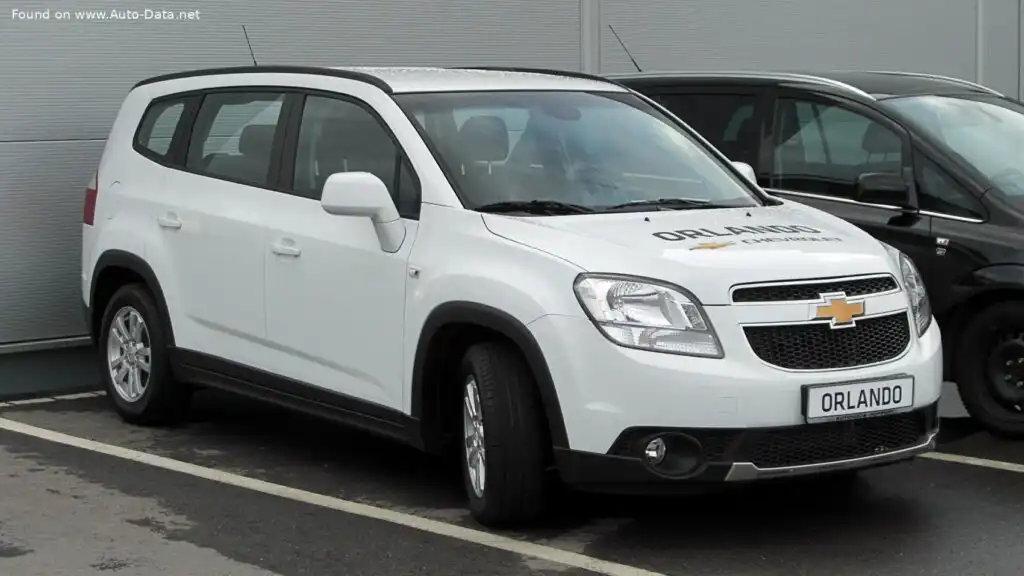
The Chevrolet Orlando 2.4L Automatic, produced from 2011 to 2014, represented a key offering in Chevrolet’s foray into the compact minivan/crossover segment. Positioned as a practical and affordable seven-passenger vehicle, the Orlando aimed to bridge the gap between traditional minivans and smaller SUVs. This particular variant, equipped with the 2.4-liter Ecotec engine and a six-speed automatic transmission, served as a mid-range option within the Orlando lineup, offering a balance of performance and fuel efficiency. It was primarily marketed towards families seeking a versatile vehicle for daily commuting and weekend trips.
Technical Specifications
| Brand | Chevrolet |
| Model | Orlando |
| Generation | Orlando I |
| Type (Engine) | 2.4 (174 Hp) Automatic |
| Start of production | 2011 |
| End of production | 2014 |
| Powertrain Architecture | Internal Combustion engine |
| Body type | Minivan |
| Seats | 7 |
| Doors | 5 |
| Fuel consumption (urban) | 10.6 l/100 km (22.2 US mpg) |
| Fuel consumption (extra urban) | 6.9 l/100 km (34.1 US mpg) |
| Fuel consumption (combined) | 9 l/100 km (26.1 US mpg) |
| Fuel Type | Petrol (Gasoline) |
| Weight-to-power ratio | 9.2 kg/Hp |
| Weight-to-torque ratio | 6.9 kg/Nm |
| Power | 174 Hp @ 6700 rpm |
| Power per litre | 73 Hp/l |
| Torque | 232 Nm @ 4900 rpm (171.11 lb.-ft. @ 4900 rpm) |
| Engine layout | Front, Transverse |
| Engine Model/Code | Ecotec / LAF |
| Engine displacement | 2384 cm3 (145.48 cu. in.) |
| Number of cylinders | 4 |
| Engine configuration | Inline |
| Cylinder Bore | 88 mm (3.46 in.) |
| Piston Stroke | 98 mm (3.86 in.) |
| Compression ratio | 11.2:1 |
| Number of valves per cylinder | 4 |
| Fuel injection system | Direct injection |
| Engine aspiration | Naturally aspirated engine |
| Valvetrain | DOHC, VVT |
| Engine oil capacity | 4.7 l (4.97 US qt | 4.14 UK qt) |
| Coolant | 7.1 l (7.5 US qt | 6.25 UK qt) |
| Kerb Weight | 1596-1637 kg (3518.58 – 3608.97 lbs.) |
| Max. weight | 2183 kg (4812.69 lbs.) |
| Max load | 546-587 kg (1203.72 – 1294.11 lbs.) |
| Trunk (boot) space – minimum | 101 l (3.57 cu. ft.) |
| Trunk (boot) space – maximum | 1594 l (56.29 cu. ft.) |
| Fuel tank capacity | 64 l (16.91 US gal | 14.08 UK gal) |
| Permitted trailer load with brakes (12%) | 454 kg (1000.9 lbs.) |
| Length | 4665 mm (183.66 in.) |
| Width | 1835 mm (72.24 in.) |
| Height | 1635 mm (64.37 in.) |
| Wheelbase | 2760 mm (108.66 in.) |
| Front track | 1587 mm (62.48 in.) |
| Rear (Back) track | 1570 mm (61.81 in.) |
| Ride height (ground clearance) | 129 mm (5.08 in.) |
| Minimum turning circle (turning diameter) | 11.3-11.8 m (37.07 – 38.71 ft.) |
| Drivetrain Architecture | The Internal combustion engine (ICE) drives the front wheels of the vehicle. |
| Drive wheel | Front wheel drive |
| Number of gears and type of gearbox | 6 gears, automatic transmission |
| Front suspension | Independent, type McPherson with coil spring and anti-roll bar |
| Rear suspension | Torsion |
| Front brakes | Ventilated discs, 300×26 mm |
| Rear brakes | Ventilated discs, 292×16 mm |
| Assisting systems | ABS (Anti-lock braking system) |
| Steering type | Steering rack and pinion |
| Power steering | Electric Steering |
| Tires size | 215/60 R16; 235/45 R18 |
| Wheel rims size | 6.5J x 16; 8J x 18 |
INTRODUCTION
The Chevrolet Orlando, launched in 2011, was a significant departure for Chevrolet, representing an attempt to capture a segment of the market increasingly interested in multi-purpose vehicles that weren’t quite as large as traditional minivans. Built on the GM Delta platform (also underpinning models like the Opel Astra and Buick Verano), the Orlando offered a unique blend of practicality, affordability, and styling. The 2.4-liter engine paired with a six-speed automatic transmission was a popular configuration, particularly in North America, offering a balance between performance and fuel economy for everyday driving. Production of the first generation Orlando concluded in 2014.
Powertrain & Engine Architecture
At the heart of the Orlando 2.4 Automatic lies the Ecotec LE9 2.4-liter inline-four cylinder engine. This engine, designated with the code LAF, featured direct fuel injection, a double overhead camshaft (DOHC) valvetrain with variable valve timing (VVT), and a cast iron block with an aluminum cylinder head. The direct injection system allowed for precise fuel delivery, enhancing both power and efficiency. The six-speed automatic transmission (6T40) was a common GM unit known for its smooth shifting and relatively reliable operation. This transmission featured electronically controlled shifting and adaptive learning capabilities to optimize performance based on driving conditions. The engine produced 174 horsepower at 6700 rpm and 232 Nm (171 lb-ft) of torque at 4900 rpm.
Driving Characteristics
The Orlando 2.4 Automatic offered adequate, though not exhilarating, performance. The 174 horsepower engine provided sufficient power for everyday driving situations, including highway merging and passing maneuvers. However, with a curb weight ranging from 1596 to 1637 kg (3518.58 to 3608.97 lbs), the Orlando wasn’t particularly quick. The six-speed automatic transmission helped to keep the engine in its optimal power band, but the overall driving experience was geared towards comfort and practicality rather than sporty handling. Compared to the base 1.8-liter engine option (available in some markets), the 2.4-liter provided a noticeable improvement in acceleration and overall responsiveness. It also offered a more relaxed driving experience, especially when fully loaded with passengers and cargo. The automatic transmission, while convenient, did result in slightly lower fuel economy compared to the available manual transmission.
Equipment & Trim Levels
The Orlando 2.4 Automatic typically came standard with features such as air conditioning, power windows and locks, a basic audio system with USB connectivity, and stability control. Higher trim levels, such as the LT and LTZ, added features like alloy wheels, a more advanced audio system with touchscreen display, Bluetooth connectivity, rear parking sensors, and heated front seats. Interior upholstery was typically cloth on the base models, with leather options available on higher trims. Optional extras included a sunroof, navigation system, and a rear entertainment system. The seven-passenger configuration featured a 60/40 split-folding second-row seat and a 50/50 split-folding third-row seat, providing flexible cargo space.
Chassis & Braking
The Orlando utilized a McPherson strut front suspension and a torsion beam rear suspension. This setup provided a comfortable ride quality, although it wasn’t particularly sporty. The front suspension incorporated a coil spring and anti-roll bar to reduce body roll during cornering. Braking duties were handled by ventilated discs on all four wheels, providing adequate stopping power for the vehicle’s weight class. The Orlando was equipped with an Anti-lock Braking System (ABS) as standard, enhancing safety during emergency braking situations. Steering was rack-and-pinion with electric power steering, offering light and easy maneuverability.
Market Reception & Comparison
The Chevrolet Orlando received mixed reviews from automotive critics. While praised for its spacious interior, versatile seating configuration, and affordable price point, it was often criticized for its bland styling and unremarkable driving dynamics. Compared to other compact minivans and crossovers of the time, such as the Honda CR-V or Toyota RAV4, the Orlando offered a more affordable option but lacked the refinement and driving experience of its competitors. Fuel economy was generally considered average for its class. Reliability reports were generally positive, with the 2.4-liter Ecotec engine and 6T40 transmission proving to be relatively durable.
Legacy
The Chevrolet Orlando, while not a runaway success, carved out a niche for itself as an affordable and practical seven-passenger vehicle. The 2.4-liter engine and six-speed automatic transmission combination proved to be a reliable powertrain, and many examples remain on the road today. In the used car market, the Orlando 2.4 Automatic represents a value-oriented option for families seeking a spacious and versatile vehicle. While it may not offer the prestige or driving excitement of some of its competitors, its affordability and practicality continue to appeal to budget-conscious buyers. The Orlando’s legacy lies in its attempt to redefine the compact minivan segment and offer a more accessible option for families needing space and versatility.