
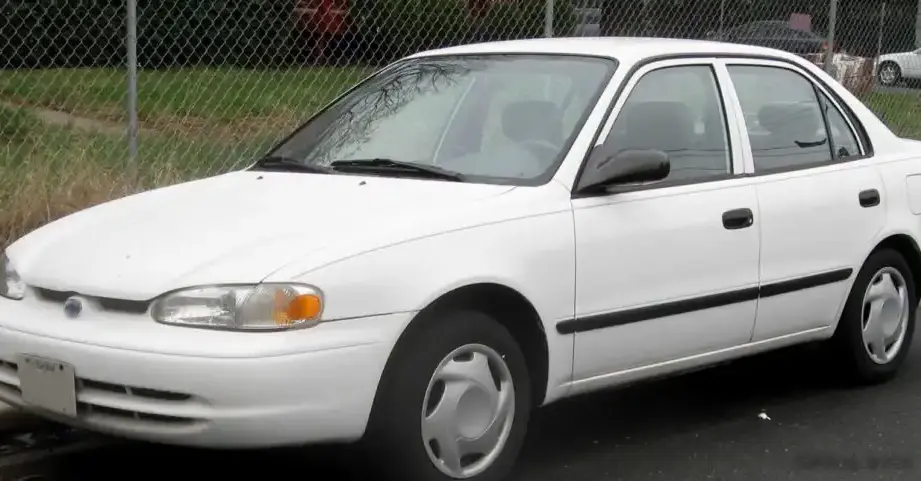
The Chevrolet Prizm 1.8 i 16V Automatic, produced between 1998 and 2001, represented a significant offering in the compact sedan segment for the American market. Essentially a rebadged Toyota Corolla, the Prizm was Chevrolet’s attempt to provide a reliable and affordable vehicle, leveraging Toyota’s manufacturing expertise. This particular variant, equipped with the 1.8-liter inline-four engine and a four-speed automatic transmission, occupied a mid-range position within the Prizm lineup, offering a balance between fuel efficiency and acceptable performance. It was designed to appeal to buyers seeking a no-frills, dependable daily driver.
Technical Specifications
| Brand | Chevrolet |
| Model | Prizm |
| Generation | Prizm |
| Type (Engine) | 1.8 i 16V (122 Hp) Automatic |
| Start of production | 1998 |
| End of production | 2001 |
| Powertrain Architecture | Internal Combustion engine |
| Body type | Sedan |
| Seats | 5 |
| Doors | 4 |
| Fuel consumption (urban) | 7.6 l/100 km (30.9 US mpg) |
| Fuel consumption (extra urban) | 6.4 l/100 km (36.8 US mpg) |
| Fuel Type | Petrol (Gasoline) |
| Maximum speed | 190 km/h (118.06 mph) |
| Weight-to-power ratio | 8.9 kg/Hp |
| Weight-to-torque ratio | 6.6 kg/Nm |
| Power | 122 Hp @ 5600 rpm |
| Power per litre | 68 Hp/l |
| Torque | 165 Nm @ 4400 rpm (121.7 lb.-ft. @ 4400 rpm) |
| Engine layout | Front, Longitudinal |
| Engine Model/Code | LV6 |
| Engine displacement | 1794 cm3 (109.48 cu. in.) |
| Number of cylinders | 4 |
| Engine configuration | Inline |
| Cylinder Bore | 79 mm (3.11 in.) |
| Piston Stroke | 91.5 mm (3.6 in.) |
| Compression ratio | 10.1:1 |
| Number of valves per cylinder | 4 |
| Fuel injection system | Multi-port manifold injection |
| Engine aspiration | Naturally aspirated engine |
| Valvetrain | DOHC |
| Engine oil capacity | 3.7 l (3.91 US qt | 3.26 UK qt) |
| Coolant capacity | 6.1 l (6.45 US qt | 5.37 UK qt) |
| Kerb Weight | 1090 kg (2403.04 lbs.) |
| Trunk (boot) space (minimum) | 340 l (12.01 cu. ft.) |
| Fuel tank capacity | 50 l (13.21 US gal | 11 UK gal) |
| Length | 4430 mm (174.41 in.) |
| Width | 1690 mm (66.54 in.) |
| Height | 1360 mm (53.54 in.) |
| Wheelbase | 2465 mm (97.05 in.) |
| Front track | 1460 mm (57.48 in.) |
| Rear track | 1450 mm (57.09 in.) |
| Drivetrain Architecture | Front wheel drive |
| Number of gears | 4 |
| Gearbox type | Automatic transmission |
| Front suspension | Spring Strut |
| Rear suspension | Coil spring |
| Front brakes | Ventilated discs |
| Rear brakes | Drum |
| Assisting systems | ABS (Anti-lock braking system) |
| Steering type | Steering rack and pinion |
| Power steering | Hydraulic Steering |
| Tires size | 185/65 R14 |
| Wheel rims size | 14 |
Powertrain & Engine Architecture
The heart of the Prizm 1.8 i was the 1.8-liter (1794 cc) inline-four cylinder engine, designated as the LV6. This engine, derived from Toyota’s well-regarded 7A-FE series, featured a double overhead camshaft (DOHC) valvetrain with four valves per cylinder. Multi-port fuel injection delivered fuel to each cylinder, optimizing combustion efficiency. The engine produced 122 horsepower at 5600 rpm and 165 Nm (121.7 lb-ft) of torque at 4400 rpm. The automatic transmission was a conventional four-speed unit, chosen for its simplicity and cost-effectiveness. While not particularly sophisticated, it provided smooth, if not sporty, shifts. The engine’s longitudinal mounting was a carryover from the Corolla design, influencing the drivetrain layout.
Driving Characteristics
The Prizm 1.8L Automatic offered adequate, but not exhilarating, performance. Acceleration was reasonable for everyday driving, but the automatic transmission did sap some power compared to the available five-speed manual. The four-speed automatic’s gear ratios were geared towards fuel economy rather than rapid acceleration. The car felt most comfortable cruising at highway speeds, where the engine settled into a relaxed rhythm. Compared to the more powerful Prizm variants, such as those with the optional engine upgrades (not commonly available in the US market), this version prioritized fuel efficiency and ease of use over outright performance. The steering was light and responsive, making it easy to maneuver in urban environments.
Equipment & Trim Levels
The 1.8 i Automatic trim typically included standard features such as air conditioning, power steering, an AM/FM radio, and cloth upholstery. Power windows and door locks were often included, but could vary depending on regional packages. Optional extras included a CD player, upgraded sound system, and alloy wheels. The interior was functional and straightforward, prioritizing practicality over luxury. The dashboard layout was simple and easy to use, with clearly labeled controls. Safety features included dual airbags and ABS (Anti-lock Braking System), which were becoming increasingly common in this class of vehicle during the late 1990s.
Chassis & Braking
The Prizm utilized a front-wheel-drive layout with a MacPherson strut suspension in the front and a coil spring suspension in the rear. The front brakes were ventilated discs, providing adequate stopping power, while the rear brakes were drums, a cost-saving measure common in this segment. The suspension was tuned for comfort, providing a relatively smooth ride over most road surfaces. Stabilizer bars were included to reduce body roll during cornering, but the car was not designed for aggressive handling. The chassis was relatively lightweight, contributing to the car’s fuel efficiency.
Market Reception & Comparison
The Chevrolet Prizm was generally well-received by consumers and automotive critics as a reliable and affordable compact sedan. However, it often suffered from being perceived as a rebadged Toyota, lacking a distinct Chevrolet identity. The 1.8L Automatic variant was praised for its fuel economy and ease of driving, making it a popular choice for commuters and families. Compared to other trims, the automatic transmission version offered less sporty driving experience but was more convenient for many drivers. Fuel economy figures were competitive for the time, averaging around 31 mpg city and 37 mpg highway. Reliability was a strong point, benefiting from Toyota’s engineering and manufacturing processes.
Legacy
The Chevrolet Prizm, and specifically the 1.8 i 16V Automatic variant, has developed a reputation for long-term reliability and durability. Many examples are still on the road today, a testament to the quality of the underlying Toyota engineering. In the used car market, these Prizms are often sought after by buyers looking for an inexpensive and dependable vehicle. While not a performance icon, the Prizm 1.8 Automatic served its purpose as a practical and economical transportation option, and continues to offer value to budget-conscious buyers. The powertrain, while not cutting-edge, proved to be robust and relatively maintenance-free, contributing to its enduring appeal.
