
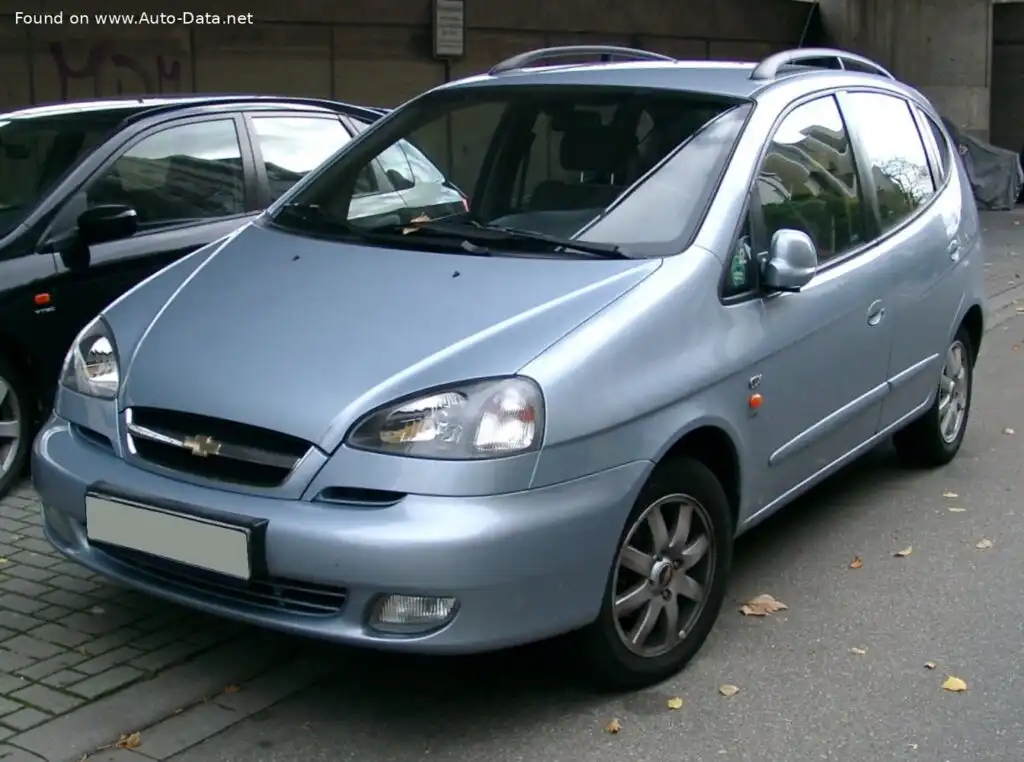
The Chevrolet Rezzo 2.0 i 16V Automatic, produced between 2004 and 2008, was a compact minivan marketed primarily in South Korea and select export markets. It represented Chevrolet’s entry into the Asian minivan segment, offering a practical and affordable family vehicle. The Rezzo was based on the GM Daewoo Tacuma platform (also known as the Nubira Wagon in some regions), and the 2.0-liter engine with an automatic transmission was a mid-range offering within the Rezzo lineup, positioned between the base 1.6L engine and potentially higher-trim level options depending on the specific market. It aimed to provide a comfortable and spacious interior with reasonable fuel efficiency for its class.
Technical Specifications
| Brand | Chevrolet |
| Model | Rezzo |
| Generation | Rezzo |
| Type (Engine) | 2.0 i 16V (121 Hp) Automatic |
| Start of production | 2004 |
| End of production | 2008 |
| Powertrain Architecture | Internal Combustion engine |
| Body type | Minivan |
| Seats | 5 |
| Doors | 5 |
| Fuel consumption (urban) | 15.1 l/100 km (15.6 US mpg, 18.7 UK mpg, 6.6 km/l) |
| Fuel consumption (extra urban) | 8.2 l/100 km (28.7 US mpg, 34.4 UK mpg, 12.2 km/l) |
| Fuel consumption (combined) | 10.8 l/100 km (21.8 US mpg, 26.2 UK mpg, 9.3 km/l) |
| Fuel Type | Petrol (Gasoline) |
| Acceleration 0 – 100 km/h | 11.7 sec |
| Acceleration 0 – 62 mph | 11.7 sec |
| Acceleration 0 – 60 mph | 11.1 sec |
| Maximum speed | 173 km/h (107.5 mph) |
| Weight-to-power ratio | 10.8 kg/Hp, 92.6 Hp/tonne |
| Weight-to-torque ratio | 7.4 kg/Nm, 134.8 Nm/tonne |
| Power | 121 Hp @ 5600 rpm |
| Power per litre | 60.6 Hp/l |
| Torque | 176 Nm @ 4000 rpm (129.81 lb.-ft. @ 4000 rpm) |
| Engine layout | Front, Transverse |
| Engine Model/Code | L88 |
| Engine displacement | 1998 cm3 (121.93 cu. in.) |
| Number of cylinders | 4 |
| Engine configuration | Inline |
| Cylinder Bore | 86 mm (3.39 in.) |
| Piston Stroke | 86 mm (3.39 in.) |
| Compression ratio | 9.6:1 |
| Number of valves per cylinder | 4 |
| Fuel injection system | Multi-port manifold injection |
| Engine aspiration | Naturally aspirated engine |
| Valvetrain | DOHC |
| Engine oil capacity | 4 l (4.23 US qt | 3.52 UK qt) |
| Coolant capacity | 7.5 l (7.93 US qt | 6.6 UK qt) |
| Kerb Weight | 1306 kg (2879.24 lbs.) |
| Max. weight | 1862 kg (4105.01 lbs.) |
| Max load | 556 kg (1225.77 lbs.) |
| Trunk (boot) space – minimum | 325 l (11.48 cu. ft.) |
| Trunk (boot) space – maximum | 1320 l (46.62 cu. ft.) |
| Fuel tank capacity | 60 l (15.85 US gal | 13.2 UK gal) |
| Length | 4350 mm (171.26 in.) |
| Width | 1755 mm (69.09 in.) |
| Height | 1580 mm (62.2 in.) |
| Wheelbase | 2600 mm (102.36 in.) |
| Front track | 1476 mm (58.11 in.) |
| Rear track | 1480 mm (58.27 in.) |
| Drivetrain Architecture | Front wheel drive |
| Number of gears | 4 |
| Gearbox type | Automatic transmission |
| Front suspension | Spring Strut |
| Rear suspension | Coil spring |
| Front brakes | Ventilated discs |
| Rear brakes | Drum |
| Assisting systems | ABS (Anti-lock braking system) |
| Steering type | Steering rack and pinion |
| Tires size | 195/60 R15 |
| Wheel rims size | 6J x 15 |
Powertrain & Engine Architecture
The Chevrolet Rezzo 2.0 i 16V Automatic was powered by the GM L88 engine, a 1.998-liter inline-four cylinder gasoline engine. This engine featured a double overhead camshaft (DOHC) valvetrain with four valves per cylinder, contributing to its relatively efficient breathing. The L88 utilized multi-port fuel injection, a common technology at the time, delivering fuel directly into the intake ports for improved combustion. The engine’s 9.6:1 compression ratio was a compromise between performance and the ability to run on readily available fuel grades. Paired with this engine was a four-speed automatic transmission, designed for smooth and convenient operation. While not offering the sportiness of a manual transmission, the automatic was geared towards providing a comfortable driving experience for everyday use. The transmission’s gear ratios were tuned for a balance of acceleration and fuel economy, prioritizing usability over outright performance.
Driving Characteristics
The Rezzo 2.0 i Automatic offered adequate, but not exhilarating, performance. With 121 horsepower and 176 Nm (129.81 lb-ft) of torque, acceleration from 0 to 60 mph took approximately 11.1 seconds. The four-speed automatic transmission, while smooth, did contribute to a slightly less responsive feel compared to a manual gearbox. The engine delivered its peak torque at 4000 rpm, meaning drivers needed to maintain a reasonable engine speed for optimal acceleration. In real-world driving, the Rezzo 2.0 Automatic was best suited for city and highway cruising, providing sufficient power for merging and overtaking, but lacking the punch for more aggressive driving. Compared to a hypothetical manual version, the automatic would have felt slightly slower, but offered a more relaxed driving experience.
Equipment & Trim Levels
The standard equipment level for the Rezzo 2.0 i Automatic varied depending on the specific market. Generally, it included features such as air conditioning, power windows, power door locks, and a basic audio system. Interior upholstery was typically cloth, with options for upgraded materials in some markets. The dashboard layout was functional and straightforward, prioritizing ease of use. Optional extras could include alloy wheels, a sunroof, and an upgraded audio system with a CD player. Safety features typically included ABS (Anti-lock Braking System) as standard, with airbags being common but potentially varying in number depending on the region.
Chassis & Braking
The Rezzo utilized a front-wheel-drive layout with a relatively simple suspension setup. The front suspension employed a MacPherson strut design, while the rear suspension utilized a coil spring arrangement. This setup prioritized ride comfort over sporty handling. The braking system featured ventilated discs on the front wheels and drum brakes on the rear wheels. ABS was standard, providing enhanced braking control in emergency situations. The steering system was a rack and pinion type, offering reasonable precision and feedback.
Market Reception & Comparison
The Chevrolet Rezzo 2.0 i Automatic received mixed reviews. Critics generally praised its spacious interior and practicality, but noted its unremarkable performance and somewhat basic interior appointments. Compared to other minivans available at the time, the Rezzo offered a competitive price point, but lacked the refinement and features of some of its rivals. Fuel economy was considered average for its class, with combined fuel consumption around 10.8 l/100 km (21.8 US mpg). Reliability reports were generally positive, with the L88 engine proving to be a reasonably durable unit.
Legacy
The Chevrolet Rezzo, while not a groundbreaking vehicle, served as an important entry point for Chevrolet into the Asian minivan market. The 2.0-liter engine and automatic transmission combination proved to be a reliable and practical powertrain. In the used car market today, the Rezzo 2.0 i Automatic is often sought after for its affordability and spaciousness. While maintenance costs are generally reasonable, finding replacement parts may become increasingly challenging as the vehicle ages. The Rezzo represents a snapshot of early 2000s compact minivan design, offering a functional and economical transportation solution for families.
