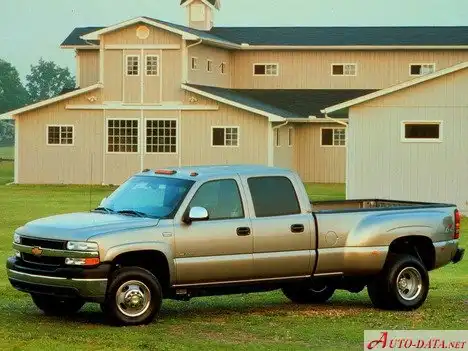
The Chevrolet Silverado 2500 HD II, specifically the Crew Cab Long Box configuration powered by the 6.6-liter Duramax turbodiesel V8 engine producing 365 horsepower and paired with a 4WD automatic transmission, represents a significant iteration in Chevrolet’s heavy-duty truck lineage. Produced from 2007 to 2010 (GMT900 platform), this variant aimed to deliver substantial towing and hauling capabilities alongside a degree of comfort and refinement expected in a crew cab pickup. It occupied a premium position within the 2500 HD lineup, appealing to owners needing serious work capacity but also desiring a more accommodating passenger space.
Technical Specifications
| Brand | Chevrolet |
| Model | Silverado 2500 HD |
| Generation | Silverado 2500 HD II (GMT900) Crew Cab Long Box |
| Type (Engine) | 6.6 Duramax TD V8 (365 Hp) 4WD Automatic |
| Start of production | 2007 |
| End of production | 2010 |
| Powertrain Architecture | Internal Combustion engine |
| Body type | Pick-up |
| Seats | 5 |
| Doors | 4 |
| Fuel Type | Diesel |
| Weight-to-power ratio | 8.5 kg/Hp, 117.2 Hp/tonne |
| Weight-to-torque ratio | 3.5 kg/Nm, 287.3 Nm/tonne |
| Power | 365 Hp @ 3200 rpm |
| Power per litre | 55.3 Hp/l |
| Torque | 895 Nm @ 1600 rpm, 660.12 lb.-ft. @ 1600 rpm |
| Maximum engine speed | 3450 rpm |
| Engine layout | Front, Longitudinal |
| Engine Model/Code | Duramax LMM |
| Engine displacement | 6599 cm3, 402.7 cu. in. |
| Number of cylinders | 8 |
| Engine configuration | V-engine |
| Cylinder Bore | 103 mm, 4.06 in. |
| Piston Stroke | 99 mm, 3.9 in. |
| Compression ratio | 16.8:1 |
| Number of valves per cylinder | 4 |
| Fuel injection system | Diesel Commonrail |
| Engine aspiration | Turbocharger, Intercooler |
| Valvetrain | OHV |
| Engine oil capacity | 9.5 l, 10.04 US qt | 8.36 UK qt |
| Coolant | 24 l, 25.36 US qt | 21.12 UK qt |
| Kerb Weight | 3115 kg, 6867.4 lbs. |
| Max. weight | 4173 kg, 9199.89 lbs. |
| Max load | 1058 kg, 2332.49 lbs. |
| Trunk (boot) space – maximum | 2138 l, 75.5 cu. ft. |
| Fuel tank capacity | 129 l, 34.08 US gal | 28.38 UK gal |
| Permitted trailer load with brakes (12%) | 5897 kg, 13000.66 lbs. |
| Length | 6572 mm, 258.74 in. |
| Width including mirrors | 2032 mm, 80 in. |
| Height | 1949 mm, 76.73 in. |
| Wheelbase | 4242 mm, 167.01 in. |
| Front track | 1744 mm, 68.66 in. |
| Rear (Back) track | 1676 mm, 65.98 in. |
| Ride height (ground clearance) | 243 mm, 9.57 in. |
| Minimum turning circle (turning diameter) | 16.8 m, 55.12 ft. |
| Drivetrain Architecture | The Internal combustion engine (ICE) drives the rear wheels permanently, and the front wheels are driven through an electrically or mechanically operated clutch if necessary. |
| Drive wheel | All wheel drive (4×4) |
| Number of gears and type of gearbox | 6 gears, automatic transmission Allison |
| Front suspension | Independent torsion bar, double wishbone |
| Rear suspension | Rigid axle suspension, Leaf spring |
| Front brakes | Ventilated discs, 325×38 mm |
| Rear brakes | Ventilated discs, 325×30 mm |
| Assisting systems | ABS (Anti-lock braking system) |
| Steering type | Cone worm with recirculation balls |
| Tires size | 245/75 R16; 265/75 R17 |
| Wheel rims size | 6.5J x 16; 7.5J x 17 |
INTRODUCTION
The 2007-2010 Chevrolet Silverado 2500 HD II, built on the GMT900 platform, represented a substantial upgrade over its predecessor. This generation focused on increased strength, improved refinement, and enhanced towing capacity. The Crew Cab Long Box configuration, combined with the 6.6L Duramax diesel and Allison automatic transmission, was positioned as a premium offering for buyers who required a powerful and comfortable work truck. This specific combination was popular among those needing to regularly tow heavy loads – construction equipment, large trailers, or livestock – while still providing ample space for passengers.
Powertrain & Engine Architecture
At the heart of this Silverado variant lies the Duramax LMM 6.6-liter V8 diesel engine. This engine is a turbocharged, overhead valve (OHV) design featuring a common rail direct fuel injection system. The LMM iteration of the Duramax brought several improvements over earlier versions, including a more robust block, improved cylinder heads, and a refined fuel injection system. These changes contributed to increased power and torque output while also meeting stricter emissions standards. The engine produces 365 horsepower at 3200 rpm and a substantial 895 lb-ft of torque at 1600 rpm. The Allison 1000 six-speed automatic transmission, known for its durability and smooth shifting, was the sole transmission option. This transmission was specifically calibrated to handle the high torque output of the Duramax engine, providing confident and controlled power delivery.
Driving Characteristics
The Silverado 2500 HD II with the Duramax/Allison combination delivers a driving experience focused on capability rather than outright speed. The substantial torque available from low engine speeds makes it exceptionally capable for towing and hauling. While not a sports truck, the 6-speed Allison transmission allows the engine to operate efficiently at highway speeds. Compared to gasoline-powered Silverado 2500 HD models, the diesel offers significantly more torque, making it far superior for demanding tasks. Compared to other Duramax variants, like those with manual transmissions, the automatic provides ease of use, particularly in stop-and-go traffic or when maneuvering in tight spaces. However, some drivers may prefer the more direct feel and potentially slightly improved fuel economy of a manual transmission.
Equipment & Trim Levels
The Crew Cab Long Box configuration typically came standard with features like air conditioning, power windows and locks, a CD player, and cloth upholstery. Higher trim levels, such as LT and LTZ, added features like leather upholstery, heated seats, a premium sound system, navigation, and a sunroof. The Silverado 2500 HD II also offered a range of optional extras, including a trailer brake controller, a backup camera, and various appearance packages. The interior design was functional and durable, prioritizing practicality over luxury, though the Crew Cab configuration offered significantly more passenger space than regular or extended cab models.
Chassis & Braking
The Silverado 2500 HD II features a robust chassis designed to withstand heavy loads. The front suspension utilizes an independent torsion bar setup with double wishbones, while the rear suspension employs a traditional leaf spring design. This configuration provides a comfortable ride while maintaining excellent load-carrying capacity. Braking duties are handled by ventilated disc brakes on all four wheels, with ABS as standard equipment. The rear brakes are slightly smaller in diameter than the front brakes. The heavy-duty chassis and braking system are essential for safely controlling the truck when towing or hauling maximum loads.
Market Reception & Comparison
The 2007-2010 Silverado 2500 HD II with the Duramax/Allison combination was generally well-received by critics and consumers. It was praised for its powerful engine, smooth transmission, and comfortable ride. Fuel economy, while not a primary concern for heavy-duty truck buyers, was considered reasonable for a vehicle of its size and capability. Compared to the gasoline-powered Silverado 2500 HD models, the diesel variant commanded a higher price but offered significantly more towing capacity and fuel efficiency under heavy loads. Reliability was generally good, although some owners reported issues with the emissions control system, a common concern with modern diesel engines.
Legacy
The Duramax LMM engine and Allison 1000 transmission have proven to be exceptionally durable and reliable powertrains. Well-maintained examples of the 2007-2010 Silverado 2500 HD II continue to command strong resale values in the used car market. These trucks are still highly sought after by those needing a capable and dependable work truck. The LMM Duramax is considered by many to be one of the most reliable Duramax engines ever produced, and the Allison transmission is renowned for its longevity. However, potential buyers should be aware of the potential for emissions system issues and the importance of regular maintenance to ensure long-term reliability.