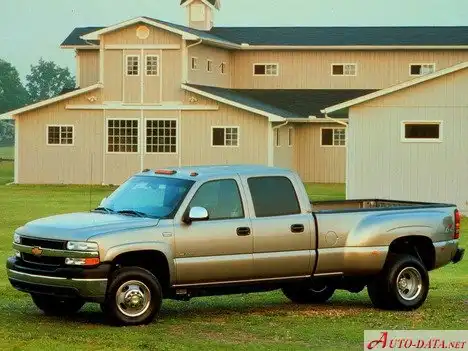
The Chevrolet Silverado 3500 HD II (GMT900) Regular Cab Long Box, equipped with the 6.0-liter V8 engine producing 360 horsepower and paired with a four-wheel-drive Dual Rear Wheel (DRW) automatic transmission, represents a significant iteration in Chevrolet’s heavy-duty truck lineage. Produced from 2007 through 2010, this variant occupied a crucial position in the Silverado 3500 HD lineup, catering to owners requiring substantial towing and hauling capabilities. It was part of the GMT900 generation, a complete redesign of the Silverado and Sierra HD trucks, focusing on increased strength, improved interior space, and enhanced functionality compared to its predecessors.
Technical Specifications
| Brand | Chevrolet |
| Model | Silverado 3500 HD |
| Generation | Silverado 3500 HD II (GMT900) Regular Cab Long Box |
| Type (Engine) | 6.0 V8 (360 Hp) 4WD DRW Automatic |
| Start of production | 2007 |
| End of production | 2010 |
| Powertrain Architecture | Internal Combustion engine |
| Body type | Pick-up |
| Seats | 2 |
| Doors | 2 |
| Fuel Type | Petrol (Gasoline) |
| Weight-to-power ratio | 7.7 kg/Hp, 130.3 Hp/tonne |
| Weight-to-torque ratio | 5.4 kg/Nm, 186.4 Nm/tonne |
| Power | 360 Hp @ 5400 rpm |
| Power per litre | 60.3 Hp/l |
| Torque | 515 Nm @ 4200 rpm, 379.84 lb.-ft. @ 4200 rpm |
| Maximum engine speed | 6000 rpm |
| Engine layout | Front, Longitudinal |
| Engine Model/Code | Vortec LY6 |
| Engine displacement | 5967 cm3, 364.13 cu. in. |
| Number of cylinders | 8 |
| Engine configuration | V-engine |
| Cylinder Bore | 101.6 mm, 4 in. |
| Piston Stroke | 92 mm, 3.62 in. |
| Compression ratio | 9.6:1 |
| Number of valves per cylinder | 2 |
| Fuel injection system | Multi-port manifold injection |
| Engine aspiration | Naturally aspirated engine |
| Valvetrain | OHV |
| Engine oil capacity | 5.7 l, 6.02 US qt | 5.02 UK qt |
| Coolant | 15.5 l, 16.38 US qt | 13.64 UK qt |
| Kerb Weight | 2763 kg, 6091.37 lbs. |
| Max. weight | 5171 kg, 11400.1 lbs. |
| Max load | 2408 kg, 5308.73 lbs. |
| Trunk (boot) space – maximum | 2170 l, 76.63 cu. ft. |
| Fuel tank capacity | 129 l, 34.08 US gal | 28.38 UK gal |
| Permitted trailer load with brakes (12%) | 5443 kg, 11999.76 lbs. |
| Length | 5714 mm, 224.96 in. |
| Width including mirrors | 2436 mm, 95.91 in. |
| Height | 1919 mm, 75.55 in. |
| Wheelbase | 3378 mm, 132.99 in. |
| Front track | 1742 mm, 68.58 in. |
| Rear (Back) track | 1897 mm, 74.69 in. |
| Ride height (ground clearance) | 233 mm, 9.17 in. |
| Drivetrain Architecture | The Internal combustion engine (ICE) drives the rear wheels permanently, and the front wheels are driven through an electrically or mechanically operated clutch if necessary. |
| Drive wheel | All wheel drive (4×4) |
| Number of gears and type of gearbox | 6 gears, automatic transmission Hydra-Matic |
| Front suspension | Independent torsion bar, double wishbone |
| Rear suspension | Rigid axle suspension, Leaf spring |
| Front brakes | Ventilated discs, 325×38 mm |
| Rear brakes | Ventilated discs, 325×30 mm |
| Assisting systems | ABS (Anti-lock braking system) |
| Steering type | Cone worm with recirculation balls |
| Tires size | 225/75 R17 |
| Wheel rims size | 6.5J x 17 |
INTRODUCTION
The Chevrolet Silverado 3500 HD II, specifically the Regular Cab Long Box configuration with the 6.0L V8 and 4WD DRW automatic, was designed for demanding tasks. This truck was aimed at professionals and individuals who regularly tow large trailers, haul heavy loads, or require a robust work vehicle. The “II” designation signifies the mid-cycle refresh of the GMT900 platform. It sat above the base 6.0L models in terms of capability due to the Dual Rear Wheel setup, offering increased stability and payload capacity. Compared to the 2500HD series, the 3500HD provided a higher Gross Vehicle Weight Rating (GVWR) and Gross Combined Weight Rating (GCWR), making it the go-to choice for serious hauling.
Powertrain & Engine Architecture
At the heart of this Silverado 3500 HD II lies the Vortec LY6 6.0-liter V8 engine. This engine is a member of Chevrolet’s Vortec family, known for its robust construction and reliable performance. The LY6 features a cast iron block and aluminum cylinder heads, contributing to its durability. It utilizes a multi-port fuel injection system, delivering fuel directly to each cylinder for efficient combustion. The overhead valve (OHV) valvetrain, while a traditional design, proved to be dependable and relatively simple to maintain. The engine produces 360 horsepower at 5400 rpm and 515 Nm (379.84 lb-ft) of torque at 4200 rpm.
The powertrain is completed by the Hydra-Matic 6-speed automatic transmission. This transmission was designed to handle the substantial torque output of the 6.0L V8 and provide smooth, reliable shifting. The 4WD system is a traditional part-time system, allowing the driver to switch between two-wheel drive and four-wheel drive as needed. The DRW configuration (Dual Rear Wheels) significantly increases the truck’s stability and load-carrying capacity, distributing the weight over a larger surface area.
Driving Characteristics
The 6.0L V8 and 6-speed automatic combination in the Silverado 3500 HD II delivers a balance of power and usability. While not as quick as some of the lighter-duty trucks, it provides ample torque for towing and hauling. The automatic transmission offers smooth shifts, and the gear ratios are well-suited for both on-road driving and off-road work. Compared to the manual transmission options, the automatic prioritizes ease of use, particularly in demanding conditions. However, the manual transmission generally offered slightly better fuel economy and a more direct connection to the engine. The DRW setup does impact ride quality, making it firmer than single rear wheel configurations, but this is a trade-off for the increased stability and payload.
Equipment & Trim Levels
The Silverado 3500 HD II Regular Cab Long Box with the 6.0L V8 typically came standard with features like air conditioning, power windows and locks, and a basic audio system. The interior was functional and durable, designed to withstand the rigors of heavy-duty use. Upholstery was typically vinyl or cloth. Optional extras included upgraded audio systems, power seats, cruise control, and various towing packages. The Regular Cab configuration focused on practicality, offering a spacious interior for two occupants and a long bed for hauling cargo. Trim levels varied, but generally included Work Truck (WT), LT, and LTZ, with increasing levels of features and refinement.
Chassis & Braking
The Silverado 3500 HD II features a robust chassis designed to handle heavy loads. The front suspension utilizes an independent torsion bar setup with double wishbones, providing a comfortable ride and good handling. The rear suspension employs a traditional leaf spring design, offering excellent load-carrying capacity. Braking duties are handled by ventilated disc brakes on all four wheels, with ABS (Anti-lock Braking System) as standard equipment. The DRW configuration necessitates larger brakes to manage the increased weight. The steering system is a cone worm with recirculation balls, providing a solid and reliable feel.
Market Reception & Comparison
The Silverado 3500 HD II was generally well-received by critics and consumers alike. It was praised for its robust construction, powerful engine, and impressive towing and hauling capabilities. Compared to its competitors, such as the Ford Super Duty and Ram Heavy Duty trucks, the Silverado 3500 HD II offered a competitive combination of features, performance, and value. Fuel economy was a common criticism, as expected with a large V8 engine and heavy-duty truck. Reliability was generally good, although some owners reported issues with the fuel injectors and cooling system. The DRW configuration, while offering increased capability, also resulted in a higher price tag and reduced maneuverability.
Legacy
The Chevrolet Silverado 3500 HD II (GMT900) with the 6.0L V8 and 4WD DRW automatic remains a popular choice in the used truck market today. Its robust powertrain and durable construction make it a reliable workhorse for those needing a heavy-duty truck. While newer models offer more advanced features and improved fuel economy, the GMT900 generation represents a solid and dependable platform. The LY6 engine is known for its longevity, and with proper maintenance, can provide many years of service. Parts availability is generally good, making it relatively easy to keep these trucks on the road. The DRW configuration continues to be favored by those who require maximum towing and hauling capacity.