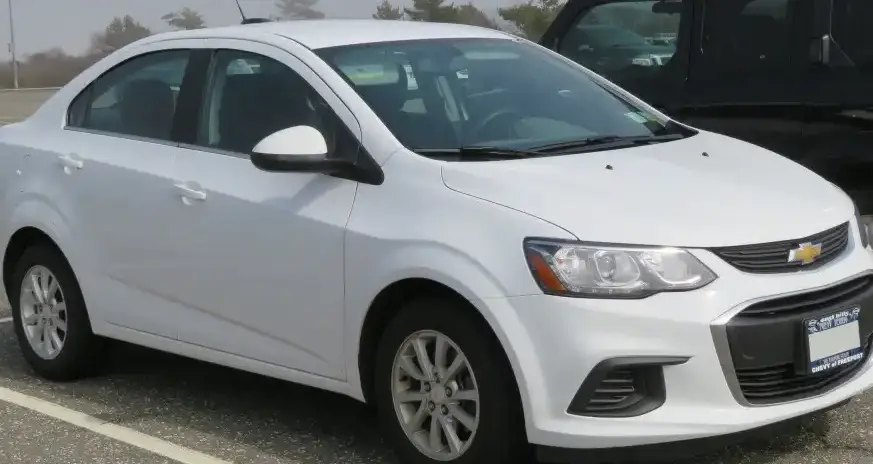
Technical Specifications
| Brand | Chevrolet |
| Model | Sonic |
| Generation | Sonic I Hatchback (facelift 2016) |
| Type (Engine) | 1.8 (138 Hp) |
| Start of production | 2016 |
| End of production | 2018 |
| Powertrain Architecture | Internal Combustion engine |
| Body type | Hatchback |
| Seats | 5 |
| Doors | 5 |
| Fuel consumption (urban) | 9.4 l/100 km (25 US mpg) |
| Fuel consumption (extra urban) | 6.7 l/100 km (35.1 US mpg) |
| Fuel Type | Petrol (Gasoline) |
| Weight-to-power ratio | 9.2 kg/Hp |
| Weight-to-torque ratio | 7.4 kg/Nm |
| Power | 138 Hp @ 6300 rpm |
| Power per litre | 76.8 Hp/l |
| Torque | 170 Nm @ 3800 rpm (125.39 lb.-ft. @ 3800 rpm) |
| Engine layout | Front, Transverse |
| Engine Model/Code | LUW, LWE |
| Engine displacement | 1796 cm3 (109.6 cu. in.) |
| Number of cylinders | 4 |
| Engine configuration | Inline |
| Cylinder Bore | 80.5 mm (3.17 in.) |
| Piston Stroke | 88.2 mm (3.47 in.) |
| Number of valves per cylinder | 4 |
| Fuel injection system | Multi-port manifold injection |
| Engine aspiration | Naturally aspirated engine |
| Valvetrain | DOHC |
| Engine oil capacity | 4.5 l (4.76 US qt | 3.96 UK qt) |
| Coolant | 6 l (6.34 US qt | 5.28 UK qt) |
| Kerb Weight | 1263 kg (2784.44 lbs.) |
| Trunk (boot) space – minimum | 539 l (19.03 cu. ft.) |
| Trunk (boot) space – maximum | 1351 l (47.71 cu. ft.) |
| Fuel tank capacity | 46 l (12.15 US gal | 10.12 UK gal) |
| Length | 4059 mm (159.8 in.) |
| Width | 1735 mm (68.31 in.) |
| Height | 1506-1516 mm (59.29 – 59.69 in.) |
| Wheelbase | 2525 mm (99.41 in.) |
| Front track | 1509 mm (59.41 in.) |
| Rear (Back) track | 1509 mm (59.41 in.) |
| Drag coefficient (Cd) | 0.33 |
| Minimum turning circle | 10.5 m (34.45 ft.) |
| Drivetrain Architecture | Front wheel drive |
| Drive wheel | Front wheel drive |
| Number of gears | 5 |
| Gearbox type | Manual transmission |
| Front suspension | Independent, McPherson with coil spring and anti-roll bar |
| Rear suspension | Semi-independent, coil spring |
| Front brakes | Ventilated discs |
| Rear brakes | Drum |
| Assisting systems | ABS (Anti-lock braking system) |
| Steering type | Steering rack and pinion |
| Power steering | Electric Steering |
| Tires size | 195/65 R15 |
| Wheel rims size | 15 |
The Chevrolet Sonic 1.8L Hatchback (2016 facelift) was designed to appeal to first-time car buyers and those seeking an economical and versatile vehicle. Built on the Gamma platform (derived from the Opel/Vauxhall Astra J’s 1HX0/A3 architecture), the Sonic aimed to provide a more refined experience than some of its competitors in the subcompact segment. The 1.8L engine and five-speed manual transmission combination represented the base powertrain option, offering a balance between affordability and usability. It served as the entry point into the Sonic range, with higher trims featuring a more powerful 1.4L turbocharged engine.
Powertrain & Engine Architecture
The heart of this Sonic variant is the 1.8-liter inline-four cylinder engine, designated with engine codes LUW or LWE. This engine is a naturally aspirated unit utilizing multi-port fuel injection. The engine features a double overhead camshaft (DOHC) valvetrain with four valves per cylinder, contributing to its relatively efficient operation. The 1.8L engine produces 138 horsepower at 6300 rpm and 170 Nm (125.39 lb-ft) of torque at 3800 rpm. The five-speed manual transmission was the standard gearbox for this trim, offering a direct connection between the engine and the front wheels. The transmission’s gear ratios were tuned for fuel economy and everyday drivability, rather than outright performance.
Driving Characteristics
The 1.8L Sonic with a manual transmission delivers adequate, though not exhilarating, performance. Acceleration is best described as sufficient for merging onto highways and navigating city streets. The five-speed manual gearbox allows for driver engagement, but the relatively low horsepower and torque figures mean that frequent downshifting is often required, especially when tackling hills or overtaking. Compared to the 1.4L turbocharged version, the 1.8L feels less responsive and requires more effort to maintain speed. However, the naturally aspirated engine provides a more linear power delivery, which some drivers may prefer. The gear ratios are spaced to prioritize fuel efficiency, resulting in a slightly less engaging driving experience than a sportier-tuned transmission.
Equipment & Trim Levels
The base 1.8L Sonic typically came equipped with a modest array of standard features. These generally included air conditioning, power windows and locks, a basic audio system with USB connectivity, and steel wheels with wheel covers. Safety features such as anti-lock brakes (ABS) and a suite of airbags were standard. Higher trim levels, such as the LS, LT, and Premier, added features like alloy wheels, a more advanced infotainment system with a touchscreen display, cruise control, and upgraded interior materials. Optional extras for the 1.8L trim could include a power sunroof, remote keyless entry, and a rear vision camera.
Chassis & Braking
The Sonic’s chassis features an independent McPherson strut suspension in the front, providing a comfortable ride quality. The rear suspension utilizes a semi-independent coil spring setup. The front brakes are ventilated discs, offering adequate stopping power, while the rear brakes are drums, a cost-saving measure common in this segment. The steering is rack and pinion with electric power steering, providing light and easy maneuverability. The 1.8L models typically featured a smaller stabilizer bar compared to the turbocharged variants, contributing to a slightly softer ride but also a bit more body roll during cornering.
Market Reception & Comparison
The Chevrolet Sonic 1.8L received mixed reviews from automotive critics. While praised for its practicality, spacious interior (for its class), and relatively comfortable ride, it was often criticized for its underpowered engine and somewhat basic interior materials. Compared to competitors like the Honda Fit, Ford Fiesta, and Toyota Yaris, the Sonic 1.8L often lagged in terms of performance and refinement. However, it offered a competitive price point and a generous amount of standard features. Fuel economy was generally considered acceptable, falling in line with other subcompact cars in its class. The 1.4L turbo offered a significant performance upgrade, but came at a higher price.
Legacy
The Chevrolet Sonic was discontinued in North America after the 2020 model year. The 1.8L engine and five-speed manual transmission combination, while not known for exceptional reliability issues, is generally considered to be a durable and relatively low-maintenance powertrain. Used examples of the 2016-2018 Sonic 1.8L are still available on the used car market, often at very affordable prices. Potential buyers should be aware of the potential for minor issues with the electric power steering system and the occasional sensor failure. Overall, the Sonic 1.8L represents a practical and economical choice for those seeking a basic and reliable subcompact car.