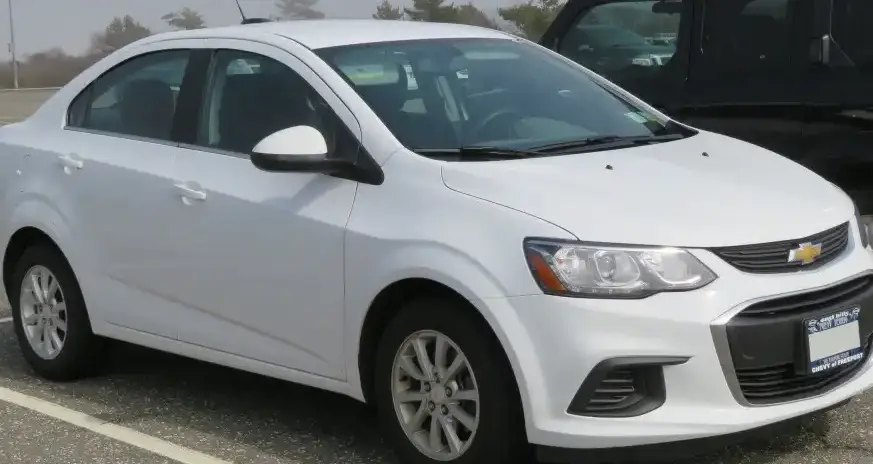
The Chevrolet Sonic I Hatchback (facelift 2016) 1.8L (138 hp) Automatic represents a key offering in Chevrolet’s subcompact car lineup during the 2016-2018 model years. Positioned as a practical and relatively affordable option, this variant aimed to provide a balance between fuel efficiency and acceptable performance for everyday commuting. It was part of the first generation Sonic (launched in 2011), which was a rebadged and significantly revised version of the Opel Astra J, adapted for the North American market. The facelift in 2016 brought updated styling and minor equipment revisions. This particular configuration, pairing the 1.8-liter engine with a six-speed automatic transmission, was intended to appeal to buyers prioritizing ease of use over outright driving engagement.
Technical Specifications
| Brand | Chevrolet |
| Model | Sonic |
| Generation | Sonic I Hatchback (facelift 2016) |
| Type (Engine) | 1.8 (138 Hp) Automatic |
| Start of production | 2016 |
| End of production | 2018 |
| Powertrain Architecture | Internal Combustion engine |
| Body type | Hatchback |
| Seats | 5 |
| Doors | 5 |
| Fuel consumption (urban) | 9.4 l/100 km (25 US mpg) |
| Fuel consumption (extra urban) | 6.9 l/100 km (34.1 US mpg) |
| Fuel Type | Petrol (Gasoline) |
| Weight-to-power ratio | 9.4 kg/Hp |
| Weight-to-torque ratio | 7.6 kg/Nm |
| Power | 138 Hp @ 6300 rpm |
| Power per litre | 76.8 Hp/l |
| Torque | 170 Nm @ 3800 rpm (125.39 lb.-ft. @ 3800 rpm) |
| Engine layout | Front, Transverse |
| Engine Model/Code | LUW, LWE |
| Engine displacement | 1796 cm3 (109.6 cu. in.) |
| Number of cylinders | 4 |
| Engine configuration | Inline |
| Cylinder Bore | 80.5 mm (3.17 in.) |
| Piston Stroke | 88.2 mm (3.47 in.) |
| Number of valves per cylinder | 4 |
| Fuel injection system | Multi-port manifold injection |
| Engine aspiration | Naturally aspirated engine |
| Valvetrain | DOHC |
| Engine oil capacity | 4.5 l (4.76 US qt | 3.96 UK qt) |
| Coolant capacity | 6 l (6.34 US qt | 5.28 UK qt) |
| Kerb Weight | 1292 kg (2848.37 lbs.) |
| Trunk (boot) space – minimum | 539 l (19.03 cu. ft.) |
| Trunk (boot) space – maximum | 1351 l (47.71 cu. ft.) |
| Fuel tank capacity | 46 l (12.15 US gal | 10.12 UK gal) |
| Length | 4059 mm (159.8 in.) |
| Width | 1735 mm (68.31 in.) |
| Height | 1506-1516 mm (59.29 – 59.69 in.) |
| Wheelbase | 2525 mm (99.41 in.) |
| Front track | 1509 mm (59.41 in.) |
| Rear track | 1509 mm (59.41 in.) |
| Drag coefficient (Cd) | 0.33 |
| Minimum turning circle | 10.5 m (34.45 ft.) |
| Drivetrain Architecture | Front wheel drive |
| Number of gears | 6 |
| Gearbox type | Automatic transmission |
| Front suspension | Independent, McPherson with coil spring and anti-roll bar |
| Rear suspension | Semi-independent, coil spring |
| Front brakes | Ventilated discs |
| Rear brakes | Drum |
| Assisting systems | ABS (Anti-lock braking system) |
| Steering type | Steering rack and pinion |
| Power steering | Electric |
| Tires size | 195/65 R15 |
| Wheel rims size | 15 |
Introduction
The 2016-2018 Chevrolet Sonic 1.8L Automatic Hatchback was a significant player in the competitive subcompact car segment. Built on the GM Gamma platform (derived from the Opel Astra J), the Sonic aimed to offer a more refined and feature-rich experience than some of its rivals. The facelifted model, introduced in 2016, featured revised front and rear styling, an updated interior, and improved connectivity options. This 1.8-liter automatic variant was positioned as a mid-range offering, slotting between the base 1.4L turbocharged model and potentially higher trim levels with more features. It was primarily marketed towards buyers seeking a practical, fuel-efficient, and easy-to-drive vehicle for urban commuting and daily errands.
Powertrain & Engine Architecture
At the heart of this Sonic variant lies the LUW/LWE 1.8-liter inline-four cylinder engine. This engine is a naturally aspirated unit utilizing multi-port fuel injection and a double overhead camshaft (DOHC) valvetrain. The engine produces 138 horsepower at 6300 rpm and 170 Nm (125.39 lb-ft) of torque at 3800 rpm. The engine’s architecture is relatively simple, contributing to its generally good reliability. The six-speed automatic transmission, sourced from GM, was designed to provide smooth shifts and optimize fuel economy. While not a performance-oriented transmission, it offered a comfortable driving experience. The transmission’s gear ratios were tuned for everyday drivability, prioritizing acceleration from a standstill and efficient cruising speeds.
Driving Characteristics
The 1.8L automatic Sonic delivers adequate, though not exhilarating, performance. Acceleration is sufficient for merging onto highways and navigating city streets, but it won’t win any drag races. The automatic transmission contributes to a relaxed driving experience, particularly in urban environments. Compared to the 1.4L turbocharged version, the 1.8L offers a more linear power delivery, lacking the turbo’s initial lag but also its peak boost. The six-speed automatic, while smooth, can sometimes feel hesitant during quick downshifts. The overall driving experience is geared towards comfort and convenience rather than sporty handling. The steering is light and precise, making it easy to maneuver in tight spaces.
Equipment & Trim Levels
The 2016-2018 Sonic 1.8L Automatic typically came standard with features such as air conditioning, power windows and locks, a basic audio system with USB connectivity, and stability control. Higher trim levels, such as the LT and Premier, added features like a touchscreen infotainment system with Apple CarPlay and Android Auto compatibility, a rearview camera, alloy wheels, and upgraded interior materials. Optional extras included a sunroof, heated seats, and a premium audio system. Interior upholstery was typically cloth, with leatherette options available on higher trims. The dashboard layout was functional and straightforward, with easy-to-reach controls.
Chassis & Braking
The Sonic’s chassis features an independent McPherson strut suspension in the front and a semi-independent coil spring suspension in the rear. This setup provides a comfortable ride quality, absorbing bumps and imperfections in the road reasonably well. The front brakes are ventilated discs, offering adequate stopping power, while the rear brakes are drums. This configuration was common for vehicles in this price range and weight class. Anti-lock braking system (ABS) was standard, enhancing safety during emergency braking situations. The steering system utilizes an electric power steering (EPS) system, providing light and responsive steering feel.
Market Reception & Comparison
The Chevrolet Sonic 1.8L Automatic received mixed reviews from automotive critics. While praised for its practicality, fuel efficiency, and relatively spacious interior, it was often criticized for its bland styling and unremarkable driving dynamics. Compared to the 1.4L turbo version, the 1.8L offered better fuel economy in some driving conditions but lacked the turbo’s punch. Reliability was generally considered average, with some reports of minor issues with the automatic transmission and electrical components. In terms of fuel economy, the 1.8L automatic typically achieved around 25 mpg in the city and 34 mpg on the highway, making it a competitive option in its class.
Legacy
The Chevrolet Sonic was discontinued in North America after the 2020 model year. The 1.8L engine and six-speed automatic transmission combination, while not particularly groundbreaking, proved to be reasonably reliable in the long run. On the used car market, the 2016-2018 Sonic 1.8L Automatic represents an affordable and practical option for buyers seeking a subcompact hatchback. However, potential buyers should be aware of potential issues with the automatic transmission and electrical systems and ensure that the vehicle has been properly maintained. The Sonic, while not a standout performer, served as a valuable entry-level offering for Chevrolet, providing a functional and economical transportation solution for many drivers.