
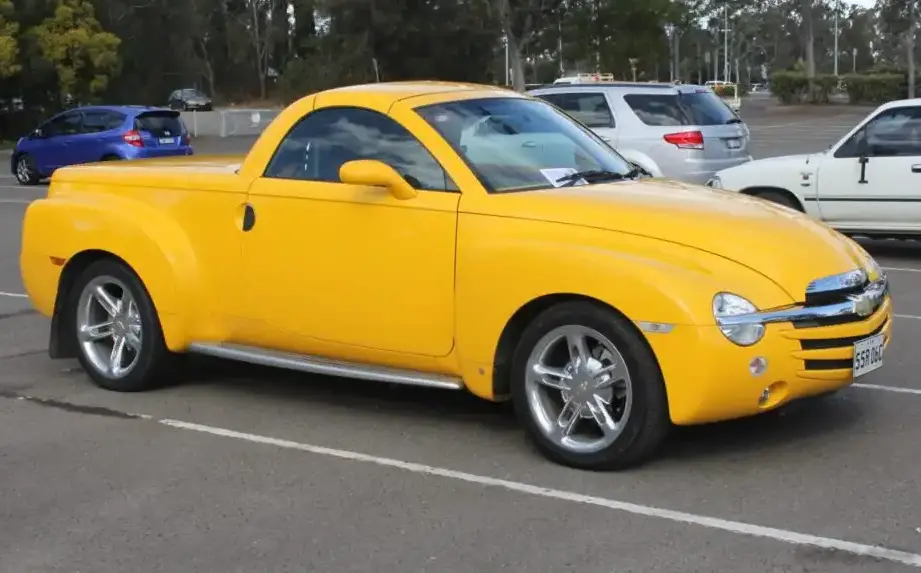
The Chevrolet SSR (Super Sport Roadster) was a retro-styled, two-seat, open-air pickup truck produced by Chevrolet from 2003 to 2006. It represented a unique attempt to blend classic styling cues with modern performance and technology. Built on a modified version of the GM TrailBlazer/GMC Envoy platform (GMT360), the SSR aimed to evoke the spirit of Chevrolet’s Advance Design pickups of the 1940s and 50s. The 5.3L V8 variant, producing 300 horsepower, was the sole engine option offered throughout its production run, paired exclusively with a four-speed automatic transmission. The SSR was positioned as a niche vehicle, appealing to buyers seeking a distinctive and somewhat unconventional vehicle.
Technical Specifications
| Brand | Chevrolet |
| Model | SSR |
| Generation | SSR |
| Type (Engine) | 5.3L V8 (300 Hp) |
| Start of production | 2003 |
| End of production | 2006 |
| Powertrain Architecture | Internal Combustion Engine |
| Body type | Pick-up |
| Seats | 2 |
| Doors | 2 |
| Fuel consumption (urban) | 15.7 l/100 km (15 US mpg, 18 UK mpg) |
| Fuel consumption (extra urban) | 12.4 l/100 km (19 US mpg, 22.8 UK mpg) |
| Fuel consumption (combined) | 13.8 l/100 km (17 US mpg, 20.5 UK mpg) |
| Fuel Type | Petrol (Gasoline) |
| Acceleration 0 – 100 km/h | 7.6 sec |
| Acceleration 0 – 62 mph | 7.6 sec |
| Acceleration 0 – 60 mph | 7.2 sec |
| Maximum speed | 210 km/h (130.49 mph) |
| Weight-to-power ratio | 7.2 kg/Hp |
| Weight-to-torque ratio | 4.8 kg/Nm |
| Power | 300 Hp @ 5200 rpm |
| Torque | 449 Nm @ 4000 rpm (331.17 lb.-ft. @ 4000 rpm) |
| Engine layout | Front, Longitudinal |
| Engine Model/Code | LM4 |
| Engine displacement | 5326 cm3 (325.01 cu. in.) |
| Number of cylinders | 8 |
| Engine configuration | V-engine |
| Cylinder Bore | 96 mm (3.78 in.) |
| Piston Stroke | 92 mm (3.62 in.) |
| Compression ratio | 9.5:1 |
| Number of valves per cylinder | 2 |
| Fuel injection system | Multi-port manifold injection |
| Engine aspiration | Naturally aspirated |
| Engine oil capacity | 5.7 l (6.02 US qt, 5.02 UK qt) |
| Coolant capacity | 14.5 l (15.32 US qt, 12.76 UK qt) |
| Kerb Weight | 2159 kg (4759.78 lbs.) |
| Trunk (boot) space – maximum | 1130 l (39.91 cu. ft.) |
| Fuel tank capacity | 95 l (25.1 US gal, 20.9 UK gal) |
| Length | 4862 mm (191.42 in.) |
| Width | 1996 mm (78.58 in.) |
| Height | 1631 mm (64.21 in.) |
| Wheelbase | 2946 mm (115.98 in.) |
| Front track | 1628 mm (64.09 in.) |
| Rear track | 1648 mm (64.88 in.) |
| Drivetrain Architecture | Rear wheel drive |
| Number of gears and type of gearbox | 4 gears, automatic transmission |
| Front suspension | Coil spring |
| Rear suspension | Coil spring |
| Front brakes | Ventilated discs |
| Rear brakes | Disc |
| Assisting systems | ABS (Anti-lock braking system) |
| Steering type | Steering rack and pinion |
| Tires size | 255/45 R19; 295/40 R20 |
| Wheel rims size | 8J x 19; 10J x 20 |
Powertrain & Engine Architecture
The Chevrolet SSR was powered by the GM LM4 5.3-liter (325 cubic inch) small-block V8 engine. This engine, a member of the Vortec family, was widely used in various Chevrolet and GMC trucks and SUVs. It featured a cast iron block with aluminum cylinder heads, and utilized a multi-port fuel injection system. The engine produced 300 horsepower at 5200 rpm and 331 lb-ft of torque at 4000 rpm. The engine’s design prioritized low-end torque, making it well-suited for the SSR’s relatively heavy weight. The sole transmission option was a four-speed automatic (4L60-E) transmission, chosen for its ease of use and suitability for the vehicle’s intended cruising character. While not a performance-oriented transmission, it provided smooth shifts and adequate responsiveness for everyday driving.
Driving Characteristics
The 5.3L V8 and four-speed automatic combination in the SSR delivered respectable, but not blistering, performance. Acceleration from 0 to 60 mph took approximately 7.2 seconds. The automatic transmission’s gear ratios were tuned for comfortable cruising rather than aggressive acceleration. The SSR felt relatively heavy behind the wheel, due in part to its robust chassis and extensive sound deadening. Compared to a hypothetical manual transmission version, the automatic offered less driver engagement but greater convenience. Compared to other potential engine options (had they been offered), such as a larger displacement V8 or a turbocharged engine, the 5.3L provided a balance of power, reliability, and fuel economy. The rear-wheel-drive layout contributed to a sporty feel, but the SSR was not intended to be a track-focused vehicle.
Equipment & Trim Levels
The SSR came relatively well-equipped, reflecting its premium positioning. Standard features included leather upholstery, power seats, air conditioning, a premium sound system, and alloy wheels. The interior featured retro-inspired styling cues, such as chrome accents and a gauge cluster designed to resemble those found in classic Chevrolet trucks. Optional extras included a power-retractable hardtop (which transformed the SSR from an open-air roadster to a coupe), a navigation system, and upgraded audio options. The SSR did not offer multiple trim levels; the equipment list was largely consistent across all models, with options being the primary means of customization.
Chassis & Braking
The SSR’s chassis was based on a modified version of the GMT360 platform used for the TrailBlazer and Envoy SUVs. It featured a fully independent front suspension with coil springs and a solid rear axle with coil springs. The braking system consisted of ventilated discs at the front and solid discs at the rear. Anti-lock brakes (ABS) were standard. The suspension was tuned for a balance of ride comfort and handling. While not a dedicated sports car, the SSR offered reasonably competent handling for its size and weight. The rear disc brakes were an upgrade over the drum brakes often found on similar trucks of the era.
Market Reception & Comparison
The Chevrolet SSR received mixed reviews from automotive critics. Many praised its unique styling and retro charm, but some criticized its high price, limited practicality, and relatively modest performance. Fuel economy was also a concern, averaging around 17 mpg in combined driving. Compared to other vehicles in its price range, such as sports cars and luxury SUVs, the SSR offered a unique proposition but lacked the outright performance or versatility of its competitors. Its fuel economy was notably worse than more efficient SUVs and trucks of the time. However, its distinctive styling and limited production numbers appealed to a niche market of buyers seeking a distinctive vehicle.
Legacy
The Chevrolet SSR was discontinued after only three model years, with approximately 25,000 units produced. While not a commercial success, the SSR has gained a following among collectors and enthusiasts. The LM4 5.3L V8 engine is known for its reliability and durability, and the 4L60-E transmission is also generally considered to be a robust unit. However, like any vehicle of this age, regular maintenance is essential to prevent issues. Today, the SSR is valued for its unique styling and limited production numbers. Well-maintained examples command a premium in the used car market, appealing to those who appreciate its retro aesthetic and unconventional design.
