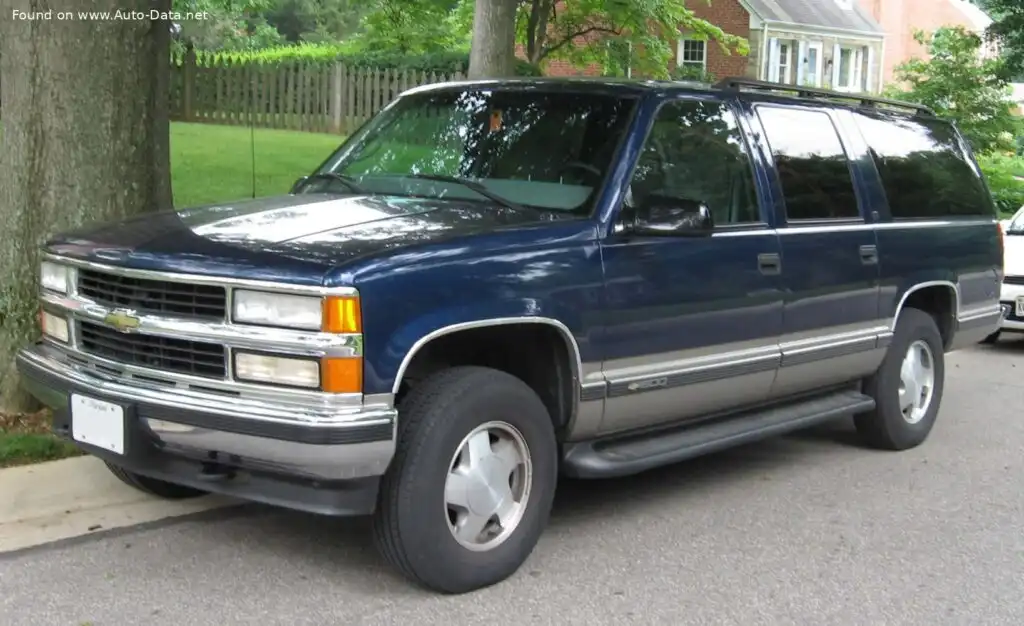
The Chevrolet Suburban (GMT400) with the 7.4-liter V8 engine, producing 230 horsepower, represents a significant iteration of Chevrolet’s long-running full-size SUV. Produced from 1991 through 1999, this variant occupied a specific niche within the GMT400 generation, offering a blend of substantial towing capacity and interior space geared towards large families or those requiring a workhorse vehicle. It was positioned as a step up in power and capability from the smaller engine options, but wasn’t the top-tier performance offering – that role was reserved for later, more powerful engine upgrades. The GMT400 platform itself was a major redesign for the Suburban, moving towards a more modern, aerodynamic shape and improved ride quality compared to its predecessors.
Technical Specifications
| Brand | Chevrolet |
| Model | Suburban |
| Generation | Suburban (GMT400) |
| Type (Engine) | 7.4 i V8 (230 Hp) |
| Start of production | 1991 year |
| End of production | 1999 year |
| Powertrain Architecture | Internal Combustion engine |
| Body type | SUV |
| Seats | 9 |
| Doors | 4 |
| Fuel Type | Petrol (Gasoline) |
| Weight-to-power ratio | 9.9 kg/Hp, 101.3 Hp/tonne |
| Weight-to-torque ratio | 4.3 kg/Nm, 230.3 Nm/tonne |
| Power | 230 Hp @ 3600 rpm |
| Power per litre | 30.9 Hp/l |
| Torque | 523 Nm @ 1600 rpm, 385.75 lb.-ft. @ 1600 rpm |
| Engine layout | Front, Longitudinal |
| Engine Model/Code | L19 |
| Engine displacement | 7446 cm3, 454.38 cu. in. |
| Number of cylinders | 8 |
| Engine configuration | V-engine |
| Cylinder Bore | 108 mm, 4.25 in. |
| Piston Stroke | 101.6 mm, 4 in. |
| Compression ratio | 7.9:1 |
| Number of valves per cylinder | 2 |
| Fuel injection system | Single-point injection |
| Engine aspiration | Naturally aspirated engine |
| Engine oil capacity | 6.6 l, 6.97 US qt | 5.81 UK qt |
| Coolant | 22 l, 23.25 US qt | 19.36 UK qt |
| Kerb Weight | 2271 kg, 5006.7 lbs |
| Fuel tank capacity | 159 l, 42 US gal | 34.98 UK gal |
| Length | 5575 mm, 219.49 in |
| Width | 1940 mm, 76.38 in |
| Height | 1748 mm, 68.82 in |
| Wheelbase | 3340 mm, 131.5 in |
| Front track | 1608 mm, 63.31 in |
| Rear (Back) track | 1623 mm, 63.9 in |
| Drivetrain Architecture | The Internal combustion engine (ICE) drives the rear wheels of the vehicle. |
| Drive wheel | Rear wheel drive |
| Number of gears and type of gearbox | 4 gears, automatic transmission |
| Front suspension | Double wishbone |
| Rear suspension | Leaf spring |
| Front brakes | Disc |
| Rear brakes | Drum |
| Assisting systems | ABS (Anti-lock braking system) |
| Power steering | Hydraulic Steering |
| Tires size | 245/75 R16 C |
Powertrain & Engine Architecture
The heart of this Suburban variant is the Chevrolet L19 7.4-liter (454 cubic inch) V8 engine. This engine, a member of Chevrolet’s small-block family, is a traditional pushrod design with two valves per cylinder. The L19 utilized a Central Port Injection (CPI) fuel injection system, a form of single-point injection where fuel injectors are located in the intake manifold runners rather than directly into the combustion chamber. While not as efficient as multi-port fuel injection, CPI offered a cost-effective upgrade over carburation. The engine’s robust bottom end and relatively conservative compression ratio of 7.9:1 contributed to its longevity and ability to run on regular unleaded gasoline. The 4L60 automatic transmission, a four-speed unit, was the standard pairing for this engine. This transmission was known for its durability, but also for its relatively conservative shift programming, prioritizing smooth operation over aggressive performance.
Driving Characteristics
The 7.4-liter Suburban, when equipped with the 4L60 automatic, delivered a driving experience focused on effortless cruising and substantial towing capacity. Acceleration was adequate, but not particularly brisk, with 0-60 mph times estimated in the 9-10 second range. The automatic transmission’s gear ratios were geared towards maximizing fuel economy and providing smooth shifts, rather than delivering quick acceleration. Compared to the available 5.7-liter V8, the 7.4 offered significantly more low-end torque, making it ideal for hauling heavy loads or navigating challenging terrain. However, the larger engine also resulted in a higher curb weight, which impacted handling and braking performance. The leaf spring rear suspension, while capable of supporting heavy loads, provided a somewhat firm and truck-like ride.
Equipment & Trim Levels
The 7.4-liter Suburban typically came in higher trim levels, often including features like air conditioning, power windows and locks, and an upgraded audio system. Interior upholstery was typically cloth or vinyl, with optional leather available. The dashboard layout was functional and straightforward, prioritizing practicality over luxury. Common optional extras included a rear air conditioning system, a towing package (including a heavy-duty hitch and wiring harness), and a sunroof. The Suburban’s spacious interior was a key selling point, offering seating for up to nine passengers and ample cargo space, especially with the rear seats folded down.
Chassis & Braking
The GMT400 Suburban utilized a body-on-frame construction, providing a robust and durable platform. The front suspension featured an independent double wishbone design, while the rear suspension employed a traditional leaf spring setup. This configuration prioritized load-carrying capacity and durability over refined handling. Braking duties were handled by disc brakes at the front and drum brakes at the rear. Anti-lock brakes (ABS) were available, but not standard on all trims. The steering system was hydraulic power steering, providing relatively easy maneuverability despite the vehicle’s size and weight.
Market Reception & Comparison
The 7.4-liter Suburban was generally well-received by buyers who needed a large, capable SUV for work or family use. Critics praised its spacious interior, powerful engine, and impressive towing capacity. However, some reviewers noted its relatively poor fuel economy and truck-like ride quality. Compared to the 5.7-liter V8 Suburban, the 7.4 offered a significant increase in torque and towing capacity, but at the expense of fuel efficiency. Compared to later Suburban models with more modern engines and transmissions, the GMT400 7.4-liter variant was considered less refined and less fuel-efficient.
Legacy
The GMT400 Suburban with the 7.4-liter V8 engine has developed a reputation for reliability and durability. The L19 engine, while not particularly high-tech, is known for its longevity and relatively simple maintenance requirements. Today, these Suburbans are often sought after by collectors and enthusiasts who appreciate their classic styling and robust construction. While fuel economy is a concern, the 7.4-liter Suburban remains a capable and versatile vehicle, particularly for those who need to tow heavy loads or transport large families. Parts availability is generally good, and the vehicle’s relatively simple design makes it relatively easy to repair and maintain. The GMT400 generation laid the groundwork for the continued success of the Suburban as a dominant force in the full-size SUV segment.