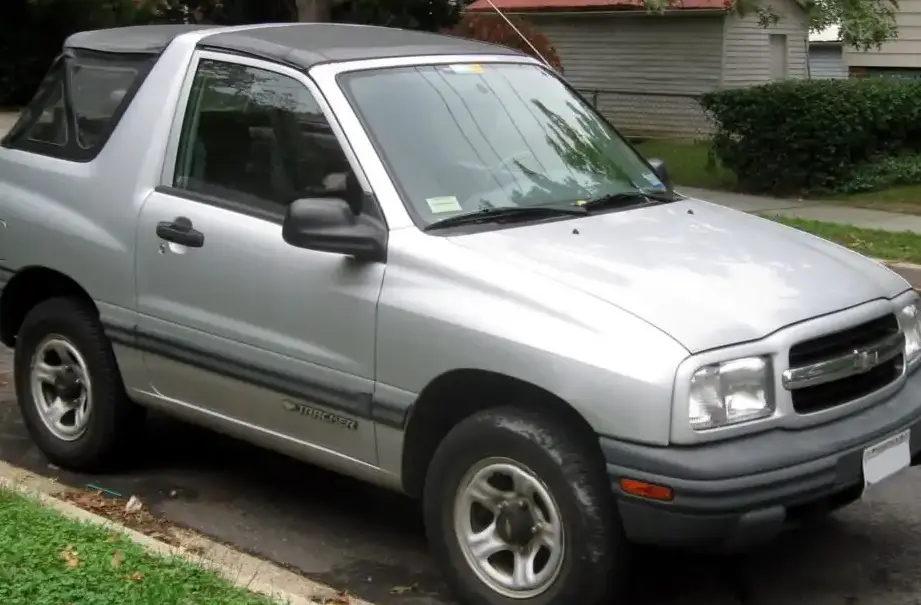
The Chevrolet Tracker Convertible II 1.6 i 16V, produced from 1998 to 2004, represents a unique offering in the compact SUV segment. This variant, powered by the 1.6-liter inline-four engine producing 97 horsepower, was primarily marketed in Latin America and select international markets. It occupied the entry-level position within the Tracker Convertible II range, offering an affordable and open-air driving experience. The Tracker Convertible II itself was based on the Suzuki Vitara/Escudo platform, a result of GM’s partnership with Suzuki, and aimed to provide a versatile and relatively inexpensive vehicle for those seeking a small, capable SUV with the added fun of a convertible top.
Technical Specifications
| Brand | Chevrolet |
| Model | Tracker |
| Generation | Tracker Convertible II |
| Type (Engine) | 1.6 i 16V (97 Hp) |
| Start of production | 1998 |
| End of production | 2004 |
| Powertrain Architecture | Internal Combustion engine |
| Body type | SUV |
| Seats | 5 |
| Doors | 3 |
| Fuel consumption (extra urban) | 8.7 l/100 km (27 US mpg) |
| Fuel Type | Petrol (Gasoline) |
| Maximum speed | 150 km/h (93.21 mph) |
| Weight-to-power ratio | 10.9 kg/Hp |
| Weight-to-torque ratio | 8 kg/Nm |
| Power | 97 Hp @ 5600 rpm |
| Power per litre | 61 Hp/l |
| Torque | 133 Nm @ 4000 rpm (98.1 lb.-ft. @ 4000 rpm) |
| Engine layout | Front, Longitudinal |
| Engine Model/Code | L01 |
| Engine displacement | 1590 cm3 (97.03 cu. in.) |
| Number of cylinders | 4 |
| Engine configuration | Inline |
| Cylinder Bore | 75 mm (2.95 in.) |
| Piston Stroke | 90 mm (3.54 in.) |
| Compression ratio | 9.5:1 |
| Number of valves per cylinder | 4 |
| Fuel injection system | Multi-port manifold injection |
| Engine aspiration | Naturally aspirated engine |
| Valvetrain | OHC |
| Engine oil capacity | 4.2 l (4.44 US qt | 3.7 UK qt) |
| Coolant | 5.5 l (5.81 US qt | 4.84 UK qt) |
| Kerb Weight | 1060 kg (2336.9 lbs.) |
| Max. weight | 1450 kg (3196.7 lbs.) |
| Max load | 390 kg (859.8 lbs.) |
| Trunk (boot) space – minimum | 230 l (8.12 cu. ft.) |
| Trunk (boot) space – maximum | 910 l (32.14 cu. ft.) |
| Fuel tank capacity | 42 l (11.1 US gal | 9.24 UK gal) |
| Length | 3650 mm (143.7 in.) |
| Width | 1630 mm (64.17 in.) |
| Height | 1650 mm (64.96 in.) |
| Wheelbase | 2200 mm (86.61 in.) |
| Front track | 1390 mm (54.72 in.) |
| Rear (Back) track | 1400 mm (55.12 in.) |
| Drivetrain Architecture | Rear wheel drive |
| Number of gears and type of gearbox | 5 gears, manual transmission |
| Front suspension | Spring Strut |
| Rear suspension | Coil spring |
| Front brakes | Ventilated discs |
| Rear brakes | Drum |
| Assisting systems | ABS (Anti-lock braking system) |
| Steering type | Worm-reduction unit |
| Power steering | Hydraulic Steering |
| Tires size | 195//75 R15 |
Powertrain & Engine Architecture
The heart of the Tracker Convertible II 1.6 i 16V is the L01 engine, a 1.6-liter inline-four cylinder gasoline engine. This engine utilizes a single overhead camshaft (OHC) valvetrain operating four valves per cylinder. Fuel delivery is managed by a multi-port fuel injection system, providing a balance between efficiency and performance. The engine’s 97 horsepower output at 5600 rpm and 133 Nm (98.1 lb-ft) of torque at 4000 rpm were considered adequate for the vehicle’s weight class, but not particularly sporty. The engine’s longitudinal mounting and rear-wheel drive configuration were somewhat unusual for a vehicle of this size and market segment, reflecting its Suzuki Vitara origins. The standard transmission was a five-speed manual, contributing to reasonable fuel economy.
Driving Characteristics
The 1.6-liter engine and five-speed manual transmission combination provided a functional, if not exhilarating, driving experience. Acceleration was modest, and the vehicle felt most comfortable at moderate speeds. The rear-wheel drive layout offered a slightly more engaging driving feel compared to front-wheel drive alternatives, but the limited horsepower meant that spirited driving required frequent downshifting. The five-speed manual transmission was well-matched to the engine’s powerband, allowing drivers to keep the engine in its optimal rev range. Compared to potential upgrades like a larger engine, this variant prioritized fuel efficiency and affordability over outright performance.
Equipment & Trim Levels
The Tracker Convertible II 1.6 i 16V typically came with a relatively basic level of equipment, reflecting its position as the entry-level trim. Standard features generally included manual windows and door locks, basic cloth upholstery, and a simple audio system. The convertible top was manually operated. Optional extras could include air conditioning, upgraded audio systems, and alloy wheels. Interior appointments were functional and durable, prioritizing practicality over luxury. The dashboard layout was straightforward and easy to use.
Chassis & Braking
The Tracker Convertible II utilized a body-on-frame construction, contributing to its ruggedness and off-road capability. The front suspension employed a spring strut setup, while the rear suspension featured coil springs. Braking duties were handled by ventilated discs at the front and drum brakes at the rear. An anti-lock braking system (ABS) was often included as standard equipment, enhancing safety. The steering system was a worm-reduction unit with hydraulic power assistance. The relatively simple suspension setup provided a comfortable ride on paved roads, while still allowing for some degree of off-road capability.
Market Reception & Comparison
The Tracker Convertible II 1.6 i 16V was generally well-received as an affordable and unique offering in its segment. Critics praised its open-air driving experience and relatively low price point. However, the engine’s modest power output was often cited as a drawback. Compared to other trims in the Tracker lineup, such as those equipped with larger engines, the 1.6-liter variant offered lower performance but better fuel economy. It appealed to buyers who prioritized affordability and practicality over outright performance. Its fuel economy was competitive for its time, offering around 27 mpg in extra urban driving.
Legacy
The Chevrolet Tracker Convertible II 1.6 i 16V has become a relatively sought-after vehicle among enthusiasts, particularly those interested in unique and affordable convertibles. The L01 engine is known for its reliability, although regular maintenance is essential to prevent issues. Parts availability can be a challenge in some regions, but the engine’s simplicity makes it relatively easy to repair. Today, these vehicles are often found in good condition, offering a fun and affordable way to experience open-air motoring. The Tracker Convertible II, in all its trims, represents a unique chapter in Chevrolet’s history, blending Suzuki engineering with American marketing.