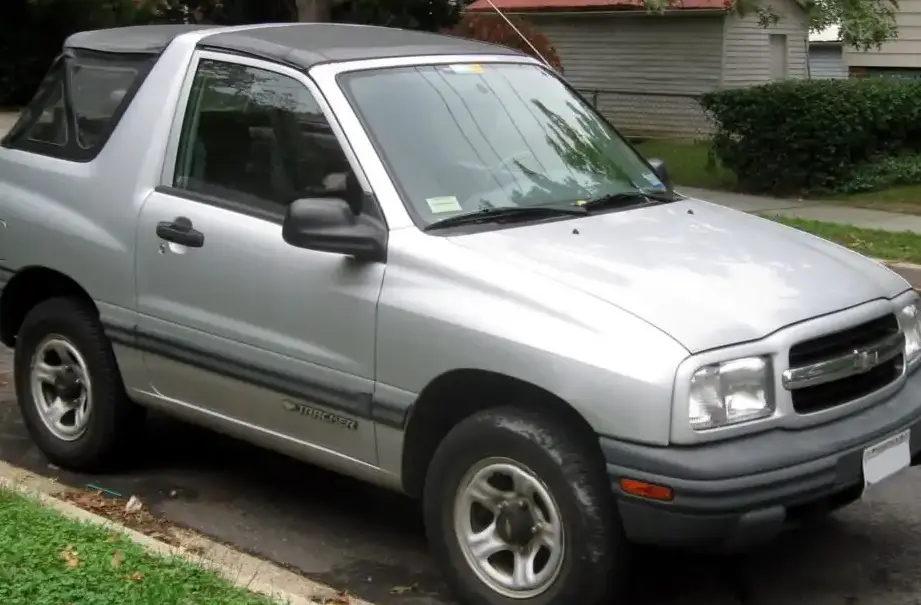
The Chevrolet Tracker Convertible II 2.0 i 16V 4WD, produced from 1998 to 2004, represents a unique offering in the compact SUV segment. This variant, powered by the J20A 2.0-liter inline-four engine and paired with a five-speed manual transmission, combined open-air motoring with all-wheel-drive capability. It was primarily marketed in North America and select international markets, offering a more affordable and adventurous alternative to larger, more established SUVs. The Tracker Convertible II sat within the second generation of the Tracker line, known for its body-on-frame construction and relatively simple mechanicals.
Technical Specifications
| Brand | Chevrolet |
| Model | Tracker |
| Generation | Tracker Convertible II |
| Type (Engine) | 2.0 i 16V 4WD (122 Hp) |
| Start of production | 1998 |
| End of production | 2004 |
| Powertrain Architecture | Internal Combustion engine |
| Body type | SUV |
| Seats | 5 |
| Doors | 3 |
| Fuel consumption (urban) | 10.2 l/100 km (23.1 US mpg) |
| Fuel consumption (extra urban) | 9.4 l/100 km (25 US mpg) |
| Fuel Type | Petrol (Gasoline) |
| Maximum speed | 155 km/h (96.31 mph) |
| Weight-to-power ratio | 10 kg/Hp |
| Weight-to-torque ratio | 6.7 kg/Nm |
| Power | 122 Hp @ 6000 rpm |
| Power per litre | 61.2 Hp/l |
| Torque | 182 Nm @ 3000 rpm (134.24 lb.-ft. @ 3000 rpm) |
| Engine layout | Front, Longitudinal |
| Engine Model/Code | J20A |
| Engine displacement | 1995 cm3 (121.74 cu. in.) |
| Number of cylinders | 4 |
| Engine configuration | Inline |
| Cylinder Bore | 84 mm (3.31 in.) |
| Piston Stroke | 90 mm (3.54 in.) |
| Compression ratio | 9.5:1 |
| Number of valves per cylinder | 4 |
| Fuel injection system | Multi-port manifold injection |
| Engine aspiration | Naturally aspirated |
| Valvetrain | OHC |
| Engine oil capacity | 5.2 l (5.49 US qt | 4.58 UK qt) |
| Coolant capacity | 6.5 l (6.87 US qt | 5.72 UK qt) |
| Kerb Weight | 1225 kg (2700.66 lbs.) |
| Max. weight | 1580 kg (3483.3 lbs.) |
| Max load | 355 kg (782.64 lbs.) |
| Trunk (boot) space – minimum | 290 l (10.24 cu. ft.) |
| Trunk (boot) space – maximum | 680 l (24.01 cu. ft.) |
| Fuel tank capacity | 56 l (14.79 US gal | 12.32 UK gal) |
| Length | 3780 mm (148.82 in.) |
| Width | 1694 mm (66.69 in.) |
| Height | 1689 mm (66.5 in.) |
| Wheelbase | 2200 mm (86.61 in.) |
| Front track | 1460 mm (57.48 in.) |
| Rear track | 1460 mm (57.48 in.) |
| Drive wheel | All wheel drive (4×4) |
| Number of gears | 5 |
| Gearbox type | Manual transmission |
| Front suspension | Spring Strut |
| Rear suspension | Coil spring |
| Front brakes | Ventilated discs |
| Rear brakes | Drum |
| Assisting systems | ABS (Anti-lock braking system) |
| Steering type | Worm-reduction unit |
| Power steering | Hydraulic |
| Tires size | 205/75 R15 |
| Wheel rims size | 15 |
Powertrain & Engine Architecture
The heart of the Tracker Convertible II 2.0 i 16V 4WD is the J20A engine, a 1.995-liter inline-four cylinder gasoline engine. This engine, part of General Motors’ small-block family, features a single overhead camshaft (SOHC) valvetrain operating four valves per cylinder. The J20A utilizes multi-port fuel injection, delivering fuel directly into the intake ports for improved combustion efficiency. The engine’s 9.5:1 compression ratio contributes to its respectable power output of 122 horsepower at 6000 rpm and 182 Nm (134 lb-ft) of torque at 3000 rpm. The five-speed manual transmission provides a relatively direct connection to the drivetrain, offering drivers more control compared to the optional automatic transmission. The transmission’s gear ratios were tuned for a balance of acceleration and fuel economy, though the vehicle’s weight and all-wheel-drive system did impact overall performance.
Driving Characteristics
The 2.0-liter engine and manual transmission combination in the Tracker Convertible II provided adequate, though not exhilarating, performance. Acceleration from 0 to 60 mph was estimated to be around 10-11 seconds. The all-wheel-drive system provided enhanced traction, particularly on loose surfaces, making it a capable vehicle for light off-roading and inclement weather. Compared to the automatic transmission version, the manual offered a more engaging driving experience and slightly improved fuel economy. The manual transmission also allowed drivers to better utilize the engine’s torque band, especially when navigating hilly terrain. However, the Tracker’s body-on-frame construction and relatively short wheelbase resulted in a ride that could be somewhat bumpy, especially on rough roads.
Equipment & Trim Levels
The Tracker Convertible II 2.0 i 16V 4WD typically came standard with features such as air conditioning, power steering, and an AM/FM radio. The convertible top was manually operated. Optional extras included upgraded audio systems, alloy wheels, and a limited-slip rear differential. Interior upholstery was typically cloth, with a relatively basic dashboard layout. The trim level was generally considered mid-range within the Tracker lineup, offering a good balance of features and affordability. It was positioned above the base models but below any potential special editions or fully-loaded trims.
Chassis & Braking
The Tracker Convertible II utilized a body-on-frame construction, a relatively traditional approach for SUVs at the time. Front suspension consisted of a spring strut setup, while the rear employed coil springs. The braking system featured ventilated discs on the front wheels and drum brakes on the rear. Anti-lock brakes (ABS) were standard, enhancing safety and control during emergency braking situations. The vehicle’s relatively high ground clearance and all-wheel-drive system contributed to its off-road capability. Stabilizer bars were present, but their thickness was modest, reflecting the vehicle’s focus on affordability rather than high-performance handling.
Market Reception & Comparison
The Chevrolet Tracker Convertible II 2.0 i 16V 4WD received mixed reviews from automotive critics. It was praised for its affordability, unique open-air design, and all-wheel-drive capability. However, it was also criticized for its relatively basic interior, bumpy ride, and modest performance. Compared to other trims in the Tracker lineup, the 2.0-liter manual version offered a more engaging driving experience and slightly better fuel economy than the automatic. The 2.0-liter engine provided a noticeable performance upgrade over the smaller 1.6-liter engine option. Fuel economy was reasonable for the time, averaging around 23 mpg in the city and 25 mpg on the highway.
Legacy
The Chevrolet Tracker Convertible II 2.0 i 16V 4WD has developed a modest following among enthusiasts. The J20A engine is generally considered reliable, though regular maintenance is crucial. The manual transmission is also known for its durability. However, like many vehicles of its age, rust can be a concern, particularly in areas with harsh winters. Today, well-maintained examples of the Tracker Convertible II are becoming increasingly collectible, appealing to those seeking a unique and affordable open-air SUV. The simplicity of its mechanicals makes it relatively easy to maintain and repair, contributing to its enduring appeal among DIY mechanics.