
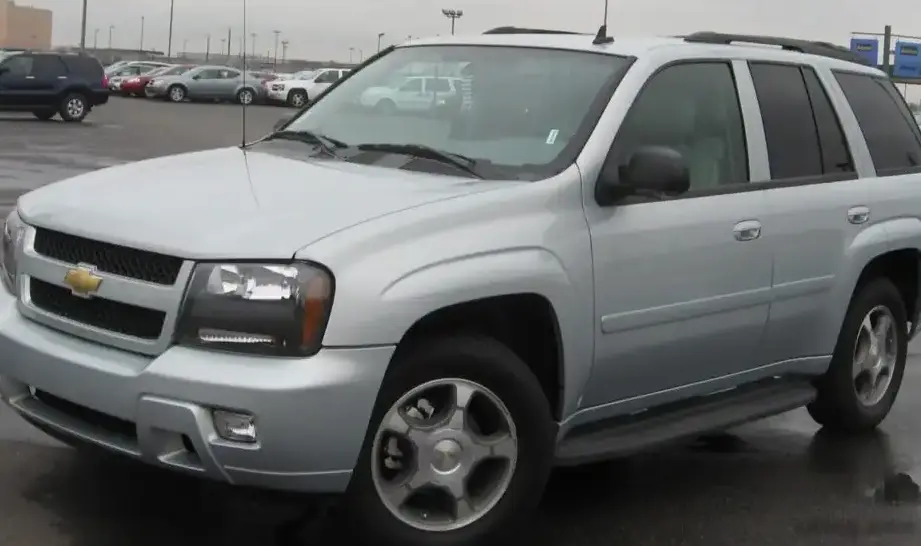
The Chevrolet Trailblazer I, specifically the 4.2i 24V AWD variant producing 273 horsepower, was a mid-size SUV manufactured by General Motors from 2006 to 2009. Positioned as a more premium offering within the Trailblazer lineup, it aimed to provide a blend of capability, space, and power for families and those needing a versatile vehicle. The Trailblazer itself was derived from the GMT360 platform, shared with the Buick Rainier, GMC Envoy, and Isuzu Ascender, representing GM’s attempt to consolidate its SUV offerings. This particular 4.2L engine and four-speed automatic transmission combination represented the top-tier engine option for the Trailblazer, offering a significant performance upgrade over the base 4.2L inline-six and the smaller V6 options.
Technical Specifications
| Brand | Chevrolet |
| Model | Trailblazer |
| Generation | Trailblazer I |
| Type (Engine) | 4.2 i 24V AWD (273 Hp) |
| Start of production | 2006 |
| End of production | 2009 |
| Powertrain Architecture | Internal Combustion engine |
| Body type | SUV |
| Seats | 5 |
| Doors | 5 |
| Fuel consumption (urban) | 17.9 l/100 km (13.1 US mpg) |
| Fuel consumption (extra urban) | 10.1 l/100 km (23.3 US mpg) |
| Fuel Type | Petrol (Gasoline) |
| Acceleration 0 – 100 km/h | 9 sec |
| Acceleration 0 – 62 mph | 9 sec |
| Acceleration 0 – 60 mph | 8.6 sec |
| Maximum speed | 192 km/h (119.3 mph) |
| Weight-to-power ratio | 7.7 kg/Hp |
| Weight-to-torque ratio | 5.6 kg/Nm |
| Power | 273 Hp @ 5750 rpm |
| Torque | 373 Nm @ 3500 rpm (275.11 lb.-ft. @ 3500 rpm) |
| Engine layout | Front, Longitudinal |
| Engine Model/Code | LL8 |
| Engine displacement | 4157 cm3 (253.68 cu. in.) |
| Number of cylinders | 6 |
| Engine configuration | Inline |
| Cylinder Bore | 93 mm (3.66 in.) |
| Piston Stroke | 102 mm (4.02 in.) |
| Compression ratio | 10:1 |
| Number of valves per cylinder | 4 |
| Fuel injection system | Multi-port manifold injection |
| Engine aspiration | Naturally aspirated engine |
| Engine oil capacity | 6.6 l (6.97 US qt | 5.81 UK qt) |
| Coolant capacity | 9.2 l (9.72 US qt | 8.09 UK qt) |
| Kerb Weight | 2095 kg (4618.68 lbs.) |
| Max. weight | 2608 kg (5749.66 lbs.) |
| Max load | 513 kg (1130.97 lbs.) |
| Trunk (boot) space – minimum | 1238 l (43.72 cu. ft.) |
| Trunk (boot) space – maximum | 2268 l (80.09 cu. ft.) |
| Fuel tank capacity | 84 l (22.19 US gal | 18.48 UK gal) |
| Length | 4890 mm (192.52 in.) |
| Width | 1897 mm (74.69 in.) |
| Height | 1842 mm (72.52 in.) |
| Wheelbase | 2870 mm (112.99 in.) |
| Front track | 1603 mm (63.11 in.) |
| Rear track | 1577 mm (62.09 in.) |
| Drive wheel | All wheel drive (4×4) |
| Number of gears | 4 |
| Gearbox type | automatic transmission |
| Front suspension | Torsion |
| Rear suspension | Coil spring |
| Front brakes | Disc |
| Rear brakes | Disc |
| Assisting systems | ABS (Anti-lock braking system) |
| Tires size | 255/60 R17 |
Powertrain & Engine Architecture
The heart of the Trailblazer 4.2i AWD was the LL8 4.2-liter inline-six engine. This engine was a descendant of GM’s long-running inline-six family, but significantly modernized with features like multi-port fuel injection and a dual overhead camshaft (DOHC) design with four valves per cylinder. The 4.2L engine produced 273 horsepower at 5750 rpm and 275 lb-ft of torque at 3500 rpm. The engine’s longitudinal mounting and all-wheel-drive system contributed to its robust character. The engine was paired with a four-speed automatic transmission (4L60-E), a common and generally reliable unit in GM vehicles of the era. While not the most advanced transmission available at the time, it was well-suited to the engine’s torque curve and provided smooth, if not particularly sporty, shifts.
Driving Characteristics
The 4.2L engine provided ample power for the Trailblazer, allowing for confident acceleration and towing capability. The 0-60 mph time of around 8.6 seconds was respectable for a mid-size SUV of its time. The automatic transmission, while smooth, wasn’t particularly quick to downshift, meaning that passing maneuvers required planning. Compared to the base 4.2L inline-six or the smaller V6 options, the 4.2i AWD offered a noticeable performance advantage. However, it wasn’t as fuel-efficient, and the added weight of the AWD system and larger engine slightly diminished its off-road agility compared to lighter, two-wheel-drive models. The gear ratios were optimized for cruising and towing, rather than outright performance.
Equipment & Trim Levels
The Trailblazer 4.2i AWD typically came well-equipped, often featuring leather upholstery, heated front seats, a premium sound system, and automatic climate control. Standard features also included power windows, locks, and mirrors, as well as keyless entry. Optional extras included a sunroof, rear-seat entertainment system, and upgraded alloy wheels. The trim level often dictated the level of interior finish and the availability of certain features. The 4.2i AWD was generally positioned as a higher-end trim, often bundled with luxury packages.
Chassis & Braking
The Trailblazer I utilized a body-on-frame construction, providing a robust and durable chassis. The front suspension employed a torsion bar setup, while the rear featured coil springs. This configuration offered a comfortable ride, but wasn’t particularly sporty in handling. All-wheel drive was standard on the 4.2i AWD model, providing enhanced traction in various weather conditions. Braking duties were handled by disc brakes on all four wheels, assisted by an anti-lock braking system (ABS). The braking system was adequate for the vehicle’s weight and performance, but lacked the sophistication of more modern braking technologies.
Market Reception & Comparison
The Trailblazer 4.2i AWD was generally well-received by critics, who praised its spacious interior, comfortable ride, and powerful engine. However, some reviewers noted its relatively poor fuel economy and somewhat dated interior design. Compared to competitors like the Ford Explorer and Jeep Grand Cherokee, the Trailblazer offered a competitive level of features and performance, but often at a slightly lower price point. The 4.2i AWD variant was seen as a good value for those needing a capable and spacious SUV with strong towing capacity.
Legacy
The Chevrolet Trailblazer I, particularly the 4.2i AWD variant, has developed a reputation for being a relatively reliable vehicle, although like any vehicle of its age, it’s prone to certain issues. Common concerns include potential problems with the fuel injectors, cooling system, and the four-speed automatic transmission. However, parts availability is generally good, and the engine is known to be durable when properly maintained. In the used car market, the 4.2i AWD Trailblazer remains a popular choice for those seeking a capable and affordable SUV with a powerful engine. Its robust construction and relatively simple mechanicals make it a good option for those comfortable with basic maintenance and repairs.
