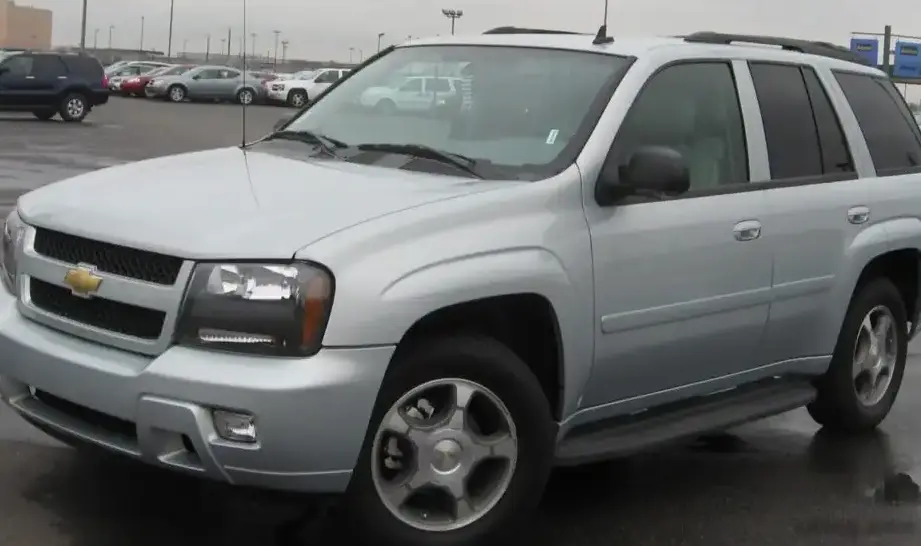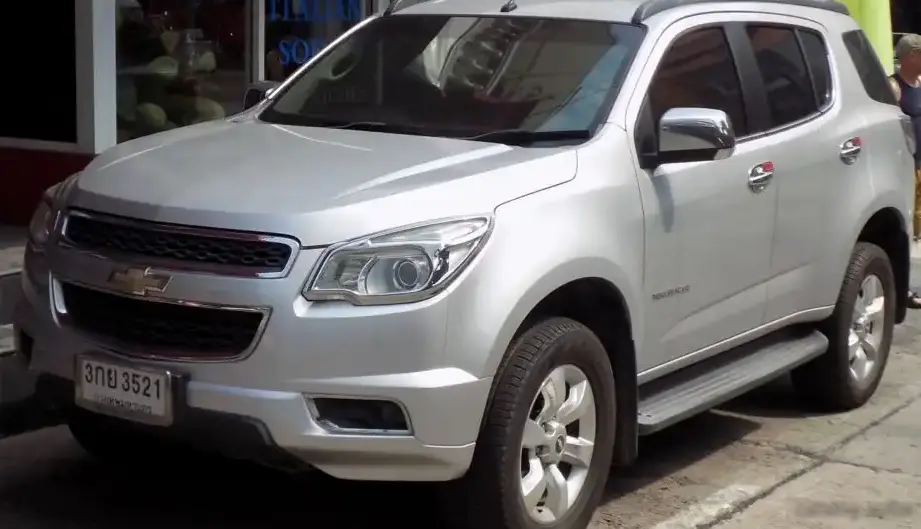
The Chevrolet Trailblazer II, specifically the 3.6-liter V6 4WD Automatic variant, represents a significant entry in Chevrolet’s mid-size SUV offerings. Produced from 2012 to 2016, this generation Trailblazer was primarily aimed at the North American and South American markets, offering a body-on-frame construction and a focus on towing capacity and interior space. This particular configuration, with its 236 horsepower V6 and automatic transmission, occupied a mid-range position within the Trailblazer lineup, balancing performance with affordability and practicality.
Technical Specifications
| Brand | Chevrolet |
| Model | Trailblazer |
| Generation | Trailblazer II |
| Type (Engine) | 3.6 V6 (236 Hp) 4WD Automatic |
| Start of production | 2012 |
| End of production | 2016 |
| Powertrain Architecture | Internal Combustion engine |
| Body type | SUV |
| Seats | 7 |
| Doors | 5 |
| Fuel consumption (combined) | 12.2 l/100 km (19.3 US mpg, 23.2 UK mpg, 8.2 km/l) |
| Fuel Type | Petrol (Gasoline) |
| Weight-to-power ratio | 8.6 kg/Hp, 116 Hp/tonne |
| Weight-to-torque ratio | 6.2 kg/Nm, 161.7 Nm/tonne |
| Power | 236 Hp @ 6500 rpm |
| Power per litre | 66.2 Hp/l |
| Torque | 329 Nm @ 2800 rpm (242.66 lb.-ft. @ 2800 rpm) |
| Engine layout | Front, Longitudinal |
| Engine Model/Code | LFX |
| Engine displacement | 3564 cm3 (217.49 cu. in.) |
| Number of cylinders | 6 |
| Engine configuration | V-engine |
| Compression ratio | 10.2:1 |
| Number of valves per cylinder | 4 |
| Fuel injection system | Multi-port manifold injection |
| Engine aspiration | Naturally aspirated engine |
| Valvetrain | DOHC, VVT |
| Kerb Weight | 2035 kg (4486.41 lbs.) |
| Trunk (boot) space – minimum | 235 l (8.3 cu. ft.) |
| Trunk (boot) space – maximum | 1830 l (64.63 cu. ft.) |
| Fuel tank capacity | 76 l (20.08 US gal | 16.72 UK gal) |
| Permitted trailer load with brakes (12%) | 2500 kg (5511.56 lbs.) |
| Length | 4878 mm (192.05 in.) |
| Width | 1902 mm (74.88 in.) |
| Width including mirrors | 2132 mm (83.94 in.) |
| Height | 1848 mm (72.76 in.) |
| Wheelbase | 2845 mm (112.01 in.) |
| Front track | 1570 mm (61.81 in.) |
| Rear (Back) track | 1588 mm (62.52 in.) |
| Front overhang | 948 mm (37.32 in.) |
| Rear overhang | 1085 mm (42.72 in.) |
| Ride height (ground clearance) | 220-232 mm (8.66 – 9.13 in.) |
| Approach angle | 31-32° |
| Departure angle | 22° |
| Ramp-over (brakeover) angle | 22° |
| Drivetrain Architecture | The Internal combustion engine (ICE) drives the rear wheels permanently, and the front wheels are driven through an electrically or mechanically operated clutch if necessary. |
| Drive wheel | All wheel drive (4×4) |
| Number of gears and type of gearbox | 6 gears, automatic transmission |
| Front suspension | Double wishbone |
| Rear suspension | Independent multi-link suspension |
| Front brakes | Ventilated discs |
| Rear brakes | Disc |
| Assisting systems | ABS (Anti-lock braking system) |
| Steering type | Steering rack and pinion |
| Power steering | Hydraulic Steering |
| Tires size | 245/70 R16; 265/60 R18 |
| Wheel rims size | 6.5J x 16; 7.5J x 18 |
INTRODUCTION
The Chevrolet Trailblazer II, launched in 2012, represented a return to the body-on-frame SUV formula for Chevrolet in many markets. Built on the GM 700 platform (also used for the GMC Acadia and Buick Enclave), the Trailblazer aimed to provide a robust and spacious vehicle capable of handling both family duties and moderate off-road conditions. The 3.6L V6 4WD Automatic variant was a popular choice, offering a balance between power, fuel efficiency, and all-weather capability. It slotted in between the base 2.5L four-cylinder models and the more powerful 3.6L V6 with two-wheel drive, appealing to buyers who needed the added traction of four-wheel drive without the higher price tag of premium trims.
Powertrain & Engine Architecture
At the heart of this Trailblazer variant lies the LFX 3.6-liter V6 engine. This engine is a naturally aspirated, 60-degree V6 featuring a cast iron block and aluminum cylinder heads. It utilizes multi-port fuel injection and a double overhead camshaft (DOHC) valvetrain with variable valve timing (VVT) on both intake and exhaust valves. This VVT system optimizes engine performance and efficiency across a wider range of engine speeds. The engine produces 236 horsepower at 6500 rpm and 242.66 lb.-ft. of torque at 2800 rpm. The engine’s longitudinal mounting allows for a rear-wheel-drive bias, with the four-wheel-drive system engaging the front wheels as needed. The transmission is a six-speed automatic, known for its smooth shifting and responsiveness. This transmission is electronically controlled and features a tow/haul mode for improved performance when towing trailers or hauling heavy loads.
Driving Characteristics
The 3.6L V6 Automatic Trailblazer delivers adequate performance for everyday driving. While not a sports SUV, it provides sufficient power for merging onto highways and passing other vehicles. The automatic transmission is well-tuned, offering smooth gear changes and a reasonable level of responsiveness. The 4WD system provides enhanced traction in slippery conditions, making it a capable vehicle for inclement weather or light off-road adventures. Compared to the base 2.5L engine, the 3.6L offers a noticeable improvement in acceleration and overall power. However, it doesn’t match the more spirited performance of some competitors with larger displacement engines. The gear ratios are optimized for both fuel economy and towing capability, resulting in a comfortable and predictable driving experience.
Equipment & Trim Levels
The 3.6L V6 4WD Automatic Trailblazer typically came standard with features such as air conditioning, power windows and locks, a basic audio system, and cloth upholstery. Higher trim levels, such as the LT and LTZ, added features like leather upholstery, a premium audio system, a touchscreen infotainment system, and additional safety features. Optional extras included a sunroof, rear-seat entertainment system, and a navigation system. The interior design was functional and spacious, with seating for up to seven passengers. The second-row seats could be folded flat to create more cargo space, and the third-row seats were suitable for occasional use.
Chassis & Braking
The Trailblazer II utilizes a body-on-frame construction, providing a robust and durable chassis. The front suspension features an independent double wishbone design, while the rear suspension employs an independent multi-link setup. This suspension configuration provides a comfortable ride quality, even on rough roads. The braking system consists of ventilated discs at the front and solid discs at the rear. Anti-lock brakes (ABS) are standard, enhancing safety and control during emergency braking situations. The steering is rack-and-pinion with hydraulic power assist, providing a responsive and precise steering feel.
Market Reception & Comparison
The Chevrolet Trailblazer II, and specifically the 3.6L V6 4WD Automatic variant, received generally positive reviews from automotive critics. It was praised for its spacious interior, comfortable ride, and capable four-wheel-drive system. However, some critics noted that its fuel economy was not class-leading and that its interior materials were not as refined as some competitors. Compared to other SUVs in its class, such as the Ford Explorer and Honda Pilot, the Trailblazer offered a more affordable price point and a greater emphasis on towing capability. The 3.6L V6 provided a good balance of power and efficiency, making it a practical choice for families and those who needed to tow trailers.
Legacy
The Chevrolet Trailblazer II, including the 3.6L V6 4WD Automatic model, has proven to be a relatively reliable vehicle in the used car market. The LFX 3.6L V6 engine is known for its durability and longevity, and the six-speed automatic transmission is generally trouble-free. Common maintenance items include regular oil changes, fluid flushes, and brake pad replacements. While some owners have reported minor issues with the infotainment system, these are typically easily resolved. Today, the Trailblazer II remains a popular choice for buyers seeking a spacious, capable, and affordable SUV. Its body-on-frame construction and robust powertrain make it a durable and dependable vehicle for years to come.