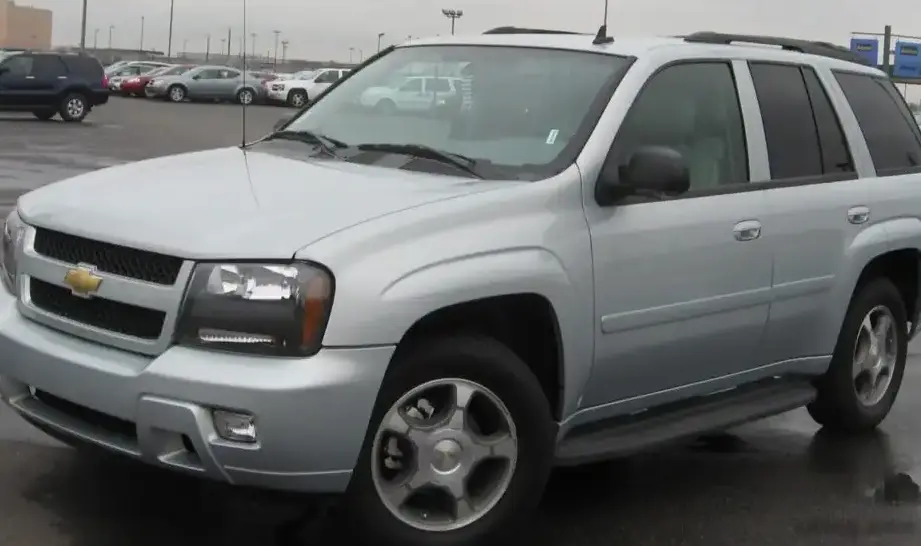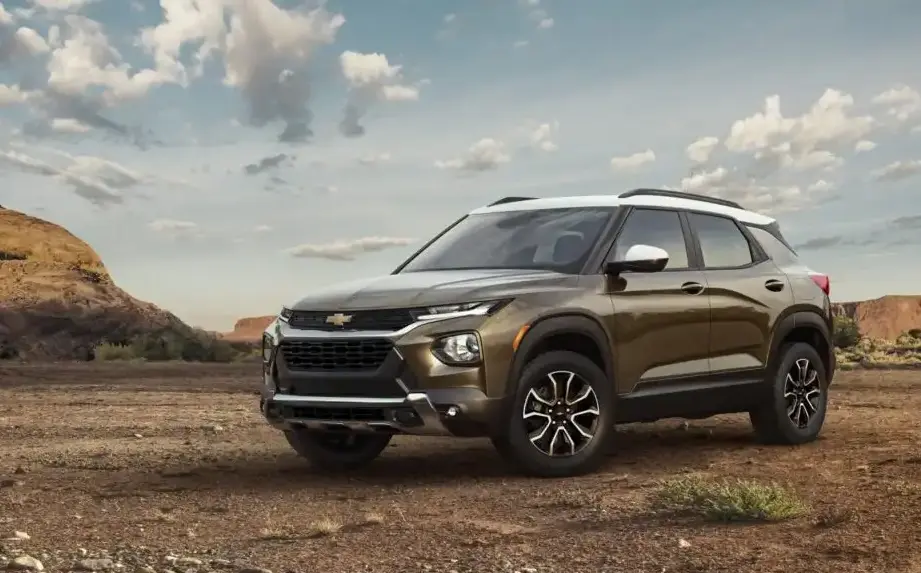
The Chevrolet Trailblazer III, launched in March 2020 and produced through February 2023, represents a significant shift for the Trailblazer nameplate, moving to a smaller, more fuel-efficient crossover SUV format. This generation, built on the GM VSS-F platform, primarily targeted the North American market, offering a more accessible entry point into the Chevrolet SUV lineup. The 1.3 ECOTEC Turbo (155 hp) paired with a Continuously Variable Transmission (CVT) served as a key volume trim, positioned as the base engine option for buyers prioritizing fuel economy and affordability. This variant aimed to compete with similarly sized crossovers from Honda, Toyota, and Mazda.
Technical Specifications
| Brand | Chevrolet |
| Model | Trailblazer |
| Generation | Trailblazer III |
| Type (Engine) | 1.3 ECOTEC Turbo (155 Hp) CVT |
| Start of production | March, 2020 |
| End of production | February, 2023 |
| Powertrain Architecture | Internal Combustion engine |
| Body type | SUV |
| Seats | 5 |
| Doors | 5 |
| Fuel consumption (urban) | 8.1 l/100 km (29 US mpg) |
| Fuel consumption (extra urban) | 7.1 l/100 km (33.1 US mpg) |
| Fuel consumption (combined) | 7.6 l/100 km (30.9 US mpg) |
| Fuel Type | Petrol (Gasoline) |
| Weight-to-power ratio | 9 kg/Hp |
| Weight-to-torque ratio | 5.9 kg/Nm |
| Power | 155 Hp @ 5600 rpm |
| Torque | 236 Nm @ 1600 rpm (174.06 lb.-ft. @ 1600 rpm) |
| Engine layout | Front, Transverse |
| Engine Model/Code | L3T |
| Number of cylinders | 3 |
| Engine configuration | Inline |
| Cylinder Bore | 79 mm (3.11 in.) |
| Piston Stroke | 91 mm (3.58 in.) |
| Fuel injection system | Direct injection |
| Engine aspiration | Turbocharger, Intercooler |
| Valvetrain | DOHC, VVT |
| Engine oil capacity | 4.5 l (4.76 US qt | 3.96 UK qt) |
| Coolant capacity | 7.4 l (7.82 US qt | 6.51 UK qt) |
| Kerb Weight | 1391 kg (3066.63 lbs.) |
| Trunk (boot) space – minimum | 716 l (25.29 cu. ft.) |
| Trunk (boot) space – maximum | 1540 l (54.38 cu. ft.) |
| Fuel tank capacity | 50 l (13.21 US gal | 11 UK gal) |
| Permitted trailer load with brakes (12%) | 495 kg (1091.29 lbs.) |
| Length | 4408 mm (173.54 in.) |
| Width | 1808 mm (71.18 in.) |
| Height | 1646-1656 mm (64.8 – 65.2 in.) |
| Wheelbase | 2640 mm (103.94 in.) |
| Front track | 1546-1554 mm (60.87 – 61.18 in.) |
| Rear track | 1557-1562 mm (61.3 – 61.5 in.) |
| Ride height (ground clearance) | 191 mm (7.52 in.) |
| Minimum turning circle | 11.39 m (37.37 ft.) |
| Drivetrain Architecture | Front wheel drive |
| Number of gears and type of gearbox | automatic transmission CVT |
| Front suspension | Independent type McPherson |
| Rear suspension | Torsion |
| Front brakes | Disc |
| Rear brakes | Disc |
| Tires size | 215/65 R16; 225/60 R17; 225/55 R18 |
| Wheel rims size | 7J x 16; 7.5J x 17; 7.5J x 18 |
Powertrain & Engine Architecture
The heart of this Trailblazer variant is the L3T 1.3-liter turbocharged inline-three cylinder engine. This engine is part of GM’s Small Engine Family (SEF), designed for efficiency and reduced friction. It utilizes direct fuel injection and a variable valve timing (VVT) system to optimize combustion. The turbocharger, coupled with an intercooler, helps to boost power output despite the small displacement. The engine produces 155 horsepower at 5600 rpm and 236 Nm (174 lb-ft) of torque at a low 1600 rpm, prioritizing low-end responsiveness. The engine is paired exclusively with a Continuously Variable Transmission (CVT), which is tuned for smooth operation and fuel efficiency rather than sporty acceleration. This CVT lacks discrete gear steps, providing a seamless power delivery.
Driving Characteristics
The 1.3L Turbo/CVT combination delivers adequate performance for everyday driving. Acceleration is not particularly brisk, with a 0-60 mph time estimated around 9-10 seconds. The CVT contributes to a smooth, linear power delivery, but can sometimes feel disconnected and exhibit “rubber band” effect during hard acceleration. Compared to the optional 1.5L turbo engine, the 1.3L feels noticeably less powerful, especially when fully loaded or tackling steep inclines. The CVT’s programming prioritizes fuel economy, resulting in a more relaxed driving experience. The gear ratios are optimized for efficient cruising, but may require more aggressive throttle input for quick overtaking maneuvers. The front-wheel-drive configuration provides predictable handling, but lacks the all-weather capability of available all-wheel-drive models.
Equipment & Trim Levels
The 1.3L Turbo CVT Trailblazer typically came standard with features like Chevrolet’s Infotainment 3 system with a 7-inch touchscreen, Apple CarPlay and Android Auto compatibility, and a rearview camera. Safety features included automatic emergency braking and lane keep assist. Interior upholstery was typically cloth, with options for upgraded materials on higher trims. Available options included a larger 8-inch touchscreen, a power driver’s seat, heated front seats, and a panoramic sunroof. Trim levels varied slightly depending on the model year, but generally included LS, LT, and ACTIV. The LS trim was the most basic, while the ACTIV trim offered a more rugged appearance and some off-road-inspired features.
Chassis & Braking
The Trailblazer III utilizes a McPherson strut front suspension and a torsion beam rear suspension. This setup provides a comfortable ride quality, suitable for everyday commuting. The torsion beam rear suspension is a cost-effective solution that prioritizes space efficiency over sophisticated handling. Braking duties are handled by disc brakes on all four wheels, providing adequate stopping power. Anti-lock Braking System (ABS) is standard. Steering is provided by an electric power steering system, offering light and easy steering feel. The suspension tuning is geared towards comfort rather than sporty handling, resulting in noticeable body roll during cornering.
Market Reception & Comparison
Critics generally praised the Trailblazer III for its stylish design, spacious interior, and fuel efficiency. However, the 1.3L Turbo/CVT combination received mixed reviews. Some reviewers found the engine adequate for city driving, while others criticized its lack of power, especially on the highway. The CVT was also a point of contention, with some finding it smooth and efficient, while others disliked its lack of responsiveness. Compared to the 1.5L turbo engine, the 1.3L offered better fuel economy but significantly less performance. The 1.3L variant was positioned as the entry-level option, appealing to budget-conscious buyers who prioritized fuel efficiency over outright performance.
Legacy
The 1.3 ECOTEC Turbo/CVT powertrain has proven to be relatively reliable in the Trailblazer III. While some owners have reported minor issues with the CVT, such as occasional hesitation or shuddering, major failures have been infrequent. The engine itself is generally considered durable, with proper maintenance. On the used car market, the 1.3L Trailblazer represents a good value proposition for buyers seeking an affordable and fuel-efficient crossover SUV. However, potential buyers should be aware of the engine’s limited power output and the CVT’s potential for minor issues. The Trailblazer III, and specifically this variant, helped Chevrolet gain market share in the competitive subcompact SUV segment, offering a compelling combination of style, features, and affordability.