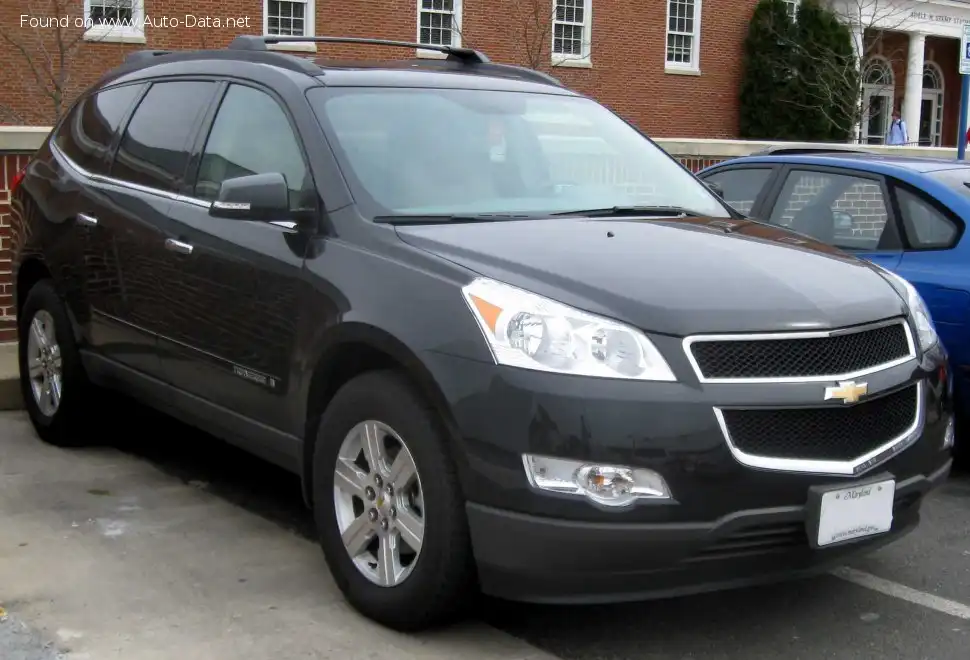
The Chevrolet Traverse, introduced for the 2009 model year, represented Chevrolet’s entry into the burgeoning full-size crossover SUV segment. The first generation Traverse (2009-2017) was notable for its spacious interior, capable of seating up to eight passengers, and its focus on family-oriented practicality. The 2012 facelift brought revised styling, enhanced interior materials, and importantly, continued refinement of the 3.6-liter V6 engine. This article focuses specifically on the 2012-2017 Chevrolet Traverse equipped with the 3.6L V6 engine producing 288 horsepower, paired with the six-speed Hydra-Matic automatic transmission. This configuration was a mainstay of the Traverse lineup, representing a balance between performance, fuel economy, and affordability within the broader range of available trims.
Technical Specifications
| Brand | Chevrolet |
| Model | Traverse |
| Generation | Traverse I (facelift 2012) |
| Type (Engine) | 3.6 V6 (288 Hp) Automatic |
| Start of production | 2012 |
| End of production | 2017 |
| Powertrain Architecture | Internal Combustion engine |
| Body type | SUV, Crossover |
| Seats | 7-8 |
| Doors | 5 |
| Fuel consumption (urban) | 13.8 l/100 km (17 US mpg, 20.5 UK mpg, 7.2 km/l) |
| Fuel consumption (combined) | 9.8 l/100 km (24 US mpg, 28.8 UK mpg, 10.2 km/l) |
| Fuel Type | Petrol (Gasoline) |
| Weight-to-power ratio | 7.4 kg/Hp, 134.7 Hp/tonne |
| Weight-to-torque ratio | 5.8 kg/Nm, 171.2 Nm/tonne |
| Power | 288 Hp @ 6300 rpm |
| Power per litre | 80.8 Hp/l |
| Torque | 366 Nm @ 3400 rpm (269.95 lb.-ft. @ 3400 rpm) |
| Maximum engine speed | 6700 rpm |
| Engine layout | Front, Transverse |
| Engine Model/Code | LLT |
| Engine displacement | 3564 cm3 (217.49 cu. in.) |
| Number of cylinders | 6 |
| Engine configuration | V-engine |
| Cylinder Bore | 94 mm (3.7 in.) |
| Piston Stroke | 85.6 mm (3.37 in.) |
| Compression ratio | 11.3:1 |
| Number of valves per cylinder | 4 |
| Fuel injection system | Direct injection |
| Engine aspiration | Naturally aspirated engine |
| Valvetrain | DOHC |
| Engine oil capacity | 5.7 l (6.02 US qt | 5.02 UK qt) |
| Coolant capacity | 11.3 l (11.94 US qt | 9.94 UK qt) |
| Kerb Weight | 2138 kg (4713.48 lbs.) |
| Max. weight | 2908 kg (6411.04 lbs.) |
| Max load | 770 kg (1697.56 lbs.) |
| Trunk (boot) space – minimum | 691 l (24.4 cu. ft.) |
| Trunk (boot) space – maximum | 3293 l (116.29 cu. ft.) |
| Fuel tank capacity | 83.3 l (22.01 US gal | 18.32 UK gal) |
| Permitted trailer load with brakes (12%) | 2358 kg (5198.5 lbs.) |
| Length | 5173 mm (203.66 in.) |
| Width including mirrors | 1993 mm (78.46 in.) |
| Height | 1792 mm (70.55 in.) |
| Wheelbase | 3021 mm (118.94 in.) |
| Front track | 1709 mm (67.28 in.) |
| Rear (Back) track | 1704 mm (67.09 in.) |
| Ride height (ground clearance) | 183 mm (7.2 in.) |
| Minimum turning circle (turning diameter) | 12.3 m (40.35 ft.) |
| Drivetrain Architecture | Front wheel drive |
| Number of gears and type of gearbox | 6 gears, automatic transmission Hydra-Matic T75 |
| Front suspension | Independent, type McPherson with coil spring and anti-roll bar |
| Rear suspension | Independent multi-link suspension |
| Front brakes | Ventilated discs, 325 mm |
| Rear brakes | Ventilated discs, 331 mm |
| Assisting systems | ABS (Anti-lock braking system) |
| Steering type | Steering rack and pinion |
| Power steering | Hydraulic Steering |
| Tires size | 245/70 R17; 255/65 R18; 255/55 R20 |
| Wheel rims size | 7J x 17; 7.5J x 18; 8J x 20 |
INTRODUCTION
The 2012-2017 Chevrolet Traverse, particularly when equipped with the 3.6-liter V6 and six-speed automatic transmission, was positioned as the mainstream offering within the Traverse lineup. It wasn’t the base model, nor was it the fully-loaded luxury trim. Instead, it represented a sweet spot for families needing three-row seating and ample cargo space without the premium price tag of the higher trims. Built on the GM Lambda platform (shared with the Buick Enclave and GMC Acadia), the Traverse aimed to provide a comfortable and practical driving experience. The facelifted model addressed some of the criticisms leveled at the original 2009-2011 models, improving interior quality and refining the overall driving experience.
Powertrain & Engine Architecture
At the heart of this Traverse variant lies the GM LLT 3.6-liter V6 engine. This engine is a naturally aspirated, 60-degree V6 featuring direct fuel injection and a double overhead camshaft (DOHC) valvetrain with four valves per cylinder. The direct injection system, a key feature, allows for precise fuel delivery, improving both power and fuel efficiency. The LLT engine produces 288 horsepower at 6300 rpm and 260 lb-ft of torque at 3400 rpm. The six-speed Hydra-Matic 6T75 automatic transmission was the sole transmission option for this engine. This transmission is known for its smooth shifting and relatively quick response. Gear ratios are tuned for a balance of acceleration and fuel economy, with a final drive ratio typically around 3.06. The engine’s transverse mounting configuration contributes to efficient packaging within the front-wheel-drive chassis.
Driving Characteristics
The 3.6-liter V6 and six-speed automatic combination in the Traverse delivers adequate, though not exhilarating, performance. Acceleration from 0 to 60 mph typically takes around 7.5-8.5 seconds. While not a sports car, the engine provides sufficient power for merging onto highways and passing other vehicles. The automatic transmission generally shifts smoothly, although some drivers have noted occasional hesitation during downshifts. Compared to the base 2.8-liter four-cylinder engine (available in earlier Traverse models), the 3.6L offers a significant improvement in power and responsiveness. It also feels more refined than the later addition of a 2.4L turbo four cylinder. The six-speed automatic, while competent, doesn’t offer the same level of control or fuel efficiency as more modern eight or nine-speed transmissions. The Traverse’s substantial weight (over 4700 lbs) is noticeable, particularly when fully loaded with passengers and cargo.
Equipment & Trim Levels
The 2012-2017 Chevrolet Traverse 3.6L Automatic was available in several trim levels, including LS, LT, and Premier. The LS trim typically included standard features such as cloth upholstery, a basic audio system, and manual climate control. The LT trim, which was a popular choice, added features like power windows and locks, keyless entry, and an upgraded audio system. Optional extras available across the trims included leather upholstery, a navigation system, a rear-seat entertainment system, and a sunroof. The Premier trim offered the most luxurious features, such as heated front seats, a premium audio system, and advanced safety features.
Chassis & Braking
The Chevrolet Traverse utilizes an independent suspension system both front and rear. The front suspension employs a McPherson strut design with coil springs and an anti-roll bar, while the rear suspension features a multi-link setup. This suspension configuration provides a comfortable ride, absorbing bumps and irregularities in the road surface effectively. Braking duties are handled by ventilated disc brakes on all four wheels. The front brakes measure 325mm in diameter, while the rear brakes are slightly larger at 331mm. Anti-lock braking system (ABS) is standard. Steering is rack-and-pinion with hydraulic power assist, providing a reasonably responsive feel.
Market Reception & Comparison
The 2012-2017 Chevrolet Traverse was generally well-received by critics and consumers alike. It was praised for its spacious interior, comfortable ride, and competitive price. However, some reviewers noted that the interior materials weren’t as upscale as those found in some competing models. Fuel economy was also a point of criticism, as the Traverse’s large size and weight resulted in relatively low MPG figures compared to smaller crossovers. Compared to the Buick Enclave and GMC Acadia, which share the same platform, the Traverse was often seen as the more value-oriented option. The Traverse offered similar space and practicality at a lower price point.
Legacy
The Chevrolet Traverse 3.6L V6 automatic powertrain has proven to be relatively reliable over the long term. The LLT engine is known for its durability, and the 6T75 transmission, while not without its occasional issues, is generally considered to be a robust unit. Common maintenance items include regular oil changes, spark plug replacements, and transmission fluid flushes. In the used car market, these Traverses represent a good value for families needing a spacious and practical SUV. While they may not be the most fuel-efficient or technologically advanced vehicles, they offer a comfortable ride, ample space, and a proven track record of reliability. The first-generation Traverse laid the groundwork for the significantly redesigned second-generation model, which addressed many of the criticisms leveled at the original.