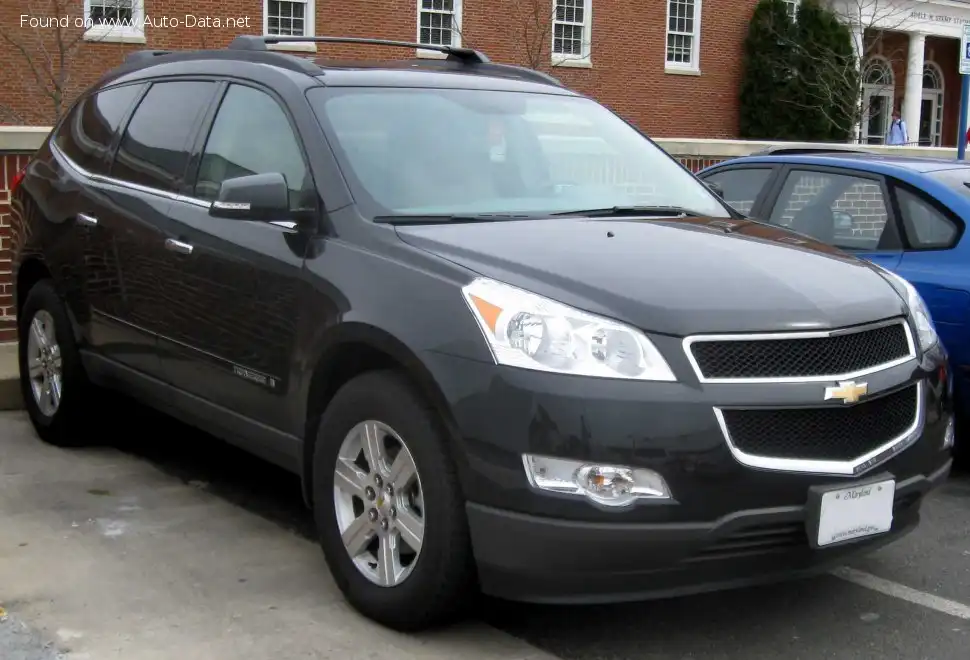
The Chevrolet Traverse II 2.0L (258 hp) Automatic, produced from 2018 to 2019, represents a significant iteration of Chevrolet’s full-size crossover SUV. Positioned as a mid-range offering within the second-generation Traverse (introduced for the 2018 model year), this variant aimed to balance fuel efficiency with respectable power for a vehicle of its size. It slotted between the base 3.6L V6 engine and the higher-output versions of that same engine, offering a turbocharged four-cylinder alternative. The Traverse II, built on the C1 platform shared with the Buick Enclave and GMC Acadia, was designed to address the growing demand for three-row SUVs in the North American market, prioritizing interior space and family-friendly features.
Technical Specifications
| Brand | Chevrolet |
| Model | Traverse |
| Generation | Traverse II |
| Type (Engine) | 2.0 (258 Hp) Automatic |
| Start of production | 2018 |
| End of production | 2019 |
| Powertrain Architecture | Internal Combustion engine |
| Body type | SUV, Crossover |
| Seats | 7-8 |
| Doors | 5 |
| Fuel consumption (urban) | 11.8 l/100 km (19.9 US mpg) |
| Fuel consumption (extra urban) | 9.4 l/100 km (25 US mpg) |
| Fuel Type | Petrol (Gasoline) |
| Weight-to-power ratio | 7.7 kg/Hp |
| Weight-to-torque ratio | 4.9 kg/Nm |
| Power | 258 Hp @ 5500 rpm |
| Power per litre | 129.1 Hp/l |
| Torque | 400 Nm @ 3000 rpm (295.02 lb.-ft. @ 3000 rpm) |
| Engine layout | Front, Longitudinal |
| Engine Model/Code | LTG |
| Engine displacement | 1998 cm3 (121.93 cu. in.) |
| Number of cylinders | 4 |
| Engine configuration | Inline |
| Cylinder Bore | 86 mm (3.39 in.) |
| Piston Stroke | 86 mm (3.39 in.) |
| Compression ratio | 9.5:1 |
| Number of valves per cylinder | 4 |
| Fuel injection system | Direct injection |
| Engine aspiration | Turbocharger, Intercooler |
| Valvetrain | DOHC-CVVT |
| Engine oil capacity | 4.7 l (4.97 US qt | 4.14 UK qt) |
| Coolant | 11.1 l (11.73 US qt | 9.77 UK qt) |
| Kerb Weight | 1978 kg (4360.74 lbs.) |
| Trunk (boot) space – minimum | 651 l (22.99 cu. ft.) |
| Trunk (boot) space – maximum | 2781 l (98.21 cu. ft.) |
| Fuel tank capacity | 73 l (19.28 US gal | 16.06 UK gal) |
| Permitted trailer load with brakes (12%) | 2268 kg (5000.08 lbs.) |
| Length | 5189 mm (204.29 in.) |
| Width | 1996 mm (78.58 in.) |
| Height | 1795 mm (70.67 in.) |
| Wheelbase | 3071 mm (120.91 in.) |
| Front track | 1709 mm (67.28 in.) |
| Rear (Back) track | 1702 mm (67.01 in.) |
| Minimum turning circle | 11.9 m (39.04 ft.) |
| Drivetrain Architecture | Front wheel drive |
| Number of gears and type of gearbox | 9 gears, automatic transmission Hydra-Matic |
| Front suspension | Independent, type McPherson with coil spring and anti-roll bar |
| Rear suspension | Independent multi-link spring suspension with stabilizer |
| Front brakes | Ventilated discs |
| Rear brakes | Ventilated discs |
| Assisting systems | ABS (Anti-lock braking system) |
| Steering type | Steering rack and pinion |
| Power steering | Electric Steering |
| Tires size | 225/65 R18; 255/55 R20 |
| Wheel rims size | 18; 20 |
Powertrain & Engine Architecture
The heart of the Traverse II 2.0L is the LTG engine, a 1.998-liter turbocharged inline-four cylinder. This engine utilizes direct injection and a sophisticated Dual Overhead Camshaft (DOHC) variable valve timing (CVVT) system to optimize both power and efficiency. The turbocharger, coupled with an intercooler, provides a significant boost in power output compared to naturally aspirated engines of similar displacement. The engine’s architecture is longitudinally mounted in the front of the vehicle, driving the front wheels. The 9-speed Hydra-Matic automatic transmission, a General Motors design, was specifically chosen for its wide gear ratio spread, contributing to both improved acceleration and highway fuel economy. This transmission features electronically controlled shifts and adaptive learning capabilities.
Driving Characteristics
The 258 horsepower and 295 lb-ft of torque delivered by the 2.0L engine provide adequate, though not exhilarating, performance for the Traverse II. Acceleration from 0 to 60 mph typically takes around 7.5-8.5 seconds, depending on load and road conditions. The 9-speed automatic transmission generally shifts smoothly, but some drivers have noted occasional hesitation or hunting for the right gear, particularly during moderate acceleration. Compared to the 3.6L V6 models, the 2.0L offers a more refined driving experience with less engine noise, but it lacks the V6’s outright power. The front-wheel-drive configuration provides decent traction in most conditions, but all-wheel drive was available as an option for improved stability and capability in inclement weather.
Equipment & Trim Levels
The 2.0L engine was typically offered on the LS, LT Cloth, and LT Leather trim levels of the Traverse II. Standard features included Chevrolet’s MyLink infotainment system with a 7-inch touchscreen, Apple CarPlay and Android Auto compatibility, a rearview camera, and keyless entry. Higher trim levels added features such as leather upholstery, heated front seats, a power liftgate, and advanced safety technologies like blind-spot monitoring and rear cross-traffic alert. Optional extras included a larger touchscreen display, a premium audio system, and a panoramic sunroof.
Chassis & Braking
The Traverse II utilizes an independent suspension system at all four wheels. The front suspension employs a McPherson strut design with coil springs and an anti-roll bar, while the rear features a multi-link setup with a stabilizer bar. This configuration provides a comfortable ride quality, although it can feel somewhat soft and body roll is noticeable during aggressive cornering. All four wheels are equipped with ventilated disc brakes, providing adequate stopping power for a vehicle of this size and weight. Anti-lock braking system (ABS) is standard, enhancing safety and control during emergency braking situations.
Market Reception & Comparison
The 2.0L turbocharged engine was generally well-received by critics as a viable alternative to the V6, particularly for buyers prioritizing fuel economy. However, some reviewers noted that the engine could feel strained when fully loaded or when towing. Fuel economy ratings were approximately 19 mpg city and 25 mpg highway, representing a modest improvement over the V6 models. Compared to the 3.6L V6, the 2.0L offered a lower price point and better fuel efficiency, but at the expense of some performance. The 2.0L appealed to families seeking a spacious and comfortable SUV with reasonable running costs.
Legacy
The LTG 2.0L engine has proven to be a relatively reliable powertrain, although some owners have reported issues with the timing chain and oil consumption. The 9-speed automatic transmission has also been subject to some complaints regarding software glitches and rough shifting. On the used car market, the Traverse II 2.0L represents a good value proposition, offering a spacious interior, a comfortable ride, and decent fuel economy at a competitive price. Regular maintenance, including oil changes and transmission fluid services, is crucial to ensure the long-term reliability of this powertrain.