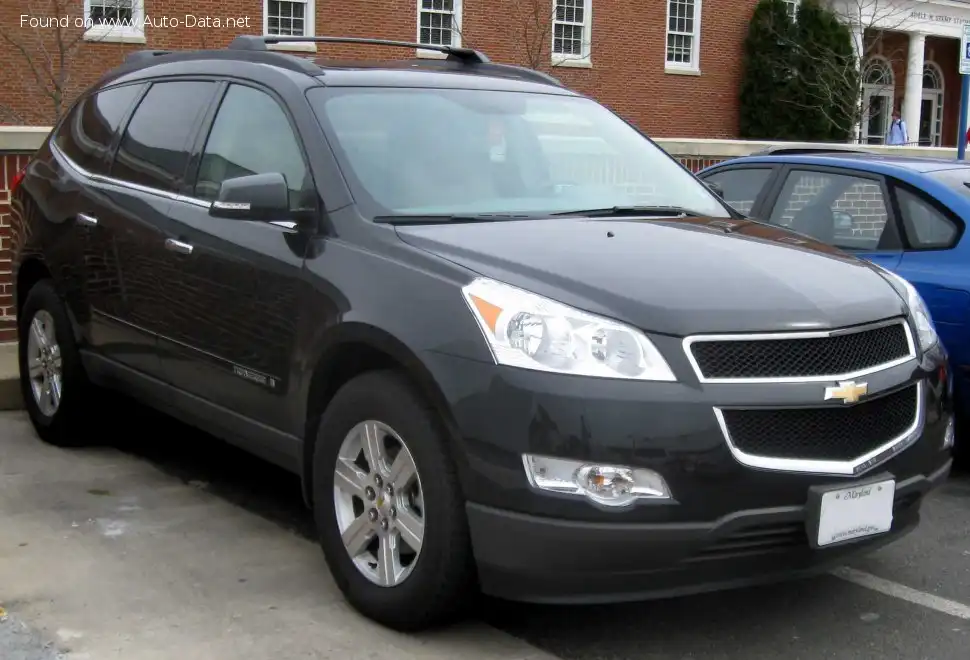
The Chevrolet Traverse II, specifically the 3.6-liter V6 variant producing 314 horsepower and paired with a 9-speed automatic transmission, represents a significant evolution in Chevrolet’s full-size crossover SUV offerings. Introduced for the 2018 model year and continuing through 2021, this configuration occupied a central position within the Traverse II lineup, offering a balance of power, space, and features aimed at families and those requiring substantial cargo capacity. It built upon the success of the first-generation Traverse, addressing criticisms regarding interior refinement and driving dynamics while maintaining the core value proposition of a spacious, three-row SUV.
Technical Specifications
| Brand | Chevrolet |
| Model | Traverse |
| Generation | Traverse II |
| Type (Engine) | 3.6 V6 (314 Hp) Automatic |
| Start of production | 2018 year |
| End of production | 2021 year |
| Powertrain Architecture | Internal Combustion engine |
| Body type | SUV, Crossover |
| Seats | 7-8 |
| Doors | 5 |
| Fuel consumption (economy) – urban | 13.1 l/100 km (18 US mpg, 21.6 UK mpg, 7.6 km/l) |
| Fuel consumption (economy) – extra urban | 8.7 l/100 km (27 US mpg, 32.5 UK mpg, 11.5 km/l) |
| Fuel Type | Petrol (Gasoline) |
| Weight-to-power ratio | 6.3 kg/Hp, 158.7 Hp/tonne |
| Weight-to-torque ratio | 5.5 kg/Nm, 182 Nm/tonne |
| Power | 314 Hp @ 6800 rpm |
| Power per litre | 88.1 Hp/l |
| Torque | 360 Nm @ 2800 rpm (265.52 lb.-ft. @ 2800 rpm) |
| Engine layout | Front, Longitudinal |
| Engine Model/Code | LFY |
| Engine displacement | 3564 cm3 (217.49 cu. in.) |
| Number of cylinders | 6 |
| Engine configuration | V-engine |
| Cylinder Bore | 94 mm (3.7 in.) |
| Piston Stroke | 85.6 mm (3.37 in.) |
| Number of valves per cylinder | 4 |
| Fuel injection system | Direct injection |
| Engine aspiration | Naturally aspirated engine |
| Valvetrain | DOHC-VVT |
| Engine oil capacity | 5.7 l (6.02 US qt | 5.02 UK qt) |
| Coolant | 14.6 l (15.43 US qt | 12.85 UK qt) |
| Kerb Weight | 1978 kg (4360.74 lbs.) |
| Trunk (boot) space – minimum | 651 l (22.99 cu. ft.) |
| Trunk (boot) space – maximum | 2781 l (98.21 cu. ft.) |
| Fuel tank capacity | 73 l (19.28 US gal | 16.06 UK gal) |
| Permitted trailer load with brakes (12%) | 2268 kg (5000.08 lbs.) |
| Length | 5189 mm (204.29 in.) |
| Width | 1996 mm (78.58 in.) |
| Height | 1795 mm (70.67 in.) |
| Wheelbase | 3071 mm (120.91 in.) |
| Front track | 1709 mm (67.28 in.) |
| Rear (Back) track | 1702 mm (67.01 in.) |
| Minimum turning circle (turning diameter) | 11.9 m (39.04 ft.) |
| Drivetrain Architecture | The Internal combustion engine (ICE) drives the front wheels of the vehicle. |
| Drive wheel | Front wheel drive |
| Number of gears and type of gearbox | 9 gears, automatic transmission Hydra-Matic |
| Front suspension | Independent, type McPherson with coil spring and anti-roll bar |
| Rear suspension | Independent multi-link spring suspension with stabilizer |
| Front brakes | Ventilated discs |
| Rear brakes | Ventilated discs |
| Assisting systems | ABS (Anti-lock braking system) |
| Steering type | Steering rack and pinion |
| Power steering | Electric Steering |
| Tires size | 225/65 R18; 255/55 R20 |
| Wheel rims size | 18; 20 |
INTRODUCTION
The Chevrolet Traverse II, launched in 2018, represented a complete redesign of Chevrolet’s largest crossover SUV. Built on the C1 platform (shared with the Buick Enclave and GMC Acadia), the Traverse II aimed to provide a more refined and spacious interior, improved ride quality, and updated technology compared to its predecessor. The 3.6L V6 with 314 horsepower and the 9-speed automatic transmission was the mainstay powertrain for the Traverse II, offering a compelling combination of performance and efficiency for the segment. This configuration was positioned as the sweet spot in the lineup, appealing to buyers who needed the space of a large SUV but didn’t necessarily require the added cost or complexity of all-wheel drive or higher trim levels.
Powertrain & Engine Architecture
At the heart of the Traverse II 3.6L is the LFY engine, a 3.6-liter naturally aspirated V6. This engine utilizes direct injection, a technology that improves fuel efficiency and power output by injecting fuel directly into the combustion chamber. The engine also features a Double Overhead Camshaft (DOHC) valvetrain with Variable Valve Timing (VVT), further optimizing performance and efficiency. The 9-speed automatic transmission, designated Hydra-Matic, was a key upgrade for the Traverse II. Compared to the 6-speed automatic in the previous generation, the 9-speed offered a wider gear ratio spread, allowing the engine to operate more efficiently at highway speeds and providing quicker acceleration. The transmission is electronically controlled and features manual shift capability. The engine’s longitudinal mounting allows for a front-wheel-drive configuration as standard, with all-wheel drive available as an option.
Driving Characteristics
The 314-horsepower V6 and 9-speed automatic combination in the Traverse II delivers adequate performance for everyday driving and highway cruising. While not a sports SUV, the powertrain provides sufficient power for merging onto freeways and passing other vehicles. The 9-speed transmission generally shifts smoothly, although some drivers have reported occasional hesitation or hunting for the right gear, particularly at lower speeds. The gear ratios are tuned for fuel efficiency, meaning the engine doesn’t feel overly stressed at highway speeds. Compared to the available 2.0L turbocharged four-cylinder engine, the V6 offers a more linear power delivery and a more refined driving experience. The V6 also feels more capable when fully loaded with passengers and cargo. Compared to the first-generation Traverse, the II offered a noticeably improved ride quality, thanks to the revised suspension tuning and the more sophisticated transmission.
Equipment & Trim Levels
The 3.6L V6 Automatic configuration was available across several Traverse II trim levels, including LS, LT Cloth, LT Leather, RS, and Premier. Standard equipment on the base LS trim included features like a 7-inch touchscreen infotainment system with Apple CarPlay and Android Auto compatibility, a rearview camera, and tri-zone automatic climate control. Higher trims added features such as leather upholstery, heated front seats, a larger touchscreen display, a premium audio system, and advanced safety technologies like blind-spot monitoring and rear cross-traffic alert. Optional extras included a panoramic sunroof, navigation system, and a rear-seat entertainment system.
Chassis & Braking
The Traverse II utilizes an independent suspension system at all four wheels. The front suspension features a McPherson strut design with coil springs and an anti-roll bar, while the rear suspension employs a multi-link setup with coil springs and a stabilizer bar. This suspension configuration provides a comfortable ride and decent handling characteristics for a vehicle of its size. Braking duties are handled by ventilated discs at all four corners. The Traverse II also comes standard with ABS (Anti-lock Braking System) and electronic stability control. The steering system is a rack-and-pinion setup with electric power steering, providing a light and responsive feel.
Market Reception & Comparison
The Chevrolet Traverse II was generally well-received by automotive critics, who praised its spacious interior, comfortable ride, and improved technology. The 3.6L V6 Automatic powertrain was considered a strong performer, offering a good balance of power and fuel economy. Compared to competitors like the Ford Explorer and Honda Pilot, the Traverse II offered more third-row legroom and a larger cargo capacity. However, some critics noted that the interior materials weren’t as premium as those found in some rivals. Fuel economy figures were competitive for the segment, averaging around 18 mpg in the city and 27 mpg on the highway.
Legacy
The Chevrolet Traverse II 3.6L V6 Automatic has proven to be a reliable and durable powertrain. The LFY V6 engine is known for its longevity, and the 9-speed automatic transmission, while occasionally exhibiting minor issues, has generally held up well over time. On the used car market, these Traverse II models represent a good value proposition, offering a lot of space and features for the price. Regular maintenance, including oil changes and transmission fluid flushes, is crucial for ensuring the long-term reliability of this powertrain. The Traverse II continues to be a popular choice for families seeking a spacious and practical SUV.