
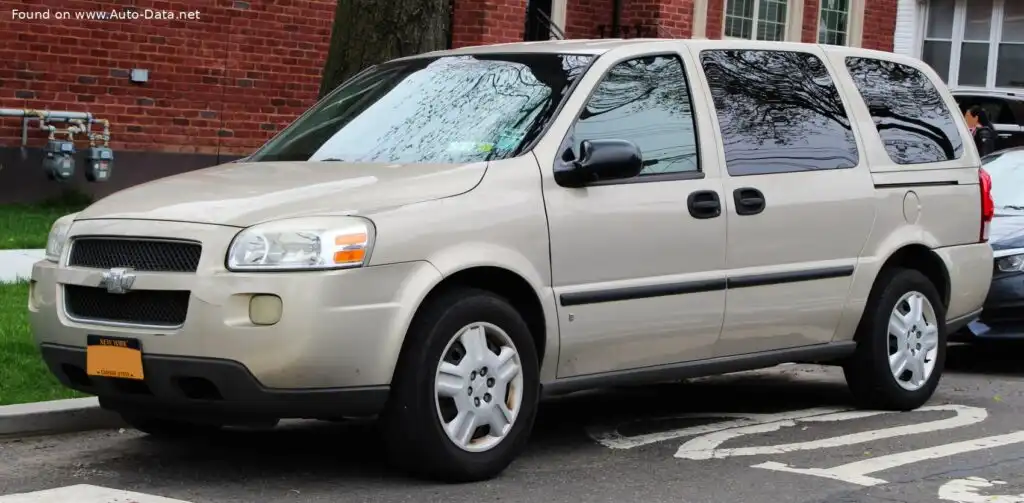
The Chevrolet Uplander 3.9 i V6 (243 Hp) was a minivan produced by Chevrolet from 2006 to 2008. It represented Chevrolet’s entry into the modern minivan segment, sharing its platform with the Buick Terraza, Pontiac Montana SV6, and Saturn Relay – all part of General Motors’ attempt to compete with established players like the Dodge Caravan and Chrysler Town & Country. The Uplander, and its siblings, were built on the W-body platform, a versatile architecture used for a variety of GM vehicles. This particular variant, equipped with the 3.9-liter V6 engine and a four-speed automatic transmission, was positioned as a mid-range offering, balancing performance with affordability within the Uplander lineup.
Technical Specifications
| Brand | Chevrolet |
| Model | Uplander |
| Generation | Uplander |
| Type (Engine) | 3.9 i V6 (243 Hp) |
| Start of production | 2006 |
| End of production | 2008 |
| Powertrain Architecture | Internal Combustion engine |
| Body type | Minivan |
| Seats | 7 |
| Doors | 5 |
| Fuel consumption (urban) | 13.1 l/100 km (18 US mpg) |
| Fuel consumption (extra urban) | 9.4 l/100 km (25 US mpg) |
| Fuel Type | Petrol (Gasoline) |
| Maximum speed | 175 km/h (108.74 mph) |
| Weight-to-power ratio | 8.3 kg/Hp |
| Weight-to-torque ratio | 6.1 kg/Nm |
| Power | 243 Hp @ 6000 rpm |
| Power per litre | 62.6 Hp/l |
| Torque | 332 Nm @ 4800 rpm (244.87 lb.-ft. @ 4800 rpm) |
| Engine layout | Front, Transverse |
| Engine Model/Code | LZ9 |
| Engine displacement | 3880 cm3 (236.77 cu. in.) |
| Number of cylinders | 6 |
| Engine configuration | V-engine |
| Cylinder Bore | 99 mm (3.9 in.) |
| Piston Stroke | 84 mm (3.31 in.) |
| Compression ratio | 9.8:1 |
| Number of valves per cylinder | 2 |
| Fuel injection system | Multi-port manifold injection |
| Engine aspiration | Naturally aspirated engine |
| Engine oil capacity | 3.8 l (4.02 US qt | 3.34 UK qt) |
| Coolant | 10.2 l (10.78 US qt | 8.97 UK qt) |
| Kerb Weight | 2020 kg (4453.34 lbs.) |
| Trunk (boot) space – minimum | 762 l (26.91 cu. ft.) |
| Trunk (boot) space – maximum | 3865 l (136.49 cu. ft.) |
| Fuel tank capacity | 95 l (25.1 US gal | 20.9 UK gal) |
| Length | 5192 mm (204.41 in.) |
| Width | 1830 mm (72.05 in.) |
| Height | 1830 mm (72.05 in.) |
| Wheelbase | 3077 mm (121.14 in.) |
| Front track | 1586 mm (62.44 in.) |
| Rear (Back) track | 1598 mm (62.91 in.) |
| Drivetrain Architecture | The Internal combustion engine (ICE) drives the front wheels of the vehicle. |
| Drive wheel | Front wheel drive |
| Number of gears and type of gearbox | 4 gears, automatic transmission |
| Front suspension | Independent, type McPherson with coil spring and anti-roll bar |
| Rear suspension | Coil spring |
| Front brakes | Disc |
| Rear brakes | Disc |
| Assisting systems | ABS (Anti-lock braking system) |
| Tires size | 225/60 R17 |
Powertrain & Engine Architecture
The heart of the Uplander 3.9 i V6 was the LZ9 engine, a 3.9-liter (3880 cc) naturally aspirated V6. This engine was a member of GM’s 3800 Series V6 family, known for its durability and relatively smooth operation. The LZ9 featured a 9.8:1 compression ratio, two valves per cylinder, and a multi-port fuel injection system. The engine produced 243 horsepower at 6000 rpm and 332 Nm (244.87 lb-ft) of torque at 4800 rpm. The engine’s transverse mounting and front-wheel-drive configuration were typical for modern minivans, optimizing interior space. Paired with the engine was a four-speed automatic transmission, a common choice for minivans prioritizing ease of use over outright performance. This transmission was designed for smooth shifts and adequate acceleration for everyday driving.
Driving Characteristics
The Uplander 3.9 i V6 offered adequate, but not exhilarating, performance. The four-speed automatic transmission, while providing smooth shifts, lacked the responsiveness of more modern transmissions with additional gears. Acceleration was sufficient for merging onto highways and passing slower traffic, but it wasn’t particularly quick. Compared to the available 3.5-liter V6 option (found in some other GM minivans), the 3.9-liter offered a noticeable increase in torque, making it feel more capable when fully loaded with passengers and cargo. However, compared to manual transmission versions of similar GM minivans, the automatic resulted in a slight decrease in fuel economy and a less engaging driving experience. The gear ratios were tuned for comfortable cruising rather than sporty acceleration.
Equipment & Trim Levels
The Uplander 3.9 i V6 typically came standard with features such as air conditioning, power windows and locks, a CD player, and basic cloth upholstery. Higher trim levels offered upgrades like leather seating, a premium sound system, power sliding doors, and a rear entertainment system. The specific standard equipment varied slightly depending on the model year and regional market. Optional extras included alloy wheels, a sunroof, and upgraded safety features. The interior design was functional and family-oriented, with ample storage compartments and a relatively spacious cabin.
Chassis & Braking
The Uplander utilized an independent McPherson strut suspension in the front and a coil spring suspension in the rear. This setup provided a comfortable ride quality, absorbing bumps and irregularities in the road surface effectively. The front and rear brakes were both disc brakes, providing adequate stopping power for a vehicle of its weight. Anti-lock Braking System (ABS) was standard, enhancing safety during emergency braking situations. The suspension was tuned for comfort rather than sporty handling, prioritizing a smooth and stable ride for passengers.
Market Reception & Comparison
The Chevrolet Uplander, along with its GM siblings, received mixed reviews from automotive critics. While praised for its spacious interior and comfortable ride, it was often criticized for its somewhat dated design and lack of refinement compared to competitors like the Honda Odyssey and Toyota Sienna. The 3.9-liter V6 engine was generally considered adequate, but not particularly fuel-efficient. Fuel economy figures of 13.1 l/100 km (18 US mpg) in the city and 9.4 l/100 km (25 US mpg) on the highway were typical for a minivan of its size and weight. Reliability was generally considered average, with some reports of minor issues with the transmission and electrical systems.
Legacy
The Chevrolet Uplander, and the broader lineup of GM minivans it was part of, didn’t achieve the sales success of its competitors. Production ended in 2008. However, the 3.9-liter V6 engine, in general, proved to be a durable and reliable powerplant. On the used car market, Uplander models with the 3.9-liter V6 are often sought after by budget-conscious buyers looking for a spacious and practical family vehicle. While not known for its performance or cutting-edge technology, the Uplander 3.9 i V6 remains a viable option for those prioritizing affordability and functionality in a minivan.
