
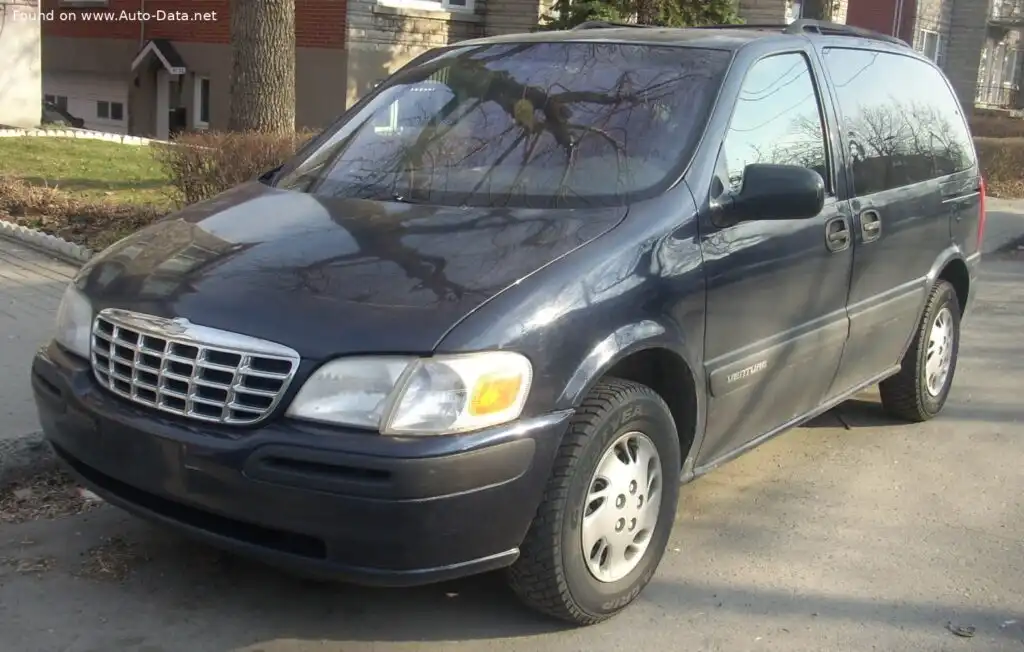
The Chevrolet Venture, introduced in 1996, was General Motors’ entry into the increasingly popular minivan segment. Replacing the aging Chevrolet Lumina APV, Astro, and Beretta van lines, the Venture aimed to provide a more modern and family-focused transportation solution. Produced from 1996 to 1999, the Venture shared its U-body platform with the Pontiac Montana, Oldsmobile Silhouette, and Buick Terraza, representing GM’s attempt to consolidate its minivan offerings. The 3.4L V6 variant, producing 180 horsepower, occupied a middle ground in the Venture lineup, offering a balance between affordability and performance. It was positioned as a step up from the base 3.1L engine, targeting families seeking a comfortable and capable vehicle without the higher price tag of the Montana’s optional supercharged engine.
Technical Specifications
| Brand | Chevrolet |
| Model | Venture |
| Generation | Venture (U) |
| Type (Engine) | 3.4 i V6 (180 Hp) |
| Start of production | 1996 |
| End of production | 1999 |
| Powertrain Architecture | Internal Combustion engine |
| Body type | Minivan |
| Seats | 7 |
| Doors | 4 |
| Fuel consumption (urban) | 13.1 l/100 km (18 US mpg, 21.6 UK mpg, 7.6 km/l) |
| Fuel consumption (extra urban) | 9.4 l/100 km (25 US mpg, 30.1 UK mpg, 10.6 km/l) |
| Fuel consumption (combined) | 11.2 l/100 km (21 US mpg, 25.2 UK mpg, 8.9 km/l) |
| Fuel Type | Petrol (Gasoline) |
| Weight-to-power ratio | 9.3 kg/Hp, 108.1 Hp/tonne |
| Weight-to-torque ratio | 6 kg/Nm, 167 Nm/tonne |
| Power | 180 Hp @ 5200 rpm |
| Power per litre | 53.7 Hp/l |
| Torque | 278 Nm @ 4000 rpm (205.04 lb.-ft. @ 4000 rpm) |
| Engine layout | Front, Transverse |
| Engine Model/Code | LA1 |
| Engine displacement | 3350 cm3 (204.43 cu. in.) |
| Number of cylinders | 6 |
| Engine configuration | V-engine |
| Cylinder Bore | 92 mm (3.62 in.) |
| Piston Stroke | 84 mm (3.31 in.) |
| Compression ratio | 9.5:1 |
| Number of valves per cylinder | 2 |
| Fuel injection system | Multi-port manifold injection |
| Engine aspiration | Naturally aspirated engine |
| Engine oil capacity | 4.25 l (4.49 US qt | 3.74 UK qt) |
| Kerb Weight | 1665 kg (3670.7 lbs.) |
| Max. weight | 2430 kg (5357.23 lbs.) |
| Max load | 765 kg (1686.54 lbs.) |
| Trunk (boot) space – minimum | 610 l (21.54 cu. ft.) |
| Trunk (boot) space – maximum | 3580 l (126.43 cu. ft.) |
| Fuel tank capacity | 76 l (20.08 US gal | 16.72 UK gal) |
| Length | 4747 mm (186.89 in.) |
| Width | 1829 mm (72.01 in.) |
| Height | 1712 mm (67.4 in.) |
| Wheelbase | 2845 mm (112.01 in.) |
| Front track | 1560 mm (61.42 in.) |
| Rear (Back) track | 1610 mm (63.39 in.) |
| Drivetrain Architecture | The Internal combustion engine (ICE) drives the front wheels of the vehicle. |
| Drive wheel | Front wheel drive |
| Number of gears and type of gearbox | 4 gears, automatic transmission |
| Front suspension | Spring Strut |
| Rear suspension | Coil spring |
| Front brakes | Ventilated discs |
| Rear brakes | Drum |
| Assisting systems | ABS (Anti-lock braking system) |
| Steering type | Steering rack and pinion |
| Power steering | Hydraulic Steering |
| Tires size | 205/70 R15 S |
Powertrain & Engine Architecture
The heart of the Chevrolet Venture 3.4L was the LA1 engine, a 3.4-liter (3350 cc) 60-degree V6. This engine was part of GM’s “3800” engine family, known for its durability and relatively smooth operation. The LA1 featured a cast iron block with aluminum cylinder heads, a configuration that balanced cost and weight. Fuel delivery was handled by a multi-port fuel injection system, providing precise fuel metering for improved efficiency and emissions. The engine utilized a two-valve-per-cylinder configuration and a 9.5:1 compression ratio. The 4L40-E four-speed automatic transmission was the sole transmission option for this variant. This transmission was electronically controlled, offering smooth shifts and adaptive learning capabilities to optimize performance based on driving conditions. The 4L40-E was a common transmission across various GM platforms during this era, known for its reliability when properly maintained.
Driving Characteristics
The 180 horsepower and 278 lb-ft of torque produced by the 3.4L V6 provided adequate, though not exhilarating, performance for the Venture. Acceleration was reasonable for everyday driving, but the minivan’s weight (approximately 3,670 lbs) meant it wasn’t particularly quick. The automatic transmission’s gear ratios were tuned for fuel economy and smooth cruising rather than aggressive acceleration. Compared to the optional supercharged 3.8L engine available in the Pontiac Montana, the 3.4L felt noticeably less powerful, especially when fully loaded with passengers and cargo. However, the 3.4L offered a more relaxed driving experience, with sufficient power for merging onto highways and passing slower vehicles. The front-wheel-drive configuration provided predictable handling, although it wasn’t particularly sporty.
Equipment & Trim Levels
The 3.4L Venture typically came standard with features such as air conditioning, power windows and locks, an AM/FM stereo, and cloth upholstery. Higher trim levels, such as the Venture GL, added features like upgraded audio systems, alloy wheels, and enhanced interior trim. Optional extras included a rear entertainment system, leather upholstery, and power-adjustable front seats. Safety features included dual front airbags and ABS (Anti-lock Braking System). The interior design was functional and family-oriented, with a focus on maximizing space and convenience. The second and third-row seats could be easily folded or removed to create a large cargo area.
Chassis & Braking
The Chevrolet Venture utilized a front-wheel-drive chassis with an independent front suspension featuring coil springs and a multi-link rear suspension. This suspension setup provided a comfortable ride, absorbing bumps and irregularities in the road surface effectively. The front brakes were ventilated discs, offering good stopping power, while the rear brakes were drums. The steering was rack-and-pinion with hydraulic power assist, providing light and responsive steering feel. Tire size was typically 205/70R15. The suspension was tuned for comfort rather than sporty handling, prioritizing a smooth and stable ride for passengers.
Market Reception & Comparison
The Chevrolet Venture 3.4L was generally well-received by critics as a practical and affordable minivan option. However, it wasn’t considered a standout performer in the segment. Critics noted that the 3.4L engine was adequate but lacked the power and refinement of some competitors’ engines. Fuel economy was average for its class, with combined MPG figures around 21. The Venture’s spacious interior and comfortable ride were praised, but some reviewers found the interior materials to be somewhat basic. Compared to the higher-trim Montana with the supercharged engine, the Venture 3.4L offered a more budget-friendly alternative, appealing to families who prioritized value and practicality over performance.
Legacy
The Chevrolet Venture, while not a long-lived model, played a significant role in establishing Chevrolet as a competitor in the minivan market. The 3.4L V6 and 4L40-E transmission combination proved to be relatively reliable, with many examples still on the road today. However, like all vehicles of this era, regular maintenance is crucial to ensure longevity. Common issues include oil leaks, transmission slippage, and corrosion. In the used car market, the Venture 3.4L represents an affordable and spacious option for families seeking a practical vehicle. While it may not offer the latest technology or features, its simplicity and durability make it a viable choice for those on a budget.
