
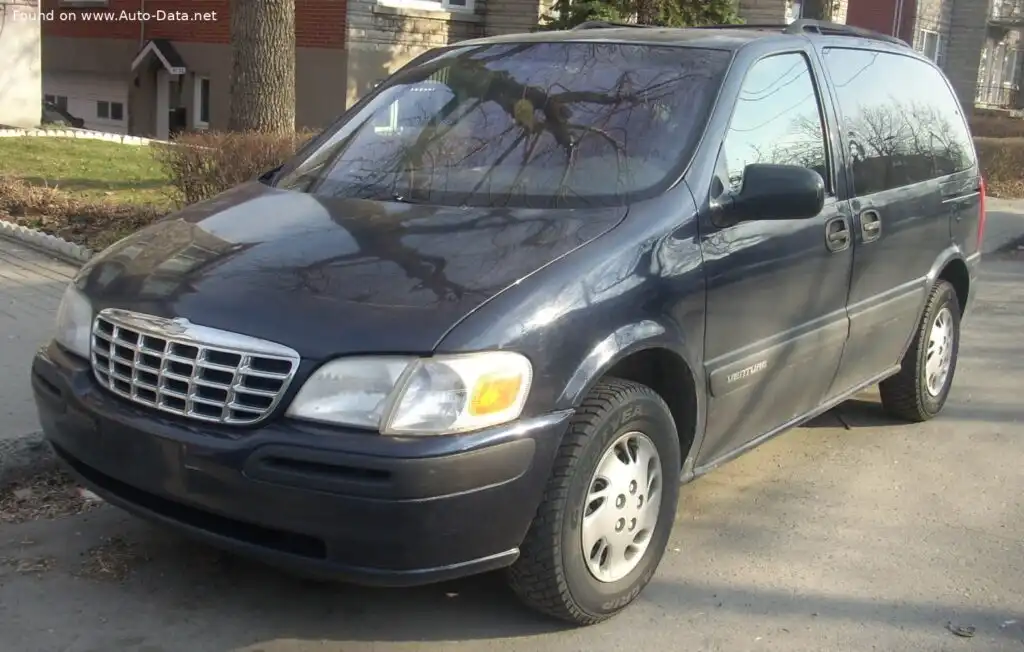
The Chevrolet Venture, introduced in 1997, was General Motors’ entry into the increasingly popular minivan segment. Produced until 2005, the Venture was part of a trio of GM minivans alongside the Pontiac Montana and Oldsmobile Silhouette, all built on the U-platform. The 3.4L V6 variant, produced from 1999 to 2001, represented a mid-range offering within the Venture lineup, balancing performance and affordability. This version aimed to provide a comfortable and practical family vehicle with adequate power for everyday driving and occasional longer trips.
Technical Specifications
| Brand | Chevrolet |
| Model | Venture |
| Generation | Venture (U) |
| Type (Engine) | 3.4 i V6 (188 Hp) |
| Start of production | 1999 year |
| End of production | 2001 year |
| Powertrain Architecture | Internal Combustion engine |
| Body type | Minivan |
| Seats | 7 |
| Doors | 4 |
| Fuel consumption (economy) – urban | 15.5 l/100 km (15.2 US mpg, 18.2 UK mpg, 6.5 km/l) |
| Fuel consumption (economy) – extra urban | 9.1 l/100 km (25.8 US mpg, 31 UK mpg, 11 km/l) |
| Fuel consumption (economy) – combined | 11.7 l/100 km (20.1 US mpg, 24.1 UK mpg, 8.5 km/l) |
| Fuel Type | Petrol (Gasoline) |
| Acceleration 0 – 100 km/h | 11.2 sec |
| Acceleration 0 – 62 mph | 11.2 sec |
| Acceleration 0 – 60 mph | 10.6 sec |
| Maximum speed | 187 km/h (116.2 mph) |
| Weight-to-power ratio | 8.9 kg/Hp, 111.9 Hp/tonne |
| Weight-to-torque ratio | 6 kg/Nm, 167.9 Nm/tonne |
| Power | 188 Hp @ 5200 rpm |
| Power per litre | 56.1 Hp/l |
| Torque | 282 Nm @ 4000 rpm (207.99 lb.-ft. @ 4000 rpm) |
| Engine layout | Front, Transverse |
| Engine Model/Code | LA1 |
| Engine displacement | 3350 cm3 (204.43 cu. in.) |
| Number of cylinders | 6 |
| Engine configuration | V-engine |
| Cylinder Bore | 92 mm (3.62 in.) |
| Piston Stroke | 84 mm (3.31 in.) |
| Compression ratio | 9.5:1 |
| Number of valves per cylinder | 2 |
| Fuel injection system | Multi-port manifold injection |
| Engine aspiration | Naturally aspirated engine |
| Engine oil capacity | 4.25 l (4.49 US qt | 3.74 UK qt) |
| Kerb Weight | 1680 kg (3703.77 lbs.) |
| Max. weight | 2430 kg (5357.23 lbs.) |
| Max load | 750 kg (1653.47 lbs.) |
| Trunk (boot) space – minimum | 610 l (21.54 cu. ft.) |
| Trunk (boot) space – maximum | 3580 l (126.43 cu. ft.) |
| Fuel tank capacity | 76 l (20.08 US gal | 16.72 UK gal) |
| Length | 4760 mm (187.4 in.) |
| Width | 1850 mm (72.83 in.) |
| Height | 1710 mm (67.32 in.) |
| Wheelbase | 2845 mm (112.01 in.) |
| Front track | 1560 mm (61.42 in.) |
| Rear (Back) track | 1610 mm (63.39 in.) |
| Drivetrain Architecture | The Internal combustion engine (ICE) drives the front wheels of the vehicle. |
| Drive wheel | Front wheel drive |
| Number of gears and type of gearbox | 4 gears, automatic transmission |
| Front suspension | Spring Strut |
| Rear suspension | Coil spring |
| Front brakes | Disc |
| Rear brakes | Drum |
| Assisting systems | ABS (Anti-lock braking system) |
| Steering type | Steering rack and pinion |
| Power steering | Hydraulic Steering |
| Tires size | 205/70 R15 |
Powertrain & Engine Architecture
The heart of the 1999-2001 Chevrolet Venture 3.4L was the LA1 engine, a 3.4-liter (3350 cc) 60-degree V6. This engine was part of GM’s “3800” family of V6 engines, known for their durability and relatively simple design. The LA1 featured a cast iron block with aluminum cylinder heads, a configuration that balanced cost and weight. Fuel delivery was handled by a multi-port fuel injection system, providing precise fuel metering for improved efficiency and emissions. The engine utilized a single overhead camshaft (SOHC) design with two valves per cylinder. The 4L60-E four-speed automatic transmission was the standard and only transmission option for this variant. This transmission was electronically controlled, offering smooth shifts and adaptive learning capabilities to optimize performance based on driving conditions.
Driving Characteristics
The 3.4L V6, producing 188 horsepower and 282 lb-ft of torque, provided adequate, though not exhilarating, performance for the Venture. Acceleration from 0-60 mph took around 10.6 seconds, making it competitive with other minivans of the era. The automatic transmission, while smooth, did contribute to a slight loss of responsiveness compared to the available manual transmission in other Venture trims. The 4L60-E’s gear ratios were tuned for fuel economy and comfortable cruising, rather than aggressive acceleration. In real-world driving, the 3.4L Venture felt capable of handling highway speeds and passing maneuvers with a fully loaded vehicle, but it wasn’t designed for sporty driving. The focus was on providing a comfortable and predictable driving experience.
Equipment & Trim Levels
The 3.4L Venture typically fell into the mid-range of the Venture trim levels. Standard features generally included air conditioning, power windows and locks, an AM/FM stereo, and cloth upholstery. Optional extras included features like a CD player, upgraded sound systems, power sliding doors, leather upholstery, and a rear entertainment system. The interior design was functional and family-oriented, with ample storage compartments and comfortable seating for seven passengers. The dashboard layout was straightforward and easy to use, prioritizing practicality over aesthetics.
Chassis & Braking
The Chevrolet Venture utilized a front-wheel-drive layout with an independent front suspension featuring coil springs and a multi-link rear suspension. This suspension setup aimed to provide a comfortable ride quality, absorbing bumps and irregularities in the road. The front brakes were disc brakes, while the rear brakes were drum brakes – a cost-saving measure common in this segment. Anti-lock Braking System (ABS) was standard, enhancing safety by preventing wheel lockup during hard braking. Steering was rack-and-pinion with hydraulic power assist, providing responsive and easy steering control.
Market Reception & Comparison
The 3.4L Venture received generally positive reviews for its spacious interior, comfortable ride, and practical features. However, critics often noted that its performance was adequate but not particularly exciting. Compared to the higher-output 3.8L V6 Venture, the 3.4L offered a more affordable price point but sacrificed some performance. Fuel economy was average for the minivan segment, with combined MPG around 20.1. Reliability was generally good, although some owners reported minor issues with the automatic transmission over time. The 3.4L Venture was often seen as a good value for families seeking a practical and reliable minivan without the need for high-performance capabilities.
Legacy
The Chevrolet Venture, and specifically the 3.4L V6 variant, remains a relatively common sight on used car lots today. The LA1 engine is known for its durability, and with proper maintenance, can provide many years of reliable service. While not a collector’s item, the 3.4L Venture represents a solid and practical choice for budget-conscious buyers seeking a spacious and functional minivan. The 4L60-E transmission, while generally reliable, may require occasional servicing or rebuilding as it ages. Overall, the 1999-2001 Chevrolet Venture 3.4L V6 offers a blend of affordability, practicality, and reliability that continues to appeal to a wide range of buyers.
