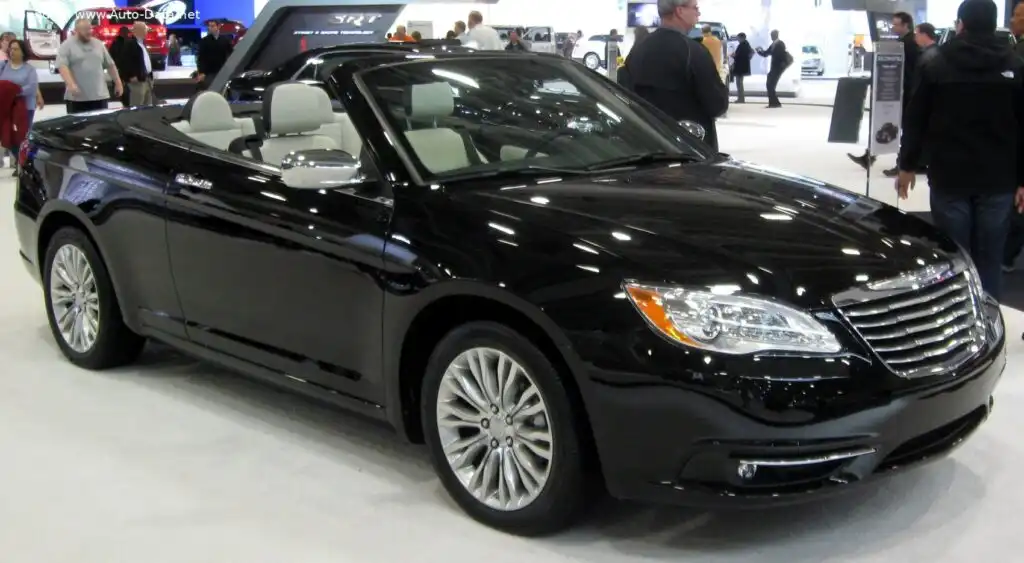
The Chrysler 200 Convertible, specifically the 3.6L V6 variant with an automatic transmission, represented a mid-cycle offering in the first generation (200 I) of the Chrysler 200 series. Produced from 2011 to 2014, this model aimed to provide an open-air experience with a respectable level of performance and features. It occupied a position as the premium engine option within the 200 Convertible lineup, appealing to buyers seeking more power than the base 2.4L four-cylinder engine offered. The 200 Convertible was Chrysler’s attempt to re-enter the mid-size convertible market, competing with established players like the Ford Mustang Convertible and Mazda MX-5 Miata, though targeting a different segment with its 2+2 seating configuration.
Technical Specifications
| Brand | Chrysler |
| Model | 200 |
| Generation | 200 I Convertible |
| Type (Engine) | 3.6 V6 (287 Hp) Automatic |
| Start of production | 2011 |
| End of production | 2014 |
| Powertrain Architecture | Internal Combustion engine |
| Body type | Cabriolet |
| Seats | 4 |
| Doors | 2 |
| Fuel consumption (urban) | 12.4 l/100 km (19 US mpg) |
| Fuel consumption (extra urban) | 8.1 l/100 km (29 US mpg) |
| Fuel consumption (combined) | 10.7 l/100 km (22 US mpg) |
| Fuel Type | Petrol (Gasoline) |
| Emission standard | Euro 4 |
| Weight-to-power ratio | 6.3 kg/Hp |
| Weight-to-torque ratio | 5.1 kg/Nm |
| Power | 287 Hp @ 6400 rpm |
| Torque | 353 Nm @ 4400 rpm (260.36 lb.-ft. @ 4400 rpm) |
| Maximum engine speed | 6800 rpm |
| Engine layout | Front, Transverse |
| Engine Model/Code | ERB |
| Engine displacement | 3604 cm3 (219.93 cu. in.) |
| Number of cylinders | 6 |
| Engine configuration | V-engine |
| Cylinder Bore | 96 mm (3.78 in.) |
| Piston Stroke | 83 mm (3.27 in.) |
| Compression ratio | 10.2:1 |
| Number of valves per cylinder | 4 |
| Fuel injection system | Multi-port manifold injection |
| Engine aspiration | Naturally aspirated engine |
| Valvetrain | DOHC-VVT |
| Engine oil capacity | 5.6 l (5.92 US qt | 4.93 UK qt) |
| Coolant capacity | 11 l (11.62 US qt | 9.68 UK qt) |
| Kerb Weight | 1804 kg (3977.14 lbs.) |
| Fuel tank capacity | 64 l (16.91 US gal | 14.08 UK gal) |
| Permitted trailer load without brakes | 454 kg (1000.9 lbs.) |
| Length | 4947 mm (194.76 in.) |
| Width | 1843 mm (72.56 in.) |
| Height | 1470 mm (57.87 in.) |
| Wheelbase | 2765 mm (108.86 in.) |
| Front track | 1567 mm (61.69 in.) |
| Rear track | 1594 mm (62.76 in.) |
| Drag coefficient (Cd) | 0.34 |
| Minimum turning circle | 11.5 m (37.73 ft.) |
| Drivetrain Architecture | Front wheel drive |
| Number of gears | 6 |
| Gearbox type | Automatic transmission |
| Front suspension | Independent, McPherson with coil spring and anti-roll bar |
| Rear suspension | Independent multi-link with stabilizer |
| Front brakes | Ventilated discs |
| Rear brakes | Disc |
| Assisting systems | ABS (Anti-lock braking system) |
| Steering type | Steering rack and pinion |
| Tires size | 225/50 R18 |
| Wheel rims size | 18 |
Powertrain & Engine Architecture
The heart of the 200 Convertible 3.6L was the ERB engine, a 3.6-liter Pentastar V6. This engine was a significant departure from Chrysler’s previous V6 designs, utilizing a 60-degree V-angle for improved balance and refinement. The ERB featured a dual overhead camshaft (DOHC) valvetrain with variable valve timing (VVT) on both intake and exhaust camshafts, optimizing performance and fuel efficiency across the rev range. Fuel delivery was handled by a multi-port fuel injection system. The engine produced 287 horsepower at 6,400 rpm and 260 lb-ft of torque at 4,400 rpm. This power was routed through a six-speed automatic transmission, which was chosen for its smooth operation and ease of use, catering to the convertible’s target audience. The transmission was calibrated for a balance between fuel economy and responsiveness, though it wasn’t designed for aggressive shifting.
Driving Characteristics
The 200 Convertible 3.6L Automatic offered a comfortable and relatively refined driving experience. While not a sports car, the V6 engine provided adequate power for highway cruising and passing maneuvers. The automatic transmission, while smooth, didn’t offer the engagement of a manual gearbox. Acceleration from 0 to 60 mph was typically in the 7-8 second range. The front-wheel-drive configuration contributed to predictable handling, but also limited the car’s cornering ability compared to rear-wheel-drive convertibles. The suspension was tuned for comfort, absorbing bumps and road imperfections reasonably well. However, body roll was noticeable during aggressive cornering. Compared to the base 2.4L four-cylinder version, the 3.6L offered a substantial performance upgrade, making it a more enjoyable vehicle for longer journeys and spirited driving.
Equipment & Trim Levels
The 3.6L Convertible typically came well-equipped, though specific features varied depending on optional packages. Standard equipment generally included air conditioning, power windows and locks, a premium audio system, and alloy wheels. Leather upholstery, heated seats, a power-adjustable driver’s seat, and a sunroof were common options. The interior design was generally considered functional and aesthetically pleasing, though material quality wasn’t on par with some European competitors. The convertible top was a power-operated soft top, offering a relatively quiet cabin experience when raised.
Chassis & Braking
The 200 Convertible utilized an independent suspension system at all four wheels. The front suspension employed a McPherson strut design with coil springs and an anti-roll bar, while the rear suspension featured a multi-link setup with a stabilizer bar. This configuration aimed to provide a balance between ride comfort and handling. Braking duties were handled by ventilated disc brakes at the front and solid disc brakes at the rear. The anti-lock braking system (ABS) was standard, enhancing safety during emergency braking situations. Steering was rack-and-pinion, providing reasonably precise steering feel.
Market Reception & Comparison
The Chrysler 200 Convertible 3.6L received mixed reviews from automotive critics. While the V6 engine was praised for its power and smoothness, the car was often criticized for its handling and overall refinement compared to competitors. Fuel economy was also a concern, with the combined fuel consumption of 22 mpg being relatively low for its class. Compared to the 2.4L four-cylinder version, the 3.6L offered a significant performance improvement, but at the cost of increased fuel consumption. The 3.6L was positioned as the premium offering, appealing to buyers who prioritized power and a more engaging driving experience.
Legacy
The Chrysler 200 Convertible, including the 3.6L V6 Automatic variant, didn’t achieve significant sales success. However, the Pentastar V6 engine proved to be a reliable and durable powerplant, and it continued to be used in various Chrysler, Dodge, and Jeep vehicles for many years. On the used car market, the 3.6L Convertible can be found at relatively affordable prices. Common issues include potential oil leaks and occasional problems with the convertible top mechanism. Overall, the 200 Convertible 3.6L represents a decent value for buyers seeking an affordable and stylish open-air experience, provided they are aware of its limitations and potential maintenance needs.