
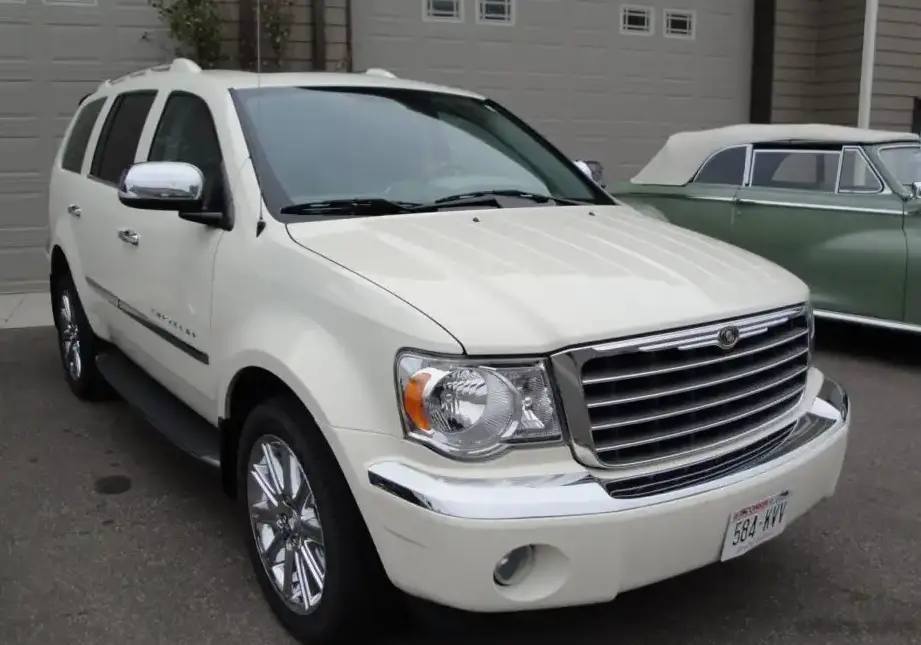
The Chrysler Aspen, produced for the 2008 and 2009 model years, was a full-size SUV positioned as Chrysler’s offering in the highly competitive American SUV market. Built on a body-on-frame platform shared with the Dodge Durango, the Aspen aimed to provide a more refined and luxurious experience than its Dodge counterpart. The 4.7i V8 16V (303 Hp) FlexFuel Automatic variant represented a mid-range offering within the Aspen lineup, balancing power with reasonable fuel economy and a relatively accessible price point. It was designed to appeal to families needing substantial space and towing capacity, but who didn’t necessarily require the higher performance of the optional 5.7L HEMI V8.
Technical Specifications
| Brand | Chrysler |
| Model | Aspen |
| Generation | Aspen |
| Type (Engine) | 4.7 i V8 16V (303 Hp) FlexFuel Automatic |
| Start of production | 2008 |
| End of production | 2009 |
| Powertrain Architecture | Internal Combustion engine |
| Body type | SUV |
| Seats | 8 |
| Doors | 5 |
| Fuel consumption (economy) – urban | 18.1 l/100 km (13 US mpg, 15.6 UK mpg, 5.5 km/l) |
| Fuel consumption (economy) – urban (Ethanol – E85) | 26.1 l/100 km |
| Fuel consumption (economy) – extra urban | 13.8 l/100 km (17 US mpg, 20.5 UK mpg, 7.2 km/l) |
| Fuel consumption (economy) – extra urban (Ethanol – E85) | 18.1 l/100 km |
| Fuel consumption (economy) – combined | 15.7 l/100 km (15 US mpg, 18 UK mpg, 6.4 km/l) |
| Fuel Type | Petrol / Ethanol – E85 |
| Weight-to-power ratio | 7.3 kg/Hp, 136.2 Hp/tonne |
| Weight-to-torque ratio | 5 kg/Nm, 201 Nm/tonne |
| Power | 303 Hp @ 5650 rpm |
| Power per litre | 64.4 Hp/l |
| Torque | 447 Nm @ 3950 rpm (329.69 lb.-ft. @ 3950 rpm) |
| Maximum engine speed | 6000 rpm |
| Engine layout | Front, Longitudinal |
| Engine Model/Code | EVD |
| Engine displacement | 4703 cm3 (286.99 cu. in.) |
| Number of cylinders | 8 |
| Engine configuration | V-engine |
| Cylinder Bore | 93 mm (3.66 in.) |
| Piston Stroke | 86.5 mm (3.41 in.) |
| Compression ratio | 9.8:1 |
| Number of valves per cylinder | 2 |
| Fuel injection system | Multi-port manifold injection |
| Engine aspiration | Naturally aspirated engine |
| Valvetrain | SOHC |
| Engine oil capacity | 5.7 l (6.02 US qt | 5.02 UK qt) |
| Coolant | 13.5 l (14.27 US qt | 11.88 UK qt) |
| Kerb Weight | 2224 kg (4903.08 lbs.) |
| Max. weight | 2926 kg (6450.73 lbs.) |
| Max load | 702 kg (1547.65 lbs.) |
| Trunk (boot) space – minimum | 538 l (19 cu. ft.) |
| Trunk (boot) space – maximum | 2900 l (102.41 cu. ft.) |
| Fuel tank capacity | 102 l (26.95 US gal | 22.44 UK gal) |
| Permitted trailer load with brakes (12%) | 2699 kg (5950.28 lbs.) |
| Length | 5101 mm (200.83 in.) |
| Width | 1930 mm (75.98 in.) |
| Height | 1887 mm (74.29 in.) |
| Wheelbase | 3027 mm (119.17 in.) |
| Front track | 1637 mm (64.45 in.) |
| Rear (Back) track | 1636 mm (64.41 in.) |
| Ride height (ground clearance) | 254 mm (10 in.) |
| Drag coefficient (Cd) | 0.391 |
| Minimum turning circle (turning diameter) | 12.2 m (40.03 ft.) |
| Drivetrain Architecture | The Internal combustion engine (ICE) drives the rear wheels of the vehicle. |
| Drive wheel | Rear wheel drive |
| Number of gears and type of gearbox | 5 gears, automatic transmission |
| Front suspension | Independent torsion bar, double wishbone |
| Rear suspension | Coil spring, Elastic beam |
| Front brakes | Ventilated discs, 336×28 mm |
| Rear brakes | Disc, 352×22 mm |
| Assisting systems | ABS (Anti-lock braking system) |
| Steering type | Steering rack and pinion |
| Tires size | 265/60 R18 |
| Wheel rims size | 8J x 18 |
INTRODUCTION
The Chrysler Aspen, launched in 2008, was a late entry into the full-size SUV segment. It was based on the WK platform, shared with the Dodge Durango, but aimed for a more premium feel. The 4.7L V8 with the automatic transmission was a key configuration, positioned as a balance between affordability and capability. Production was short-lived, ending in 2009, likely due to the economic downturn and shifting consumer preferences towards more fuel-efficient vehicles. The Aspen sought to capitalize on the demand for large SUVs, offering three rows of seating and substantial towing capacity.
Powertrain & Engine Architecture
The heart of the Aspen 4.7i was the EVD engine, a 4.7-liter (4703 cc) V8. This engine featured a single overhead camshaft (SOHC) design with two valves per cylinder. It utilized a multi-port fuel injection system, delivering fuel directly to the intake ports. The 4.7L V8 was notable for its “FlexFuel” capability, meaning it could run on gasoline or a blend of up to 85% ethanol (E85). The engine produced 303 horsepower at 5650 rpm and 447 Nm (329.69 lb-ft) of torque at 3950 rpm. Paired with this engine was a 5-speed automatic transmission, designed to provide smooth shifting and adequate power delivery for everyday driving and towing. This transmission wasn’t known for being particularly advanced, but it was reliable and well-suited to the engine’s characteristics.
Driving Characteristics
The 4.7L V8 and 5-speed automatic combination in the Aspen delivered adequate, but not exhilarating, performance. Acceleration was reasonable for a vehicle of its size and weight, but it lacked the punch of the optional 5.7L HEMI. The automatic transmission was tuned for comfort and fuel economy, resulting in somewhat conservative gear ratios. This meant that while it was capable of highway cruising, passing maneuvers required a bit more planning. Compared to a manual transmission equipped Aspen (which wasn’t commonly available), the automatic offered greater convenience but sacrificed some responsiveness. The rear-wheel-drive configuration provided a traditional SUV feel, and the suspension was tuned for a comfortable ride, though it could feel somewhat floaty when fully loaded.
Equipment & Trim Levels
The Aspen 4.7i typically came standard with features like air conditioning, power windows and locks, a CD player with auxiliary input, and cloth upholstery. Higher trim levels offered upgrades such as leather seats, a premium sound system, a sunroof, and rear-seat entertainment. The interior design was generally functional and spacious, prioritizing practicality over outright luxury. Optional extras included navigation system, remote start, and various chrome exterior accents. The Aspen aimed to provide a comfortable and well-equipped interior, but it didn’t quite reach the level of refinement offered by some of its competitors.
Chassis & Braking
The Aspen utilized a body-on-frame construction, providing a robust and durable chassis. The front suspension featured an independent torsion bar and double wishbone setup, while the rear suspension employed a coil spring and elastic beam design. This configuration prioritized ride comfort and load-carrying capacity. Braking duties were handled by ventilated discs at the front and solid discs at the rear. An Anti-lock Braking System (ABS) was standard. The braking performance was adequate for the vehicle’s weight, but it wasn’t particularly sporty. The Aspen’s relatively high curb weight (2224 kg / 4903.08 lbs) meant that it required a bit more stopping distance than lighter vehicles.
Market Reception & Comparison
The Chrysler Aspen received mixed reviews from automotive critics. While it was praised for its spacious interior and comfortable ride, it was often criticized for its unremarkable performance and relatively poor fuel economy. Compared to the Dodge Durango, which shared the same platform, the Aspen was positioned as the more refined and luxurious option. However, it often came at a higher price point. Against competitors like the Chevrolet Tahoe and Ford Expedition, the Aspen struggled to stand out, lacking the brand recognition and established reputation of those models. Fuel economy was a significant drawback, with combined figures of 15.7 l/100 km (15 US mpg) being considerably higher than many of its rivals.
Legacy
The Chrysler Aspen’s short production run limited its long-term impact. However, the 4.7L V8 engine proved to be relatively reliable, although regular maintenance is crucial. In the used car market, Aspens are generally affordable, but finding well-maintained examples can be challenging. The FlexFuel capability is a plus for some buyers, but the poor fuel economy remains a significant concern. The Aspen represents a somewhat forgotten chapter in Chrysler’s SUV history, a vehicle that offered a reasonable combination of space, comfort, and capability, but ultimately failed to gain significant traction in a highly competitive market.
