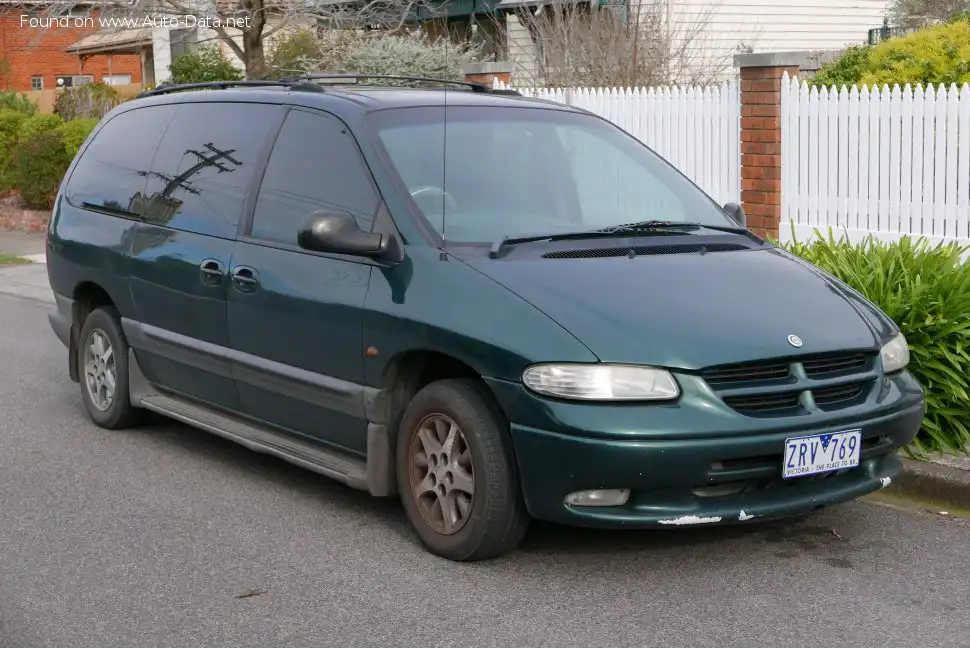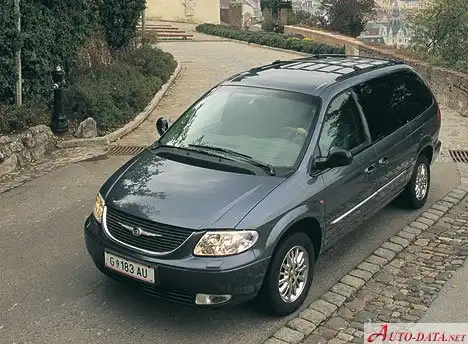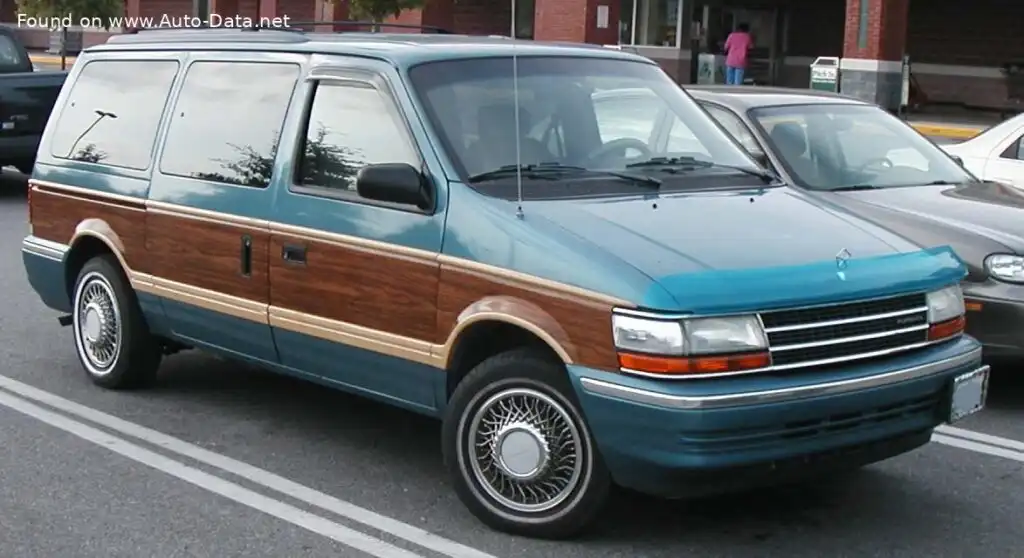
The Chrysler Grand Voyager II 2.5 TD, produced between 1992 and 1995, represented a significant offering in the European minivan market. Positioned as a diesel-powered variant within the broader Grand Voyager II range (based on the Chrysler VS platform), it catered to buyers seeking fuel efficiency and practicality in a spacious family vehicle. This model was primarily sold in Europe, where diesel engines held a larger market share than in the United States. The 2.5 TD trim occupied a middle ground in the lineup, offering a balance between affordability and features, slotting below the gasoline-powered V6 models and often above base-level trims.
Technical Specifications
| Brand | Chrysler |
| Model | Voyager |
| Generation | Grand Voyager II |
| Type (Engine) | 2.5 TD (118 Hp) |
| Start of production | 1992 |
| End of production | 1995 |
| Powertrain Architecture | Internal Combustion engine |
| Body type | Minivan |
| Seats | 7 |
| Doors | 3 |
| Fuel consumption (combined) | 6.7 l/100 km (35.1 US mpg, 42.2 UK mpg, 14.9 km/l) |
| Fuel Type | Diesel |
| Acceleration 0 – 100 km/h | 12.5 sec |
| Acceleration 0 – 62 mph | 12.5 sec |
| Acceleration 0 – 60 mph | 11.9 sec |
| Maximum speed | 180 km/h (111.85 mph) |
| Weight-to-power ratio | 14.9 kg/Hp (67 Hp/tonne) |
| Weight-to-torque ratio | 6.8 kg/Nm (146 Nm/tonne) |
| Power | 118 Hp @ 4200 rpm |
| Power per litre | 47.2 Hp/l |
| Torque | 257 Nm @ 2200 rpm (189.55 lb.-ft. @ 2200 rpm) |
| Engine layout | Front, Transverse |
| Engine displacement | 2499 cm3 (152.5 cu. in.) |
| Number of cylinders | 4 |
| Engine configuration | Inline |
| Cylinder Bore | 92 mm (3.62 in.) |
| Piston Stroke | 94 mm (3.7 in.) |
| Compression ratio | 21:1 |
| Number of valves per cylinder | 2 |
| Fuel injection system | Precombustion chamber injection |
| Engine aspiration | Turbocharger |
| Engine oil capacity | 6 l (6.34 US qt | 5.28 UK qt) |
| Coolant | 9.5 l (10.04 US qt | 8.36 UK qt) |
| Kerb Weight | 1760 kg (3880.14 lbs.) |
| Max. weight | 2550 kg (5621.79 lbs.) |
| Max load | 790 kg (1741.65 lbs.) |
| Trunk (boot) space – minimum | 3990 l (140.91 cu. ft.) |
| Trunk (boot) space – maximum | 3990 l (140.91 cu. ft.) |
| Fuel tank capacity | 76 l (20.08 US gal | 16.72 UK gal) |
| Length | 4896 mm (192.76 in.) |
| Width | 1830 mm (72.05 in.) |
| Height | 1707 mm (67.2 in.) |
| Wheelbase | 3031 mm (119.33 in.) |
| Front track | 1522 mm (59.92 in.) |
| Rear (Back) track | 1578 mm (62.13 in.) |
| Drivetrain Architecture | The Internal combustion engine (ICE) drives the front wheels of the vehicle. |
| Drive wheel | Front wheel drive |
| Number of gears and type of gearbox | 5 gears, manual transmission |
| Front suspension | Wishbone |
| Rear suspension | Rigid axle suspension |
| Front brakes | Ventilated discs |
| Rear brakes | Drum |
| Assisting systems | ABS (Anti-lock braking system) |
| Steering type | Steering rack and pinion |
| Power steering | Hydraulic Steering |
| Tires size | 205/70 R15 |
Powertrain & Engine Architecture
The heart of the Grand Voyager II 2.5 TD was the Chrysler-sourced 2.5-liter inline-four cylinder diesel engine. This engine, often identified by internal codes depending on specific market variations, utilized a precombustion chamber injection system. This system, common in European diesels of the era, involved injecting fuel into a small pre-chamber within the cylinder head, where it partially combusted before igniting the main charge. This design aided in smoother combustion and reduced engine noise compared to direct injection systems. The engine was turbocharged, boosting power output to 118 horsepower at 4200 rpm and 257 Nm (189.55 lb-ft) of torque at 2200 rpm. The five-speed manual transmission was the standard offering, providing a relatively direct connection to the engine. While an automatic transmission was available on other Grand Voyager II models, it was less commonly paired with the 2.5 TD engine, particularly in European markets.
Driving Characteristics
The 2.5 TD Grand Voyager II offered a driving experience focused on practicality and fuel economy rather than outright performance. Acceleration from 0-100 km/h (0-62 mph) took approximately 12.5 seconds, which was typical for a diesel-powered minivan of the early 1990s. The turbocharger helped to mitigate some of the inherent lag associated with diesel engines, providing a usable boost in power for overtaking maneuvers. The manual transmission allowed for greater driver control, but the relatively long gearing emphasized fuel efficiency over spirited driving. Compared to the gasoline-powered V6 versions, the 2.5 TD offered significantly better fuel economy but lacked the V6’s quicker acceleration and overall refinement. The engine’s torque characteristics made it well-suited for carrying a full load of passengers and luggage, providing adequate pulling power even when fully occupied.
Equipment & Trim Levels
The 2.5 TD Grand Voyager II typically came equipped with a reasonable level of standard features. These included power steering, central locking, and basic instrumentation. Interior upholstery was generally cloth, with options for upgraded materials available. The dashboard layout was functional and straightforward, prioritizing ease of use. Optional extras could include air conditioning, power windows, and an upgraded audio system. Trim levels varied slightly depending on the specific market, but the 2.5 TD generally represented a mid-range offering, bridging the gap between basic workhorse models and more luxurious trims.
Chassis & Braking
The Grand Voyager II utilized a front-wheel-drive layout with a relatively simple suspension setup. The front suspension employed a wishbone configuration, while the rear suspension featured a rigid axle. This setup prioritized ride comfort and load-carrying capacity over sporty handling. Braking duties were handled by ventilated discs at the front and drum brakes at the rear. An anti-lock braking system (ABS) was included as standard equipment, enhancing safety and control during emergency braking situations. The steering system was a rack and pinion setup with hydraulic power assistance, providing relatively light and precise steering feel.
Market Reception & Comparison
The Chrysler Grand Voyager II 2.5 TD was generally well-received in European markets as a practical and fuel-efficient family vehicle. Critics praised its spacious interior, comfortable ride, and relatively affordable price point. However, some reviewers noted the engine’s lack of refinement compared to gasoline alternatives and its somewhat sluggish acceleration. Compared to other diesel-powered minivans of the era, such as the Renault Espace or the Volkswagen Transporter, the Grand Voyager II offered a more American-style design and a focus on comfort and convenience. Fuel economy was competitive, and the 2.5 TD engine proved to be reasonably reliable with proper maintenance.
Legacy
The Chrysler Grand Voyager II 2.5 TD, while not a performance icon, established a foothold for Chrysler in the European minivan market. The 2.5 TD powertrain, when properly maintained, proved to be durable and long-lasting. Today, these vehicles are relatively rare, and well-preserved examples are sought after by enthusiasts and collectors. The engine’s simplicity and robust construction contribute to its continued reliability, although finding replacement parts can sometimes be a challenge. The Grand Voyager II 2.5 TD remains a testament to the practicality and versatility of the American minivan design, adapted for the demands of the European market.