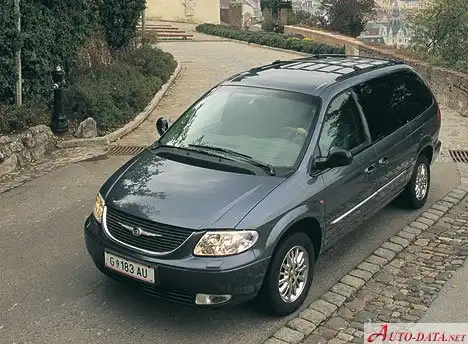
The Chrysler Grand Voyager IV 2.8 CRD TD (150 Hp) Automatic, produced between 2001 and 2007, represents a significant iteration of Chrysler’s popular minivan offering in the European market. Positioned as a diesel-powered option within the fourth generation (NS) Grand Voyager lineup, this variant aimed to provide a balance of fuel efficiency, practicality, and comfortable family transportation. It was built on the Chrysler NS platform, sharing components with the Dodge Caravan and Plymouth Voyager, though the CRD diesel engine was primarily geared towards European consumers. This model filled a niche for buyers seeking the space and versatility of a minivan with the economy of a diesel engine, offering an alternative to the gasoline-powered versions available.
Technical Specifications
| Brand | Chrysler |
| Model | Voyager |
| Generation | Grand Voyager IV |
| Type (Engine) | 2.8 CRD TD (150 Hp) Automatic |
| Start of production | 2001 |
| End of production | 2007 |
| Powertrain Architecture | Internal Combustion engine |
| Body type | Minivan |
| Seats | 7 |
| Doors | 5 |
| Fuel consumption (urban) | 11.5 l/100 km (20.5 US mpg) |
| Fuel consumption (extra urban) | 6.7 l/100 km (35.1 US mpg) |
| Fuel Type | Diesel |
| Acceleration 0 – 100 km/h | 12 sec |
| Acceleration 0 – 62 mph | 12 sec |
| Acceleration 0 – 60 mph | 11.4 sec |
| Maximum speed | 180 km/h (111.85 mph) |
| Weight-to-power ratio | 13.5 kg/Hp |
| Weight-to-torque ratio | 5.6 kg/Nm |
| Power | 150 Hp @ 3800 rpm |
| Power per litre | 54 Hp/l |
| Torque | 360 Nm @ 1800 rpm (265.52 lb.-ft. @ 1800 rpm) |
| Engine layout | Front, Transverse |
| Engine Model/Code | ENR |
| Engine displacement | 2776 cm3 (169.4 cu. in.) |
| Number of cylinders | 4 |
| Engine configuration | Inline |
| Cylinder Bore | 94 mm (3.7 in.) |
| Piston Stroke | 100 mm (3.94 in.) |
| Compression ratio | 17.5:1 |
| Number of valves per cylinder | 4 |
| Fuel injection system | Diesel Commonrail |
| Engine aspiration | Turbocharger, Intercooler |
| Engine oil capacity | 6 l (6.34 US qt | 5.28 UK qt) |
| Coolant | 13.8 l (14.58 US qt | 12.14 UK qt) |
| Kerb Weight | 2030 kg (4475.38 lbs.) |
| Max. weight | 2630 kg (5798.16 lbs.) |
| Max load | 600 kg (1322.77 lbs.) |
| Trunk (boot) space – minimum | 920 l (32.49 cu. ft.) |
| Trunk (boot) space – maximum | 4130 l (145.85 cu. ft.) |
| Fuel tank capacity | 75 l (19.81 US gal | 16.5 UK gal) |
| Length | 5095 mm (200.59 in.) |
| Width | 1997 mm (78.62 in.) |
| Height | 1750 mm (68.9 in.) |
| Wheelbase | 3030 mm (119.29 in.) |
| Front track | 1600 mm (62.99 in.) |
| Rear (Back) track | 1625 mm (63.98 in.) |
| Drivetrain Architecture | The Internal combustion engine (ICE) drives the front wheels of the vehicle. |
| Drive wheel | Front wheel drive |
| Number of gears and type of gearbox | 4 gears, automatic transmission |
| Front suspension | Wishbone |
| Rear suspension | Leaf spring |
| Front brakes | Ventilated discs |
| Rear brakes | Disc |
| Assisting systems | ABS (Anti-lock braking system) |
| Steering type | Steering rack and pinion |
| Power steering | Hydraulic Steering |
| Tires size | 215/65 R16 |
Powertrain & Engine Architecture
The heart of the Grand Voyager IV 2.8 CRD TD is the ENR engine, a 2.8-liter inline-four cylinder diesel engine. This engine utilized a common rail direct injection system, a technology that significantly improved fuel efficiency and reduced noise compared to older diesel injection methods. The common rail system, supplied by Bosch, allowed for precise control of fuel delivery, optimizing combustion and minimizing emissions. A turbocharger with an intercooler was employed to boost power output, bringing the engine to 150 horsepower and 360 Nm (265 lb-ft) of torque. The engine featured four valves per cylinder and a compression ratio of 17.5:1. The automatic transmission was a four-speed unit, designed to provide smooth shifting and ease of driving, particularly in urban environments. While not known for its sportiness, the transmission was reliable and well-suited to the engine’s torque characteristics.
Driving Characteristics
The 2.8 CRD TD Automatic Grand Voyager offered a comfortable and relaxed driving experience. Acceleration from 0-60 mph took around 11.4 seconds, which was adequate for everyday driving but not particularly brisk. The automatic transmission, while smooth, did contribute to some power loss compared to the available manual transmission options. The engine’s torque peak at 1800 rpm provided good pulling power for overtaking and carrying a full load of passengers and luggage. The gear ratios were optimized for fuel economy and cruising, rather than outright performance. Compared to the gasoline-powered versions, the diesel offered significantly better fuel economy, making it a popular choice for long-distance travel. However, it lacked the responsiveness and higher revving nature of the petrol engines.
Equipment & Trim Levels
The Grand Voyager IV 2.8 CRD TD Automatic typically came with a reasonable level of standard equipment. This included air conditioning, power windows and locks, a basic audio system, and alloy wheels. Higher trim levels, such as the Limited, added features like leather upholstery, a premium sound system, rear climate control, and power-adjustable front seats. Optional extras included a DVD entertainment system for rear passengers, sunroof, and parking sensors. The interior design was functional and family-oriented, with durable materials and ample storage space. The seven-seat configuration offered flexibility, with the rear seats folding flat into the floor to maximize cargo capacity.
Chassis & Braking
The Grand Voyager IV featured a front-wheel-drive layout. The front suspension utilized a wishbone design, providing a comfortable ride and decent handling. The rear suspension employed a leaf spring setup, which was a cost-effective solution but less sophisticated than independent suspension systems. Braking duties were handled by ventilated discs at the front and solid discs at the rear. An Anti-lock Braking System (ABS) was standard, enhancing safety during emergency braking. The steering was rack and pinion with hydraulic power assistance, providing light and easy steering feel.
Market Reception & Comparison
The 2.8 CRD TD Automatic Grand Voyager was generally well-received in Europe as a practical and economical family vehicle. Critics praised its spacious interior, comfortable ride, and fuel efficiency. However, some noted the lack of performance compared to gasoline-powered rivals and the somewhat dated interior design. Compared to the 2.4-liter gasoline engine, the diesel offered significantly better fuel economy, but at the cost of some refinement. Against the higher-powered gasoline engines, the diesel provided a more sensible option for those prioritizing economy and practicality over outright performance. Reliability was generally good, although some owners reported issues with the diesel particulate filter (DPF) and common rail injection system.
Legacy
The Chrysler Grand Voyager IV 2.8 CRD TD Automatic remains a relatively common sight on European roads today. The ENR engine, while not without its quirks, proved to be reasonably durable with proper maintenance. The automatic transmission is also known for its reliability. In the used car market, these Grand Voyagers represent a good value proposition for buyers seeking a spacious and affordable family vehicle. However, potential buyers should be aware of the potential for DPF issues and the importance of regular servicing. The model helped establish Chrysler as a viable competitor in the European minivan segment, offering a diesel alternative that appealed to a wide range of buyers.