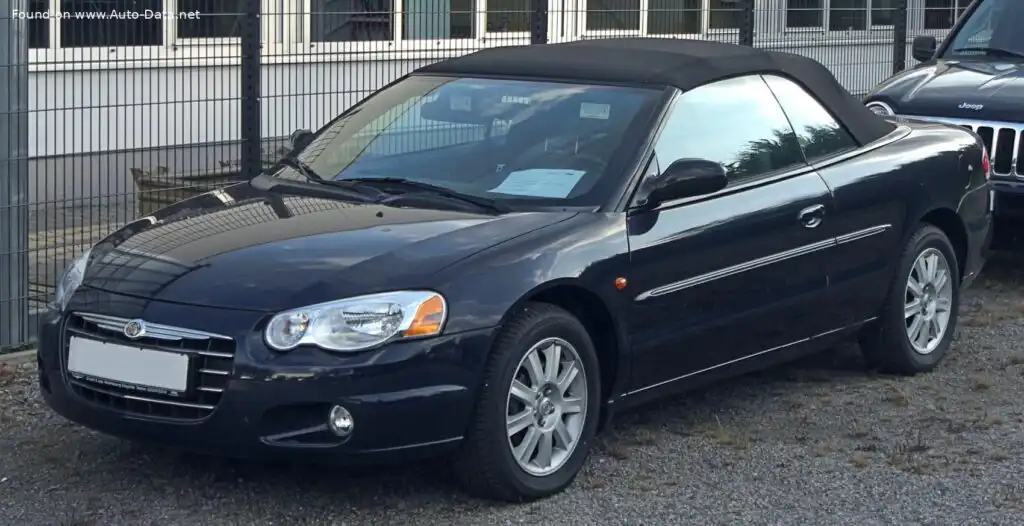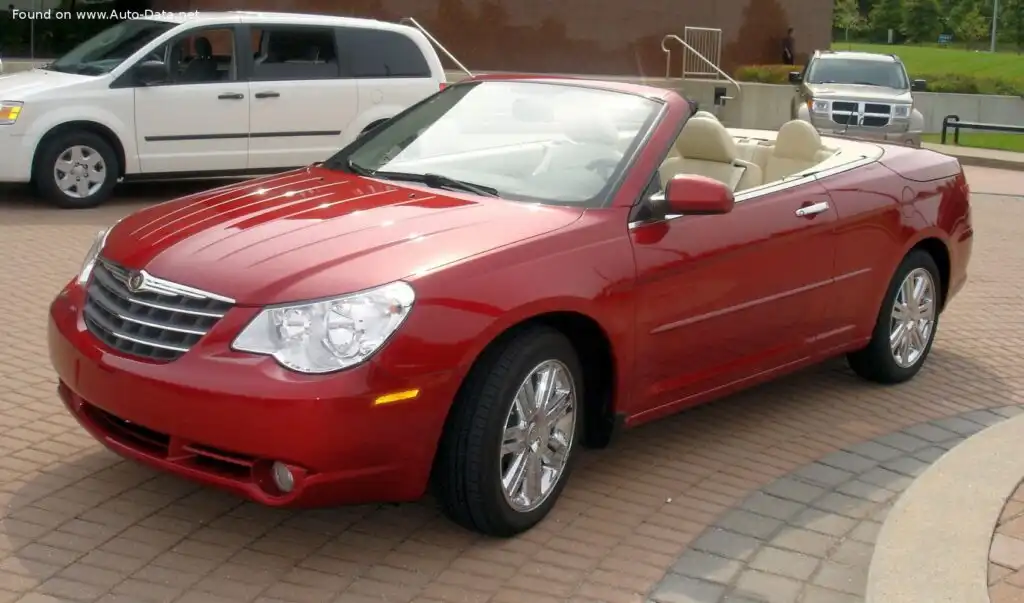
The Chrysler Sebring Convertible (JS) 2.7i V6 Automatic, produced between 2007 and 2010, represented a mid-cycle offering within the second generation of the Sebring convertible. Positioned as a step up from the base 2.4L four-cylinder models, the 2.7L V6 provided a balance of performance and affordability in the American convertible market. This variant was part of the JS platform, shared with the Dodge Caliber and Jeep Compass, though the Sebring Convertible distinguished itself with its focus on open-air driving enjoyment. It aimed to appeal to buyers seeking a stylish and relatively accessible convertible experience.
Technical Specifications
| Brand | Chrysler |
| Model | Sebring |
| Generation | Sebring Convertible (JS) |
| Type (Engine) | 2.7i V6 (188 Hp) Automatic |
| Start of production | 2007 |
| End of production | 2010 |
| Powertrain Architecture | Internal Combustion engine |
| Body type | Cabriolet |
| Seats | 4 |
| Doors | 2 |
| Fuel consumption (urban) | 13.1 l/100 km (18 US mpg, 21.6 UK mpg) |
| Fuel consumption (extra urban) | 9 l/100 km (26.1 US mpg, 31.4 UK mpg) |
| Fuel Type | Petrol (Gasoline) |
| Emission standard | Euro 5 |
| Power | 188 Hp @ 6400 rpm |
| Power per litre | 68.7 Hp/l |
| Torque | 256 Nm @ 4000 rpm (188.82 lb.-ft. @ 4000 rpm) |
| Engine layout | Front, Longitudinal |
| Engine Model/Code | EER |
| Engine displacement | 2736 cm3 (166.96 cu. in.) |
| Number of cylinders | 6 |
| Engine configuration | V-engine |
| Cylinder Bore | 86 mm (3.39 in.) |
| Piston Stroke | 78.5 mm (3.09 in.) |
| Compression ratio | 9.7:1 |
| Number of valves per cylinder | 4 |
| Fuel injection system | Multi-port manifold injection |
| Engine aspiration | Naturally aspirated engine |
| Valvetrain | DOHC |
| Engine oil capacity | 5.2 l (5.49 US qt | 4.58 UK qt) |
| Coolant | 9.3 l (9.83 US qt | 8.18 UK qt) |
| Fuel tank capacity | 64 l (16.91 US gal | 14.08 UK gal) |
| Length | 4850 mm (190.94 in.) |
| Width | 1843 mm (72.56 in.) |
| Height | 1497 mm (58.94 in.) |
| Wheelbase | 2765 mm (108.86 in.) |
| Drivetrain Architecture | The Internal combustion engine (ICE) drives the front wheels of the vehicle. |
| Drive wheel | Front wheel drive |
| Number of gears and type of gearbox | 4 gears, automatic transmission |
| Front suspension | Independent type McPherson |
| Rear suspension | Several levers and rods |
| Front brakes | Ventilated discs |
| Rear brakes | Disc |
| Assisting systems | ABS (Anti-lock braking system) |
| Steering type | Steering rack and pinion |
| Power steering | Hydraulic Steering |
Powertrain & Engine Architecture
The heart of the Sebring Convertible 2.7i was the EER engine, a 2.7-liter (2736 cc) V6. This engine was part of Chrysler’s family of modular V6 engines, utilizing a 60-degree V-angle. It featured a double overhead camshaft (DOHC) valvetrain with four valves per cylinder, contributing to its relatively high output for its displacement. The engine employed multi-port fuel injection, delivering fuel directly into the intake ports. The 2.7L V6 produced 188 horsepower at 6400 rpm and 256 Nm (188.82 lb.-ft.) of torque at 4000 rpm. This power was delivered to the front wheels through a four-speed automatic transmission. While not a particularly advanced transmission by modern standards, it was a reliable unit commonly found in Chrysler vehicles of the era. The engine’s longitudinal mounting allowed for a more balanced weight distribution, though front-wheel drive inherently limits the benefits of this layout.
Driving Characteristics
The 2.7L V6 automatic combination in the Sebring Convertible offered a comfortable and adequate driving experience. Acceleration was reasonable, though not particularly brisk, with a 0-60 mph time estimated around 8-9 seconds. The four-speed automatic transmission, while smooth, lacked the responsiveness of more modern transmissions with more gears. Gear ratios were tuned for cruising comfort rather than outright performance. Compared to the base 2.4L four-cylinder model, the 2.7L V6 provided noticeably more power, making highway merging and passing maneuvers easier. However, it didn’t offer the same level of performance as the optional 3.5L V6 found in higher trim levels. The front-wheel-drive configuration contributed to predictable handling, but also limited the car’s cornering ability compared to rear-wheel-drive convertibles.
Equipment & Trim Levels
The 2.7i V6 trim typically included features such as air conditioning, power windows and locks, a CD player with auxiliary input, and cruise control. Standard upholstery was cloth, though leather was available as an option. The Sebring Convertible offered several optional packages, including premium sound systems, upgraded interior trim, and automatic climate control. Safety features included anti-lock brakes (ABS) and front airbags. The convertible top was typically a power-operated soft top, available in various colors. The 2.7i V6 trim sat in the middle of the Sebring Convertible lineup, offering a step up in features and performance compared to the base model, but lacking the luxury appointments of the higher-end trims.
Chassis & Braking
The Sebring Convertible utilized an independent McPherson strut suspension in the front and a multi-link suspension in the rear. This setup aimed to provide a comfortable ride while maintaining reasonable handling characteristics. Front brakes were ventilated discs, providing adequate stopping power, while rear brakes were solid discs. The steering system was a hydraulic rack-and-pinion setup, offering a decent level of feedback. Stabilizer bars were included both front and rear to reduce body roll during cornering. The chassis was reinforced to compensate for the lack of a fixed roof, providing adequate torsional rigidity for a convertible.
Market Reception & Comparison
The Chrysler Sebring Convertible 2.7i V6 Automatic received mixed reviews from automotive critics. While the styling was generally well-received, the car was often criticized for its interior quality and lack of refinement compared to competitors like the Mazda MX-5 Miata and Ford Mustang Convertible. Fuel economy was average for its class, with the 2.7L V6 consuming around 18 mpg in the city and 26 mpg on the highway. Reliability was also a concern for some owners, with reports of issues with the engine and transmission. Compared to the 2.4L four-cylinder model, the 2.7L V6 offered a significant performance improvement, but at the cost of slightly lower fuel economy. The 3.5L V6 provided even more power, but came with a higher price tag.
Legacy
The Chrysler Sebring Convertible 2.7i V6 Automatic, while not a standout performer in its segment, remains a relatively affordable and accessible entry point into the world of convertible ownership. The EER 2.7L V6 engine, while not known for exceptional longevity, is generally considered reliable with proper maintenance. Parts availability is generally good, as the engine was used in a variety of Chrysler vehicles. Today, these convertibles can be found on the used car market at relatively low prices, making them an attractive option for buyers seeking a stylish and fun-to-drive convertible on a budget. However, potential buyers should be aware of the potential for age-related issues and the importance of a thorough pre-purchase inspection.