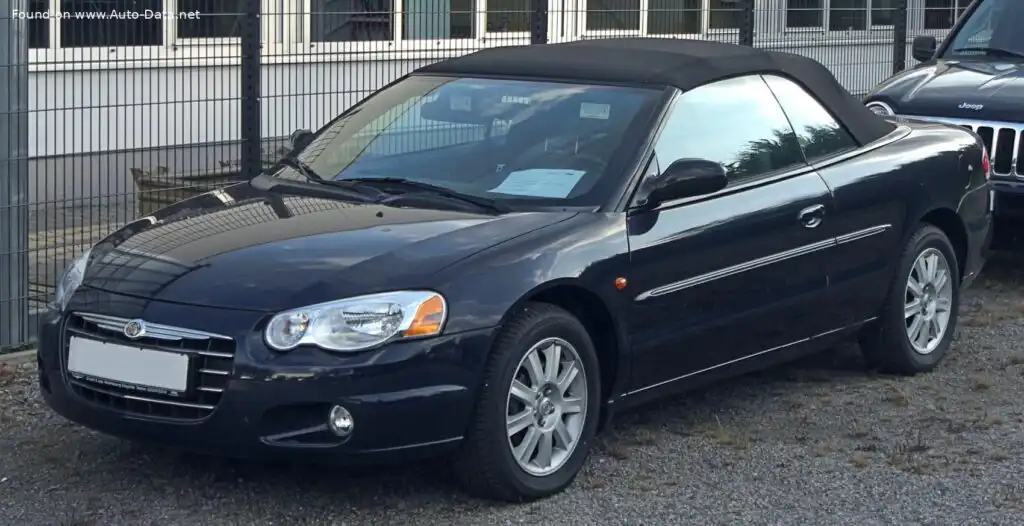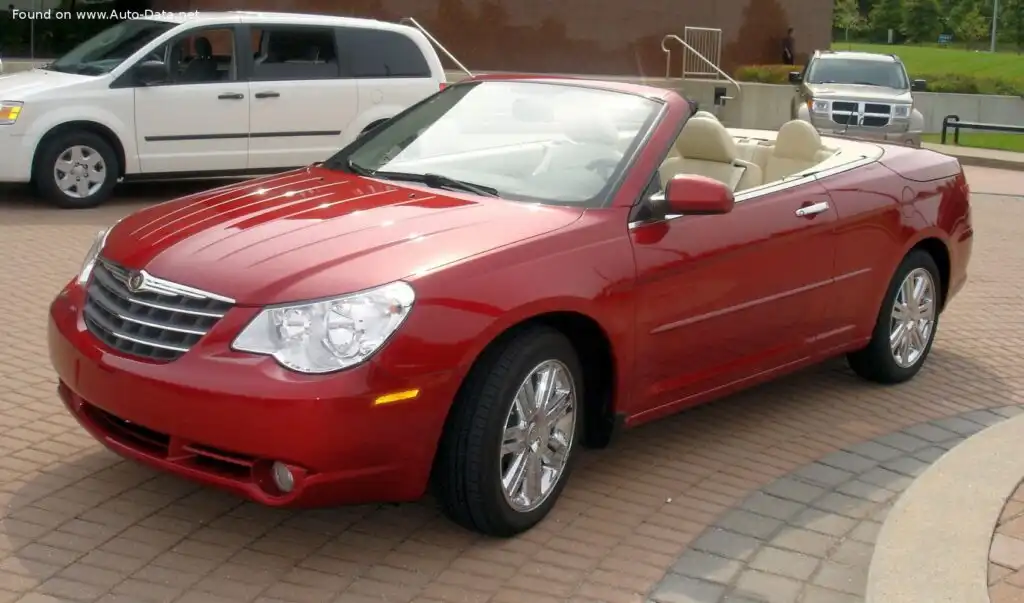
The Chrysler Sebring Sedan (JS) 2.7i V6 Automatic, produced between 2006 and 2010, represented a mid-range offering within the JS generation of the Sebring. Positioned above the base 2.4L four-cylinder models, it aimed to provide a balance of performance and affordability for American consumers seeking a comfortable and reasonably powerful family sedan. The JS Sebring was Chrysler’s attempt to revitalize the mid-size sedan segment, competing with established rivals like the Honda Accord, Toyota Camry, and Ford Fusion. This particular variant, with its 2.7-liter V6 engine and automatic transmission, was a popular choice for buyers prioritizing ease of driving and a more refined experience than the base models offered.
Technical Specifications
| Brand | Chrysler |
| Model | Sebring |
| Generation | Sebring Sedan (JS) |
| Type (Engine) | 2.7i V6 (188 Hp) Automatic |
| Start of production | 2006 |
| End of production | 2010 |
| Powertrain Architecture | Internal Combustion engine |
| Body type | Sedan |
| Seats | 5 |
| Doors | 4 |
| Fuel consumption (urban) | 10.7 l/100 km (22 US mpg) |
| Fuel consumption (extra urban) | 7.8 l/100 km (30.2 US mpg) |
| Fuel Type | Petrol (Gasoline) |
| Acceleration 0 – 100 km/h | 10.3 sec |
| Acceleration 0 – 62 mph | 10.3 sec |
| Acceleration 0 – 60 mph | 9.8 sec |
| Maximum speed | 206 km/h (128 mph) |
| Emission standard | Euro 5 |
| Weight-to-power ratio | 8.6 kg/Hp |
| Weight-to-torque ratio | 6.3 kg/Nm |
| Power | 188 Hp @ 6400 rpm |
| Torque | 256 Nm @ 4000 rpm (188.82 lb.-ft. @ 4000 rpm) |
| Engine layout | Front, Longitudinal |
| Engine Model/Code | EER |
| Engine displacement | 2736 cm3 (166.96 cu. in.) |
| Number of cylinders | 6 |
| Engine configuration | V-engine |
| Cylinder Bore | 86 mm (3.39 in.) |
| Piston Stroke | 78.5 mm (3.09 in.) |
| Compression ratio | 9.7:1 |
| Number of valves per cylinder | 4 |
| Fuel injection system | Multi-port manifold injection |
| Engine aspiration | Naturally aspirated engine |
| Valvetrain | DOHC |
| Engine oil capacity | 5.2 l (5.49 US qt | 4.58 UK qt) |
| Coolant capacity | 9.3 l (9.83 US qt | 8.18 UK qt) |
| Kerb Weight | 1615 kg (3560.47 lbs.) |
| Max. weight | 2040 kg (4497.43 lbs.) |
| Max load | 425 kg (936.96 lbs.) |
| Trunk (boot) space – minimum | 441 l (15.57 cu. ft.) |
| Fuel tank capacity | 64 l (16.91 US gal | 14.08 UK gal) |
| Length | 4850 mm (190.94 in.) |
| Width | 1843 mm (72.56 in.) |
| Height | 1497 mm (58.94 in.) |
| Wheelbase | 2767 mm (108.94 in.) |
| Front track | 1570 mm (61.81 in.) |
| Rear track | 1570 mm (61.81 in.) |
| Drivetrain Architecture | Front wheel drive |
| Number of gears | 6 |
| Gearbox type | Automatic transmission |
| Front suspension | Independent type McPherson |
| Rear suspension | Several levers and rods |
| Front brakes | Ventilated discs |
| Rear brakes | Disc |
| Assisting systems | ABS (Anti-lock braking system) |
| Steering type | Steering rack and pinion |
| Power steering | Hydraulic Steering |
| Tires size | 215/55 R18 |
| Wheel rims size | 7.0J x 18 |
Powertrain & Engine Architecture
The heart of the Sebring 2.7i was the EER engine, a 60-degree V6. This engine was part of Chrysler’s modular engine family, sharing design elements with other Chrysler, Dodge, and Jeep powerplants. The 2.7-liter displacement was achieved with a 86 mm bore and a 78.5 mm stroke. It featured a dual overhead camshaft (DOHC) valvetrain with four valves per cylinder, contributing to its relatively high output for its size. Fuel delivery was handled by a multi-port fuel injection system, providing precise fuel metering for optimal combustion. The engine’s 188 horsepower at 6400 rpm and 256 Nm (188.82 lb.-ft.) of torque at 4000 rpm provided adequate power for everyday driving. The engine was paired with a six-speed automatic transmission, offering smooth shifts and contributing to a comfortable driving experience. This transmission was a crucial component in making the V6 accessible to a wider range of drivers who preferred the convenience of an automatic.
Driving Characteristics
The Sebring 2.7i Automatic offered a comfortable and predictable driving experience. While not a performance-oriented vehicle, the V6 engine provided sufficient power for merging onto highways and passing other vehicles. The automatic transmission, while smooth, wasn’t particularly quick to downshift, resulting in a slightly less responsive feel compared to the manual transmission options available on other Sebring trims. The six-speed automatic helped to keep the engine in its optimal power band, but the overall acceleration of 0-60 mph in around 9.8 seconds was typical for a mid-size sedan of its era. The front-wheel-drive configuration provided decent traction in most conditions, but it wasn’t ideal for spirited driving. The suspension was tuned for comfort, absorbing bumps and road imperfections effectively, but at the expense of sharp handling.
Equipment & Trim Levels
The 2.7i V6 Automatic trim typically included features such as air conditioning, power windows and locks, a CD player with an auxiliary input, and cruise control. Higher trim levels, often denoted by “Limited” or “Touring” packages, added features like leather upholstery, heated front seats, a premium sound system, and alloy wheels. Optional extras included a sunroof, navigation system, and upgraded safety features. The interior design was generally functional and comfortable, though the materials used were not always of the highest quality. The Sebring aimed to provide a good value proposition, offering a reasonable level of equipment for its price point.
Chassis & Braking
The Sebring JS utilized an independent McPherson strut suspension in the front and a multi-link suspension in the rear. This setup provided a comfortable ride, but wasn’t particularly sporty. The front brakes were ventilated discs, offering good stopping power, while the rear brakes were solid discs. Anti-lock braking system (ABS) was standard, enhancing safety by preventing wheel lockup during hard braking. The steering was a hydraulic rack-and-pinion system, providing adequate feedback and precision. The standard tire size was 215/55 R18, mounted on 7.0J x 18 inch alloy wheels.
Market Reception & Comparison
The Sebring 2.7i Automatic received mixed reviews from automotive critics. While the V6 engine was praised for its smooth operation and adequate power, the overall driving experience was often described as unremarkable. Critics noted that the Sebring lacked the refinement and handling prowess of some of its Japanese competitors. Fuel economy was considered average for its class, with combined fuel consumption around 25 mpg. Compared to the base 2.4L four-cylinder model, the 2.7i offered a noticeable performance improvement, but at a higher price point. The 2.7i was also a more affordable alternative to the higher-end trims with more powerful engines. Reliability was generally considered average, with some reports of minor issues with the engine and transmission.
Legacy
The Chrysler Sebring 2.7i V6 Automatic, while not a standout performer, remains a relatively affordable and accessible option in the used car market. The EER V6 engine, when properly maintained, is generally considered to be a reliable powerplant. However, potential buyers should be aware of potential issues with the automatic transmission and the possibility of oil leaks. The Sebring’s comfortable ride and spacious interior make it a practical choice for families and commuters. While it may not offer the same level of prestige or driving excitement as some of its rivals, the Sebring 2.7i represents a solid value proposition for those seeking a reasonably priced and reliable mid-size sedan.