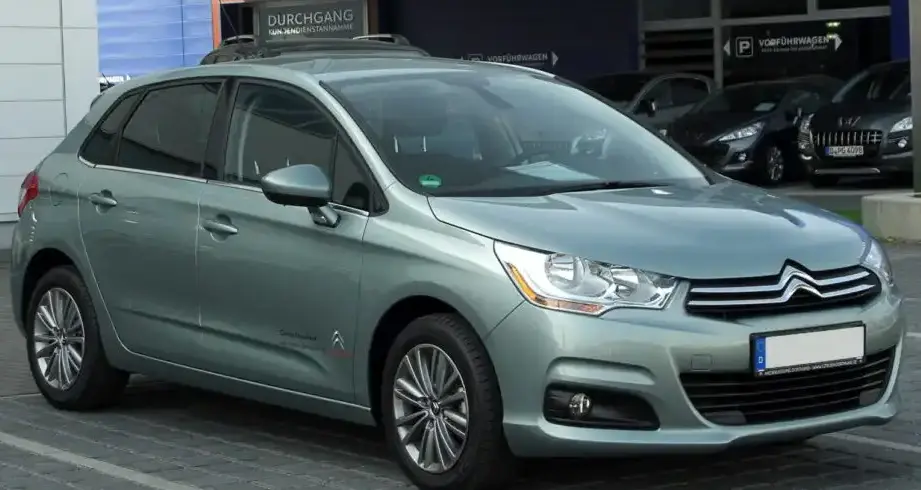
The Citroen C4 II Hatchback, specifically the 1.6 VTi (120 hp) Automatic variant, was produced between 2010 and 2014 as part of the second generation of the C4 model line. This version occupied a mid-range position within the C4 II lineup, offering a balance between fuel efficiency, comfort, and affordability. It was primarily marketed in Europe, aiming at buyers seeking a practical and reasonably equipped family hatchback with the convenience of an automatic transmission. The C4 II itself was built on the PSA Peugeot Citroen’s Platform 2, also known as the EMP2 platform, shared with models like the Peugeot 308.
Technical Specifications
| Brand | Citroen |
| Model | C4 |
| Generation | C4 II Hatchback (Phase I, 2010) |
| Type (Engine) | 1.6 VTi (120 Hp) Automatic |
| Start of production | 2010 |
| End of production | 2014 |
| Powertrain Architecture | Internal Combustion engine |
| Body type | Hatchback |
| Seats | 5 |
| Doors | 5 |
| Fuel consumption (urban) | 10 l/100 km (23.5 US mpg, 28.2 UK mpg, 10 km/l) |
| Fuel consumption (extra urban) | 5.1 l/100 km (46.1 US mpg, 55.4 UK mpg, 19.6 km/l) |
| Fuel consumption (combined) | 6.9 l/100 km (34.1 US mpg, 40.9 UK mpg, 14.5 km/l) |
| CO2 emissions | 159 g/km |
| Fuel Type | Petrol (Gasoline) |
| Acceleration 0 – 100 km/h | 12.5 sec |
| Acceleration 0 – 62 mph | 12.5 sec |
| Acceleration 0 – 60 mph | 11.9 sec |
| Maximum speed | 188 km/h (116.82 mph) |
| Emission standard | Euro 5 |
| Weight-to-power ratio | 10.6 kg/Hp, 94.5 Hp/tonne |
| Weight-to-torque ratio | 7.9 kg/Nm, 126 Nm/tonne |
| Power | 120 Hp @ 6000 rpm |
| Power per litre | 75.1 Hp/l |
| Torque | 160 Nm @ 4250 rpm (118.01 lb.-ft. @ 4250 rpm) |
| Engine layout | Front, Transverse |
| Engine Model/Code | 5FS EP6C |
| Engine displacement | 1598 cm3 (97.52 cu. in.) |
| Number of cylinders | 4 |
| Engine configuration | Inline |
| Cylinder Bore | 77 mm (3.03 in.) |
| Piston Stroke | 85.8 mm (3.38 in.) |
| Compression ratio | 11:1 |
| Number of valves per cylinder | 4 |
| Fuel injection system | Multi-port manifold injection |
| Engine aspiration | Naturally aspirated engine |
| Valvetrain | DOHC |
| Engine oil capacity | 4.25 l (4.49 US qt | 3.74 UK qt) |
| Kerb Weight | 1270 kg (2799.87 lbs.) |
| Max. weight | 1755 kg (3869.11 lbs.) |
| Max load | 485 kg (1069.24 lbs.) |
| Trunk (boot) space – minimum | 380 l (13.42 cu. ft.) |
| Trunk (boot) space – maximum | 1183 l (41.78 cu. ft.) |
| Fuel tank capacity | 60 l (15.85 US gal | 13.2 UK gal) |
| Permitted trailer load with brakes (8%) | 1510 kg (3328.98 lbs.) |
| Permitted trailer load with brakes (12%) | 1300 kg (2866.01 lbs.) |
| Permitted trailer load without brakes | 670 kg (1477.1 lbs.) |
| Permitted towbar download | 75 kg (165.35 lbs.) |
| Length | 4329 mm (170.43 in.) |
| Width | 1789 mm (70.43 in.) |
| Width including mirrors | 2050 mm (80.71 in.) |
| Height | 1489-1502 mm (58.62 – 59.13 in.) |
| Wheelbase | 2608 mm (102.68 in.) |
| Front track | 1522-1536 mm (59.92 – 60.47 in.) |
| Rear (Back) track | 1515-1529 mm (59.65 – 60.2 in.) |
| Front overhang | 935 mm (36.81 in.) |
| Rear overhang | 786 mm (30.94 in.) |
| Drag coefficient (Cd) | 0.30 |
| Minimum turning circle (turning diameter) | 10.7 m (35.1 ft.) |
| Drivetrain Architecture | The Internal combustion engine (ICE) drives the front wheels of the vehicle. |
| Drive wheel | Front wheel drive |
| Number of gears and type of gearbox | 4 gears, automatic transmission |
| Front suspension | Independent, type McPherson with coil spring and anti-roll bar |
| Rear suspension | Semi-independent, coil spring |
| Front brakes | Ventilated discs |
| Rear brakes | Disc |
| Assisting systems | ABS (Anti-lock braking system) |
| Steering type | Steering rack and pinion |
| Tires size | 205/55 R16; 225/45 R17 |
| Wheel rims size | 16; 17 |
Powertrain & Engine Architecture
The heart of this C4 variant is the 1.6-liter (1598cc) naturally aspirated inline-four cylinder engine, designated the 5FS EP6C. This engine is part of the Prince engine family, a collaborative development between PSA Peugeot Citroen and BMW. It features a double overhead camshaft (DOHC) valvetrain with four valves per cylinder, and multi-point fuel injection. The engine produces 120 horsepower at 6000 rpm and 160 Nm (118 lb-ft) of torque at 4250 rpm. The engine’s 11:1 compression ratio contributes to its efficiency. The engine is transversely mounted at the front of the vehicle. Paired with this engine is a four-speed automatic transmission, which, while providing convenience, is a relatively older design compared to more modern automatic gearboxes with more ratios.
Driving Characteristics
The 1.6 VTi Automatic C4 offers a comfortable, if not particularly sporty, driving experience. The four-speed automatic transmission, while smooth, lacks the responsiveness and efficiency of newer transmissions. Acceleration from 0-100 km/h takes around 12.5 seconds, making it adequate for everyday driving but not particularly quick. The engine feels somewhat strained when accelerating hard, and the limited number of gears means the engine often operates at higher revs, impacting fuel economy. Compared to the more powerful 1.6 THP turbocharged engine or the diesel variants, this version feels noticeably less energetic. The automatic transmission prioritizes smooth shifts over aggressive performance.
Equipment & Trim Levels
The 1.6 VTi Automatic trim typically included features such as air conditioning, electric front windows, a CD stereo with MP3 compatibility, and ABS brakes. Higher trim levels, often available as options, added features like alloy wheels, rear parking sensors, automatic headlights and wipers, and a more advanced infotainment system. Interior upholstery was generally cloth, with options for upgraded materials. The dashboard layout was functional and user-friendly, though the design was somewhat conservative compared to some competitors.
Chassis & Braking
The C4 II utilizes an independent McPherson strut suspension at the front and a semi-independent coil spring suspension at the rear. This setup provides a comfortable ride quality, absorbing bumps and imperfections in the road effectively. Front brakes are ventilated discs, while rear brakes are solid discs. ABS (Anti-lock Braking System) is standard, enhancing safety during emergency braking. The steering is a rack and pinion system, providing reasonable precision and feedback. Stabilizer bars are fitted to both the front and rear axles to reduce body roll during cornering.
Market Reception & Comparison
The Citroen C4 II 1.6 VTi Automatic was generally well-received as a practical and comfortable family hatchback. Critics praised its ride quality and spacious interior, but noted that the engine and transmission combination lacked the refinement and performance of some rivals. Fuel economy was considered average for its class. Compared to the diesel variants, the 1.6 VTi offered lower running costs in terms of fuel price but potentially higher maintenance costs due to the complexity of the petrol engine. The automatic transmission was seen as a convenience feature, but its age and limited number of gears were drawbacks.
Legacy
The 1.6 VTi engine, while generally reliable, has been known to exhibit occasional issues with the timing chain, particularly on higher mileage examples. The four-speed automatic transmission, while durable, is less efficient than modern automatic gearboxes. Today, the C4 II 1.6 VTi Automatic represents an affordable entry point into the used family hatchback market. Its simplicity and relatively low maintenance costs make it an attractive option for budget-conscious buyers. However, potential buyers should be aware of the potential timing chain issues and the limitations of the older automatic transmission.