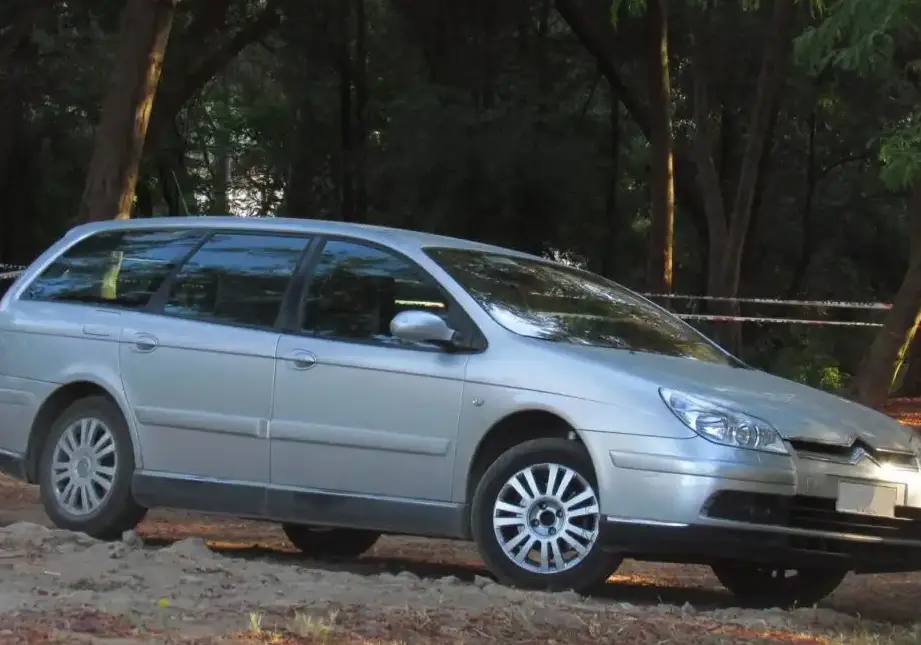
The Citroën C5 I Break (Phase II), specifically the 2.2 HDi 133 horsepower variant with an automatic transmission, represents a significant offering in the mid-size station wagon segment. Produced from 2004 to 2005, this version of the C5 aimed to balance fuel efficiency, practicality, and comfort for European drivers. It sat within the broader C5 I Break (Phase II) range, which was itself a facelift of the original C5 introduced in 2001, built on the PSA Group’s Platform 2 (also known as the 1HX0/A3 platform). This particular model was positioned as a mid-range option, offering a step up in performance and refinement compared to the lower-powered diesel engines, while remaining more accessible than the flagship petrol variants.
Technical Specifications
| Brand | Citroën |
| Model | C5 |
| Generation | C5 I Break (Phase II, 2004) |
| Type (Engine) | 2.2 HDi (133 Hp) FAP Automatic |
| Start of production | 2004 |
| End of production | 2005 |
| Powertrain Architecture | Internal Combustion engine |
| Body type | Station wagon (estate) |
| Seats | 5 |
| Doors | 5 |
| Fuel consumption (urban) | 9.8 l/100 km (24 US mpg, 28.8 UK mpg, 10.2 km/l) |
| Fuel consumption (extra urban) | 5.5 l/100 km (42.8 US mpg, 51.4 UK mpg, 18.2 km/l) |
| Fuel consumption (combined) | 7.1 l/100 km (33.1 US mpg, 39.8 UK mpg, 14.1 km/l) |
| CO2 emissions | 186 g/km |
| Fuel Type | Diesel |
| Acceleration 0 – 100 km/h | 11.6 sec |
| Acceleration 0 – 62 mph | 11.6 sec |
| Acceleration 0 – 60 mph | 11 sec |
| Maximum speed | 200 km/h (124.27 mph) |
| Emission standard | Euro 4 |
| Weight-to-power ratio | 12 kg/Hp, 83.6 Hp/tonne |
| Weight-to-torque ratio | 5 kg/Nm, 201.1 Nm/tonne |
| Power | 133 Hp @ 4000 rpm |
| Power per litre | 61 Hp/l |
| Torque | 320 Nm @ 2000 rpm (236.02 lb.-ft. @ 2000 rpm) |
| Engine layout | Front, Transverse |
| Engine Model/Code | 4HX DW12TED4 |
| Engine displacement | 2179 cm3 (132.97 cu. in.) |
| Number of cylinders | 4 |
| Engine configuration | Inline |
| Cylinder Bore | 85 mm (3.35 in.) |
| Piston Stroke | 96 mm (3.78 in.) |
| Compression ratio | 18:1 |
| Number of valves per cylinder | 4 |
| Fuel injection system | Diesel Commonrail |
| Engine aspiration | Turbocharger, Intercooler |
| Valvetrain | DOHC |
| Engine oil capacity | 4.75 l (5.02 US qt, 4.18 UK qt) |
| Coolant | 8.8 l (9.3 US qt, 7.74 UK qt) |
| Kerb Weight | 1591 kg (3507.55 lbs.) |
| Max. weight | 2171 kg (4786.24 lbs.) |
| Max load | 580 kg (1278.68 lbs.) |
| Trunk (boot) space – minimum | 563 l (19.88 cu. ft.) |
| Trunk (boot) space – maximum | 1658 l (58.55 cu. ft.) |
| Fuel tank capacity | 67 l (17.7 US gal, 14.74 UK gal) |
| Max. roof load | 75 kg (165.35 lbs.) |
| Permitted trailer load with brakes (12%) | 1300 kg (2866.01 lbs.) |
| Permitted trailer load without brakes | 750 kg (1653.47 lbs.) |
| Permitted towbar download | 75 kg (165.35 lbs.) |
| Length | 4839 mm (190.51 in.) |
| Width | 1780 mm (70.08 in.) |
| Height | 1511 mm (59.49 in.) |
| Wheelbase | 2750 mm (108.27 in.) |
| Front track | 1528 mm (60.16 in.) |
| Rear track | 1495 mm (58.86 in.) |
| Front overhang | 1033 mm (40.67 in.) |
| Rear overhang | 1056 mm (41.57 in.) |
| Minimum turning circle | 12.43 m (40.78 ft.) |
| Drivetrain Architecture | Front wheel drive |
| Number of gears | 4 |
| Gearbox type | Automatic transmission |
| Front suspension | Independent, type McPherson with coil spring and anti-roll bar |
| Rear suspension | Semi-independent, coil spring |
| Front brakes | Ventilated discs |
| Rear brakes | Disc |
| Assisting systems | ABS (Anti-lock braking system) |
| Tires size | 215/55 R16 |
| Wheel rims size | 16 |
Powertrain & Engine Architecture
The heart of this C5 variant is the 4HX DW12TED4 engine, a 2.2-liter inline-four cylinder diesel. This engine is a product of PSA’s collaboration with Ford, and is known for its robust construction and relatively straightforward maintenance. It utilizes a common rail direct injection system, delivering fuel at extremely high pressure for improved combustion efficiency and reduced emissions. The engine is turbocharged and intercooled, boosting power output to 133 horsepower and 320 Nm (236 lb-ft) of torque. The automatic transmission is a four-speed unit, designed to provide smooth shifts and ease of driving, particularly in urban environments. This transmission, while not as sophisticated as modern automatics, was considered reliable for its time.
Driving Characteristics
The 2.2 HDi automatic C5 Break offered a comfortable and relaxed driving experience. While not particularly sporty, the engine provided adequate power for everyday driving and highway cruising. The automatic transmission, while smooth, did impact acceleration compared to the manual versions. The 0-60 mph time of around 11 seconds reflects this. The gear ratios were optimized for fuel economy and mid-range torque, making it easy to maintain speed on the open road. The C5’s renowned hydropneumatic suspension (though evolving from earlier iterations) contributed to a remarkably smooth ride, absorbing bumps and imperfections in the road surface effectively.
Equipment & Trim Levels
The 2.2 HDi automatic trim typically included features such as air conditioning, power windows, central locking, and an RDS radio. Higher trim levels, often denoted by “Exclusive” or similar designations, added features like leather upholstery, automatic headlights and wipers, a multi-function steering wheel, and upgraded audio systems. Safety features included ABS brakes, front airbags, and often side airbags depending on the specific year and market. The interior design was functional and comfortable, prioritizing ergonomics and practicality.
Chassis & Braking
The C5 I Break featured independent front suspension with McPherson struts and a coil spring/anti-roll bar setup. The rear suspension was a semi-independent torsion beam arrangement. This configuration provided a good balance between ride comfort and handling. Braking duties were handled by ventilated discs at the front and solid discs at the rear. ABS was standard, enhancing braking performance and stability. The steering was power-assisted, offering light and precise control.
Market Reception & Comparison
The Citroën C5 I Break 2.2 HDi automatic was generally well-received by automotive critics. It was praised for its comfortable ride, spacious interior, and fuel efficiency. However, the automatic transmission was sometimes criticized for being slightly sluggish compared to the manual gearbox. Compared to the 1.8-liter petrol versions, the 2.2 HDi offered significantly better fuel economy and torque, making it a more practical choice for long-distance driving. Against competitors like the Ford Mondeo Estate and Volkswagen Passat Variant, the C5 distinguished itself with its unique hydropneumatic suspension and distinctive styling.
Legacy
The 4HX DW12TED4 engine, when properly maintained, proved to be a durable and reliable unit. Common issues included occasional problems with the fuel injectors and the diesel particulate filter (DPF), particularly on vehicles that primarily saw short journeys. The automatic transmission, while generally robust, could experience wear and tear over time. Today, the C5 I Break 2.2 HDi automatic represents an affordable and practical option in the used car market. Its comfortable ride, spacious interior, and reasonable fuel economy continue to appeal to buyers seeking a well-rounded family vehicle. However, potential buyers should be aware of the potential maintenance costs associated with the DPF and the age of the vehicle.