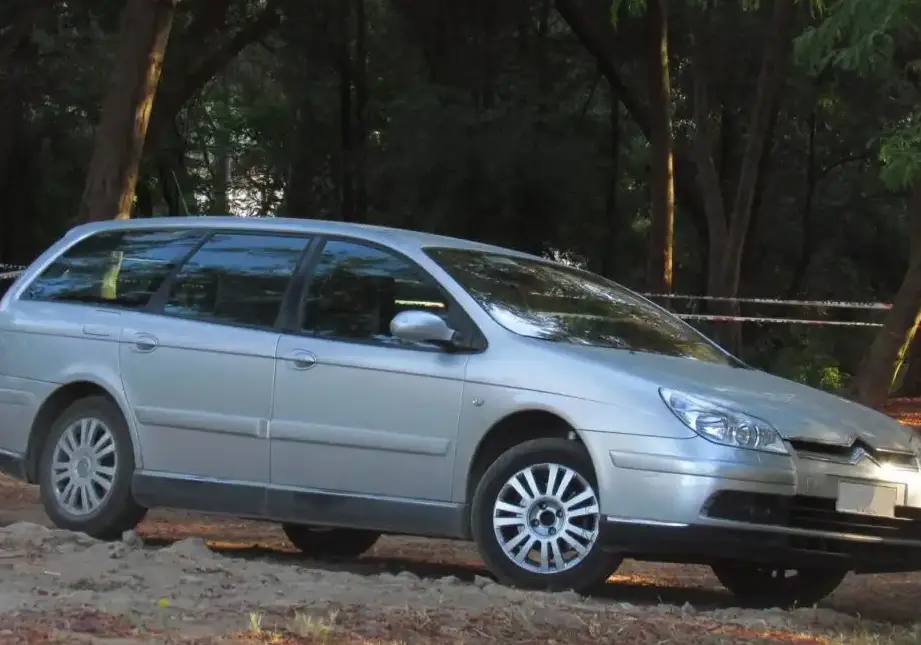
The Citroën C5 I Break (Phase II), specifically the 2.2 HDi Biturbo 170 hp variant produced between 2006 and 2008, represents a sophisticated evolution of Citroën’s large family car. Positioned as a premium offering within the C5 Break (estate) range, this model aimed to combine practicality, comfort, and performance. It built upon the foundation of the X7 platform (also known as the 1HX0/A3 platform), shared with the Peugeot 607, offering a spacious and well-equipped vehicle for families and long-distance travelers. The Phase II facelift brought styling updates and refinements to the original C5 I, enhancing its appeal in the European market.
Technical Specifications
| Brand | Citroen |
| Model | C5 |
| Generation | C5 I Break (Phase II, 2004) |
| Type (Engine) | 2.2 HDi Biturbo (170 Hp) FAP |
| Start of production | 2006 |
| End of production | 2008 |
| Powertrain Architecture | Internal Combustion engine |
| Body type | Station wagon (estate) |
| Seats | 5 |
| Doors | 5 |
| Fuel consumption (urban) | 8.2 l/100 km (28.7 US mpg, 34.4 UK mpg, 12.2 km/l) |
| Fuel consumption (extra urban) | 5.1 l/100 km (46.1 US mpg, 55.4 UK mpg, 19.6 km/l) |
| Fuel consumption (combined) | 6.2 l/100 km (37.9 US mpg, 45.6 UK mpg, 16.1 km/l) |
| Fuel Type | Diesel |
| Acceleration 0 – 100 km/h | 8.7 sec |
| Acceleration 0 – 62 mph | 8.7 sec |
| Acceleration 0 – 60 mph | 8.3 sec |
| Maximum speed | 217 km/h (134.84 mph) |
| Emission standard | Euro 4 |
| Weight-to-power ratio | 9.5 kg/Hp, 105.6 Hp/tonne |
| Weight-to-torque ratio | 4.4 kg/Nm, 229.8 Nm/tonne |
| Power | 170 Hp @ 4000 rpm |
| Power per litre | 78 Hp/l |
| Torque | 370 Nm @ 1500 rpm (272.9 lb.-ft. @ 1500 rpm) |
| Engine layout | Front, Transverse |
| Engine Model/Code | 4HT DW12BTED4 |
| Engine displacement | 2179 cm3 (132.97 cu. in.) |
| Number of cylinders | 4 |
| Engine configuration | Inline |
| Cylinder Bore | 85 mm (3.35 in.) |
| Piston Stroke | 96 mm (3.78 in.) |
| Compression ratio | 16.6:1 |
| Number of valves per cylinder | 4 |
| Fuel injection system | Diesel Commonrail |
| Engine aspiration | BiTurbo, Intercooler |
| Valvetrain | DOHC |
| Engine oil capacity | 5.25 l (5.55 US qt | 4.62 UK qt) |
| Coolant | 10.7 l (11.31 US qt | 9.41 UK qt) |
| Kerb Weight | 1610 kg (3549.44 lbs.) |
| Max. weight | 2170 kg (4784.03 lbs.) |
| Max load | 560 kg (1234.59 lbs.) |
| Trunk (boot) space – minimum | 563 l (19.88 cu. ft.) |
| Trunk (boot) space – maximum | 1658 l (58.55 cu. ft.) |
| Fuel tank capacity | 66 l (17.44 US gal | 14.52 UK gal) |
| Max. roof load | 75 kg (165.35 lbs.) |
| Permitted towbar download | 75 kg (165.35 lbs.) |
| Length | 4839 mm (190.51 in.) |
| Width | 1780 mm (70.08 in.) |
| Height | 1511 mm (59.49 in.) |
| Wheelbase | 2750 mm (108.27 in.) |
| Front track | 1528 mm (60.16 in.) |
| Rear (Back) track | 1495 mm (58.86 in.) |
| Front overhang | 1033 mm (40.67 in.) |
| Rear overhang | 1056 mm (41.57 in.) |
| Minimum turning circle | 12.43 m (40.78 ft.) |
| Drivetrain Architecture | Front wheel drive |
| Drive wheel | Front wheel drive |
| Number of gears | 6 gears, manual transmission |
| Front suspension | Independent, type McPherson with coil spring and anti-roll bar |
| Rear suspension | Semi-independent, coil spring |
| Front brakes | Ventilated discs |
| Rear brakes | Disc |
| Assisting systems | ABS (Anti-lock braking system) |
| Tires size | 215/55 R16 |
| Wheel rims size | 16 |
Powertrain & Engine Architecture
The heart of the C5 I Break 2.2 HDi Biturbo is the DW12BTED4 engine, a 2.2-liter inline-four diesel. This engine is notable for its use of a sequential twin-turbocharger setup. The smaller turbocharger provides quick response at low engine speeds, minimizing turbo lag, while the larger turbocharger delivers increased power at higher RPMs. This configuration, combined with a common rail direct fuel injection system, allows for a broad torque curve and strong performance. The engine produces 170 horsepower at 4000 rpm and a substantial 370 Nm (272.9 lb-ft) of torque at just 1500 rpm. The high compression ratio of 16.6:1 is typical for diesel engines, contributing to efficiency. The engine also features an intercooler to cool the intake air, further enhancing performance. The 6-speed manual transmission was the standard offering, providing a good balance between fuel economy and driver control.
Driving Characteristics
The 2.2 HDi Biturbo offered a compelling driving experience for a large estate car. The twin-turbo setup provided strong acceleration, with a 0-60 mph time of around 8.3 seconds and a top speed of 134.84 mph. The abundance of low-end torque made overtaking effortless, even when fully loaded. While not a sports car, the C5 I Break felt composed and stable at highway speeds. The manual transmission allowed for precise gear selection, and the gear ratios were well-matched to the engine’s power delivery. Compared to the base 1.8L petrol engine, the 2.2 HDi Biturbo offered significantly more power and torque, resulting in a much more relaxed and capable driving experience. It also outperformed the lower-powered diesel variants, such as the 1.6 HDi, in terms of both acceleration and overall refinement.
Equipment & Trim Levels
The 2.2 HDi Biturbo trim typically included a generous level of standard equipment. This often included automatic climate control, power windows and mirrors, a CD stereo system, and alloy wheels. Higher trim levels added features such as leather upholstery, a sunroof, and parking sensors. The C5 I Break was known for its comfortable and well-appointed interior, with a focus on practicality and usability. The Phase II facelift brought subtle improvements to the interior design and materials, enhancing the overall sense of quality.
Chassis & Braking
The C5 I Break featured a McPherson strut front suspension and a semi-independent coil spring rear suspension. This setup provided a good balance between ride comfort and handling. The car was equipped with ventilated disc brakes at the front and solid discs at the rear, providing adequate stopping power. ABS (Anti-lock Braking System) was standard, enhancing safety. The suspension was tuned to prioritize comfort, resulting in a smooth and compliant ride, even on rough roads.
Market Reception & Comparison
The Citroën C5 I Break 2.2 HDi Biturbo was generally well-received by automotive critics. It was praised for its comfortable ride, spacious interior, and strong performance. The twin-turbo diesel engine was particularly lauded for its responsiveness and fuel efficiency. Compared to competitors such as the Ford Mondeo Estate and Volkswagen Passat Variant, the C5 I Break offered a unique blend of French flair and practicality. Fuel economy was a strong point, with combined figures around 37.9 US mpg. Reliability was generally good, although some owners reported issues with the complex turbocharger system and the electronic parking brake.
Legacy
The 2.2 HDi Biturbo engine proved to be a durable and reliable powerplant when properly maintained. Today, well-maintained examples of the C5 I Break 2.2 HDi Biturbo can still be found on the used car market. While age and mileage are factors, these cars offer a comfortable and practical option for those seeking a spacious estate car with good fuel economy. The twin-turbo diesel engine remains a strong performer, and the C5 I Break continues to be appreciated for its unique character and comfortable ride.