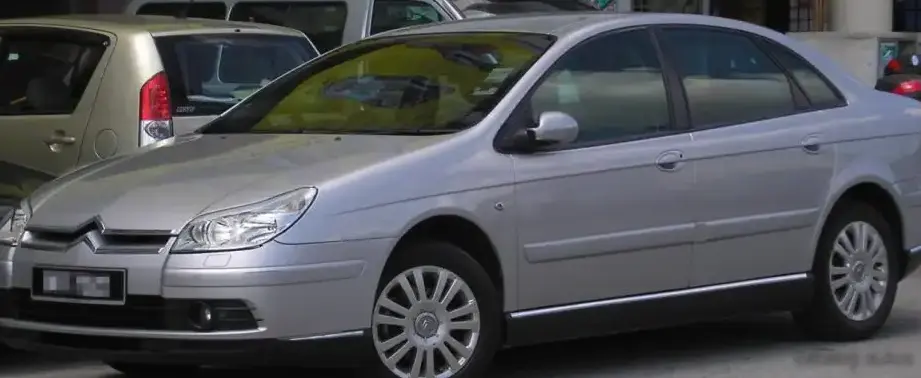
The Citroën C5 I (Phase II), specifically the 2.2 HDi 133 horsepower variant with an automatic transmission, represents a significant iteration of Citroën’s large family car, produced from 2004 to 2005. This model falls within the broader C5 I generation (produced from 2001-2008), known for its emphasis on comfort and innovative suspension technology. The Phase II update brought styling revisions and refinements to the powertrain options, including this 2.2-liter diesel. Positioned as a mid-range offering, it aimed to balance fuel efficiency with acceptable performance for long-distance cruising, appealing to families and business travelers alike. It was primarily sold in the European market, where large sedans and wagons remained popular.
Technical Specifications
| Brand | Citroen |
| Model | C5 |
| Generation | C5 I (Phase II, 2004) |
| Type (Engine) | 2.2 HDi (133 Hp) FAP Automatic |
| Start of production | 2004 |
| End of production | 2005 |
| Powertrain Architecture | Internal Combustion engine |
| Body type | Sedan |
| Seats | 5 |
| Doors | 4 |
| Fuel consumption (urban) | 9.8 l/100 km (24 US mpg, 28.8 UK mpg, 10.2 km/l) |
| Fuel consumption (extra urban) | 5.5 l/100 km (42.8 US mpg, 51.4 UK mpg, 18.2 km/l) |
| Fuel consumption (combined) | 7.1 l/100 km (33.1 US mpg, 39.8 UK mpg, 14.1 km/l) |
| CO2 emissions | 186 g/km |
| Fuel Type | Diesel |
| Acceleration 0 – 100 km/h | 11.3 sec |
| Acceleration 0 – 62 mph | 11.3 sec |
| Acceleration 0 – 60 mph | 10.7 sec |
| Maximum speed | 204 km/h (126.76 mph) |
| Emission standard | Euro 3 |
| Weight-to-power ratio | 11.7 kg/Hp, 85.4 Hp/tonne |
| Weight-to-torque ratio | 5 kg/Nm, 201.5 Nm/tonne |
| Power | 133 Hp @ 4000 rpm |
| Power per litre | 61 Hp/l |
| Torque | 314 Nm @ 2000 rpm (231.59 lb.-ft. @ 2000 rpm) |
| Engine layout | Front, Transverse |
| Engine Model/Code | 4HX DW12TED4 |
| Engine displacement | 2179 cm3 (132.97 cu. in.) |
| Number of cylinders | 4 |
| Engine configuration | Inline |
| Cylinder Bore | 85 mm (3.35 in.) |
| Piston Stroke | 96 mm (3.78 in.) |
| Compression ratio | 18:1 |
| Number of valves per cylinder | 4 |
| Fuel injection system | Diesel Commonrail |
| Engine aspiration | Turbocharger, Intercooler |
| Valvetrain | DOHC |
| Engine oil capacity | 4.75 l (5.02 US qt, 4.18 UK qt) |
| Coolant | 8.8 l (9.3 US qt, 7.74 UK qt) |
| Kerb Weight | 1558 kg (3434.8 lbs.) |
| Max. weight | 2078 kg (4581.21 lbs.) |
| Max load | 520 kg (1146.4 lbs.) |
| Trunk (boot) space – minimum | 471 l (16.63 cu. ft.) |
| Trunk (boot) space – maximum | 1315 l (46.44 cu. ft.) |
| Fuel tank capacity | 67 l (17.7 US gal, 14.74 UK gal) |
| Max. roof load | 75 kg (165.35 lbs.) |
| Permitted trailer load with brakes (12%) | 1400 kg (3086.47 lbs.) |
| Permitted trailer load without brakes | 750 kg (1653.47 lbs.) |
| Permitted towbar download | 75 kg (165.35 lbs.) |
| Length | 4745 mm (186.81 in.) |
| Width | 1780 mm (70.08 in.) |
| Height | 1476 mm (58.11 in.) |
| Wheelbase | 2750 mm (108.27 in.) |
| Front track | 1528 mm (60.16 in.) |
| Rear (Back) track | 1495 mm (58.86 in.) |
| Front overhang | 1033 mm (40.67 in.) |
| Rear overhang | 962 mm (37.87 in.) |
| Minimum turning circle | 12.43 m (40.78 ft.) |
| Drivetrain Architecture | Front wheel drive |
| Drive wheel | Front wheel drive |
| Number of gears and type of gearbox | 4 gears, automatic transmission |
| Front suspension | Independent, type McPherson with coil spring and anti-roll bar |
| Rear suspension | Semi-independent, coil spring |
| Front brakes | Ventilated discs |
| Rear brakes | Disc |
| Assisting systems | ABS (Anti-lock braking system) |
| Tires size | 215/55 R16 |
| Wheel rims size | 16 |
Powertrain & Engine Architecture
The heart of this C5 variant is the 4HX (DW12TED4) 2.2-liter inline-four diesel engine. This engine, a product of PSA Group (Peugeot Citroën), was a common sight in their vehicles during the early 2000s. It utilizes a common rail direct injection system, delivering fuel at extremely high pressure for improved combustion efficiency and reduced emissions. The engine is turbocharged and intercooled, boosting power output to 133 horsepower and 314 Nm (231.59 lb-ft) of torque. The valvetrain employs a double overhead camshaft (DOHC) design with four valves per cylinder, optimizing gas flow. The automatic transmission is a four-speed unit, designed for smooth operation and ease of use. While not offering the sporty responsiveness of a manual gearbox, it suited the C5’s comfort-oriented character. A particulate filter (FAP) was included to reduce soot emissions, a requirement for meeting Euro 3 standards.
Driving Characteristics
The 2.2 HDi automatic C5 offered a relaxed and comfortable driving experience. The 133 hp output, while not particularly brisk, provided adequate power for highway cruising and overtaking. The automatic transmission, while smooth, could feel somewhat sluggish in kickdown situations. The gear ratios were optimized for fuel economy rather than outright performance. Compared to the more powerful 2.0 HDi or petrol variants, this version prioritized efficiency and refinement over sporty handling. The torque curve was relatively flat, providing usable power across a wide rev range, making it easy to drive in everyday conditions. The C5’s renowned hydropneumatic suspension (depending on the specific trim level) further enhanced ride quality, absorbing bumps and imperfections in the road with ease.
Equipment & Trim Levels
The 2.2 HDi automatic typically came with a reasonable level of standard equipment. This included air conditioning, power windows, central locking, and an RDS stereo. Higher trim levels added features such as leather upholstery, automatic climate control, alloy wheels, and a trip computer. Safety features like ABS and front airbags were standard. Optional extras included rear parking sensors, a sunroof, and upgraded audio systems. Interior upholstery was generally cloth, with leather available as an upgrade. The dashboard layout was functional and ergonomically designed, prioritizing ease of use.
Chassis & Braking
The C5 I featured a front-wheel-drive layout. The front suspension utilized an independent McPherson strut setup with coil springs and an anti-roll bar, while the rear suspension was a semi-independent torsion beam arrangement with coil springs. This configuration provided a good balance between comfort and handling. Braking duties were handled by ventilated discs at the front and solid discs at the rear. ABS (Anti-lock Braking System) was standard, enhancing braking performance and stability. The steering was power-assisted, providing light and easy steering feel.
Market Reception & Comparison
The Citroën C5 I 2.2 HDi automatic was generally well-received by critics as a comfortable and practical family car. It was praised for its ride quality, spacious interior, and fuel efficiency. However, some reviewers noted that the automatic transmission could feel a bit slow and that the engine lacked the punch of some of its rivals. Compared to the 2.0 HDi variant, the 2.2 offered slightly more power but at the cost of slightly higher fuel consumption. The petrol engines provided more responsive performance but were less fuel-efficient. The C5 competed with other large family cars such as the Ford Mondeo, Volkswagen Passat, and Peugeot 607.
Legacy
The 4HX DW12TED4 engine, while not without its quirks, proved to be a relatively reliable unit when properly maintained. Common issues included injector problems and occasional turbocharger failures. The automatic transmission, while generally durable, could require servicing at higher mileages. Today, the C5 I 2.2 HDi automatic represents an affordable and comfortable used car option. Its spacious interior, good fuel economy, and comfortable ride continue to appeal to buyers looking for a practical and reliable family vehicle. However, potential buyers should be aware of the age-related issues common to vehicles of this era and ensure that the car has been well-maintained.