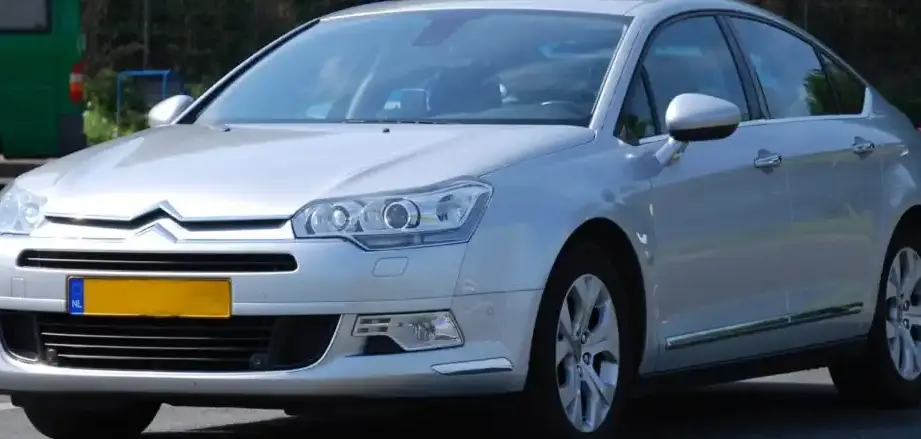
The Citroën C5 II (Phase I), produced from 2008 to 2012, represented a significant evolution in Citroën’s large family car offering. The 1.6 VTi 120 hp variant with the electronically controlled gearbox (EGS) was introduced in 2010, positioned as an entry-level to mid-range option within the C5 II lineup. This model aimed to provide a balance of affordability, reasonable performance, and Citroën’s renowned comfort, primarily targeting European markets where fuel efficiency and comfortable long-distance cruising were highly valued. It sat below the more powerful 2.0L petrol and HDi diesel options, and above the base 1.8L engine where available.
Technical Specifications
| Brand | Citroen |
| Model | C5 |
| Generation | C5 II (Phase I, 2008) |
| Type (Engine) | 1.6 VTi (120 Hp) EGS |
| Start of production | 2010 |
| End of production | 2012 |
| Powertrain Architecture | Internal Combustion engine |
| Body type | Sedan |
| Seats | 5 |
| Doors | 4 |
| Fuel consumption (urban) | 8.3 l/100 km (28.3 US mpg, 34 UK mpg, 12 km/l) |
| Fuel consumption (extra urban) | 5 l/100 km (47 US mpg, 56.5 UK mpg, 20 km/l) |
| Fuel consumption (combined) | 6.2 l/100 km (37.9 US mpg, 45.6 UK mpg, 16.1 km/l) |
| CO2 emissions | 144 g/km |
| Fuel Type | Petrol (Gasoline) |
| Acceleration 0 – 100 km/h | 12.2 sec |
| Acceleration 0 – 62 mph | 12.2 sec |
| Acceleration 0 – 60 mph | 11.6 sec |
| Maximum speed | 198 km/h (123.03 mph) |
| Emission standard | Euro 5 |
| Weight-to-power ratio | 11.9 kg/Hp, 84.2 Hp/tonne |
| Weight-to-torque ratio | 8.9 kg/Nm, 112.3 Nm/tonne |
| Power | 120 Hp @ 6000 rpm |
| Power per litre | 75.1 Hp/l |
| Torque | 160 Nm @ 4250 rpm (118.01 lb.-ft. @ 4250 rpm) |
| Engine layout | Front, Transverse |
| Engine Model/Code | 5FS EP6C |
| Engine displacement | 1598 cm3 (97.52 cu. in.) |
| Number of cylinders | 4 |
| Engine configuration | Inline |
| Cylinder Bore | 77 mm (3.03 in.) |
| Piston Stroke | 85.8 mm (3.38 in.) |
| Compression ratio | 11:1 |
| Number of valves per cylinder | 4 |
| Fuel injection system | Multi-port manifold injection |
| Engine aspiration | Naturally aspirated engine |
| Valvetrain | DOHC |
| Engine oil capacity | 4.25 l (4.49 US qt | 3.74 UK qt) |
| Kerb Weight | 1425 kg (3141.59 lbs.) |
| Max. weight | 2018 kg (4448.93 lbs.) |
| Max load | 593 kg (1307.34 lbs.) |
| Trunk (boot) space – minimum | 439 l (15.5 cu. ft.) |
| Fuel tank capacity | 71 l (18.76 US gal | 15.62 UK gal) |
| Max. roof load | 80 kg (176.37 lbs.) |
| Permitted trailer load with brakes (12%) | 1570 kg (3461.26 lbs.) |
| Permitted trailer load without brakes | 750 kg (1653.47 lbs.) |
| Length | 4779 mm (188.15 in.) |
| Width | 1860 mm (73.23 in.) |
| Width including mirrors | 2096 mm (82.52 in.) |
| Height | 1451-1458 mm (57.13 – 57.4 in.) |
| Wheelbase | 2815 mm (110.83 in.) |
| Front track | 1586 mm (62.44 in.) |
| Rear (Back) track | 1557 mm (61.3 in.) |
| Front overhang | 1054 mm (41.5 in.) |
| Rear overhang | 910 mm (35.83 in.) |
| Minimum turning circle | 11.7 m (38.39 ft.) |
| Drivetrain Architecture | The Internal combustion engine (ICE) drives the front wheels of the vehicle. |
| Drive wheel | Front wheel drive |
| Number of gears and type of gearbox | 6 gears, automatic transmission EGS |
| Front suspension | Double wishbone |
| Rear suspension | Independent multi-link suspension |
| Front brakes | Ventilated discs |
| Rear brakes | Disc |
| Assisting systems | ABS (Anti-lock braking system) |
| Steering type | Steering rack and pinion |
| Power steering | Hydraulic Steering |
| Tires size | 225/60 R16 |
| Wheel rims size | 16 |
Powertrain & Engine Architecture
The heart of this C5 variant is the 1.6-liter (1598cc) inline-four cylinder petrol engine, designated the 5FS EP6C. This engine belongs to the Prince engine family, a collaborative development between PSA Peugeot Citroën and BMW. It features a double overhead camshaft (DOHC) valvetrain with four valves per cylinder, and multi-point fuel injection. The engine produces 120 horsepower at 6000 rpm and 160 Nm (118 lb-ft) of torque at 4250 rpm. The relatively high compression ratio of 11:1 contributes to its efficiency. The engine is transversely mounted at the front of the vehicle.
The EGS (Electronically Controlled Gearbox) transmission is a six-speed automated manual transmission. Unlike a traditional automatic with a torque converter, the EGS uses actuators to shift gears, offering a degree of control similar to a manual gearbox but without the need for a clutch pedal. It’s essentially a manual gearbox controlled by a computer, aiming to combine the efficiency of a manual with the convenience of an automatic.
Driving Characteristics
The 1.6 VTi EGS C5 offers a comfortable, if not particularly sporty, driving experience. Acceleration from 0-100 km/h (0-62 mph) takes around 12.2 seconds, and top speed is rated at 198 km/h (123 mph). The EGS transmission can sometimes exhibit slightly jerky shifts, especially at lower speeds, a common characteristic of early automated manual systems. Compared to the more powerful 2.0L petrol or HDi diesel versions, the 1.6L feels noticeably less responsive, particularly when overtaking. However, the gear ratios are well-chosen for relaxed cruising, and the engine is relatively quiet at highway speeds. The EGS transmission prioritizes fuel economy over rapid acceleration.
Equipment & Trim Levels
The 1.6 VTi EGS trim typically included standard features such as air conditioning, power windows, central locking, and an audio system with CD player. Higher trim levels, often denoted by additions like “Exclusive” or “Sensium,” added features like automatic climate control, rain-sensing wipers, parking sensors, and upgraded interior upholstery. Interior materials were generally of good quality, reflecting Citroën’s focus on comfort. Optional extras included a navigation system, leather seats, and a panoramic sunroof.
Chassis & Braking
The C5 II utilizes a double wishbone front suspension and an independent multi-link rear suspension, contributing to its comfortable ride quality. The front brakes are ventilated discs, while the rear brakes are solid discs. ABS (Anti-lock Braking System) is standard. The suspension is tuned for comfort rather than outright handling, prioritizing a smooth ride over sharp cornering. The hydraulic power steering provides a light and easy steering feel.
Market Reception & Comparison
The 1.6 VTi EGS C5 was generally well-received as a practical and comfortable family car. Critics praised its ride quality and fuel efficiency, but some noted the EGS transmission’s occasional jerkiness and the engine’s lack of outright power. Compared to the 2.0L petrol and HDi diesel variants, the 1.6L offered lower running costs but at the expense of performance. The HDi diesel models were particularly popular in Europe due to their superior fuel economy and torque. The 1.6L appealed to buyers who prioritized comfort and affordability over performance.
Legacy
The 1.6 VTi EGS C5 II has proven to be a relatively reliable vehicle, although the EGS transmission can be prone to issues if not properly maintained. Regular servicing, including fluid changes, is crucial for ensuring its longevity. In the used car market, these models represent a good value proposition for buyers seeking a comfortable and affordable family car. While not as sought-after as the more powerful variants, the 1.6L C5 II remains a viable option for those prioritizing fuel efficiency and a relaxed driving experience. The Prince engine itself has seen widespread use in various PSA and BMW models, establishing a reasonable parts availability and a growing body of knowledge regarding its maintenance.