Technical Specifications
| Brand | Citroen |
| Model | C5 |
| Generation | C5 II (Phase I, 2008) |
| Type (Engine) | 2.0 16V (140 Hp) Bioflex |
| Start of production | 2008 |
| End of production | 2009 |
| Powertrain Architecture | Internal Combustion engine |
| Body type | Sedan |
| Seats | 5 |
| Doors | 4 |
| Fuel consumption (economy) – urban | 12 l/100 km (19.6 US mpg, 23.5 UK mpg, 8.3 km/l) |
| Fuel consumption (economy) – urban (Ethanol – E85) | 15.5 l/100 km |
| Fuel consumption (economy) – extra urban | 6.3 l/100 km (37.3 US mpg, 44.8 UK mpg, 15.9 km/l) |
| Fuel consumption (economy) – extra urban (Ethanol – E85) | 9.1 l/100 km |
| Fuel consumption (economy) – combined | 8.4 l/100 km (28 US mpg, 33.6 UK mpg, 11.9 km/l) |
| Fuel consumption (economy) – combined (Ethanol – E85) | 11.4 l/100 km |
| CO2 emissions | 198 g/km |
| CO2 emissions (Ethanol – E85) | 189 g/km |
| Fuel Type | Petrol / Ethanol – E85 |
| Emission standard | Euro 4 |
| Weight-to-power ratio | 10.9 kg/Hp, 92 Hp/tonne |
| Weight-to-torque ratio | 7.6 kg/Nm, 131.5 Nm/tonne |
| Power | 140 Hp @ 6000 rpm |
| Power per litre | 70.1 Hp/l |
| Torque | 200 Nm @ 4000 rpm (147.51 lb.-ft. @ 4000 rpm) |
| Engine layout | Front, Transverse |
| Engine Model/Code | RFJ EW10A |
| Engine displacement | 1997 cm3 (121.86 cu. in.) |
| Number of cylinders | 4 |
| Engine configuration | Inline |
| Cylinder Bore | 85 mm (3.35 in.) |
| Piston Stroke | 88 mm (3.46 in.) |
| Compression ratio | 10.8:1 |
| Number of valves per cylinder | 4 |
| Fuel injection system | Multi-port manifold injection |
| Engine aspiration | Naturally aspirated engine |
| Valvetrain | DOHC |
| Engine oil capacity | 5 l (5.28 US qt | 4.4 UK qt) |
| Coolant | 9.4 l (9.93 US qt | 8.27 UK qt) |
| Kerb Weight | 1521 kg (3353.23 lbs.) |
| Max. weight | 2063 kg (4548.14 lbs.) |
| Max load | 542 kg (1194.91 lbs.) |
| Trunk (boot) space – minimum | 439 l (15.5 cu. ft.) |
| Max. roof load | 80 kg (176.37 lbs.) |
| Permitted trailer load with brakes (12%) | 1500 kg (3306.93 lbs.) |
| Permitted trailer load without brakes | 750 kg (1653.47 lbs.) |
| Permitted towbar download | 69 kg (152.12 lbs.) |
| Length | 4779 mm (188.15 in.) |
| Width | 1860 mm (73.23 in.) |
| Width including mirrors | 2096 mm (82.52 in.) |
| Height | 1451-1458 mm (57.13 – 57.4 in.) |
| Wheelbase | 2815 mm (110.83 in.) |
| Front track | 1586 mm (62.44 in.) |
| Rear (Back) track | 1557 mm (61.3 in.) |
| Front overhang | 1054 mm (41.5 in.) |
| Rear overhang | 910 mm (35.83 in.) |
| Minimum turning circle (turning diameter) | 11.7 m (38.39 ft.) |
| Drivetrain Architecture | The Internal combustion engine (ICE) drives the front wheels of the vehicle. |
| Drive wheel | Front wheel drive |
| Number of gears and type of gearbox | 5 gears, manual transmission |
| Front suspension | Double wishbone |
| Rear suspension | Independent multi-link suspension |
| Front brakes | Ventilated discs |
| Rear brakes | Disc |
| Assisting systems | ABS (Anti-lock braking system) |
| Steering type | Steering rack and pinion |
| Power steering | Hydraulic Steering |
| Tires size | 225/55 R17 |
| Wheel rims size | 17 |
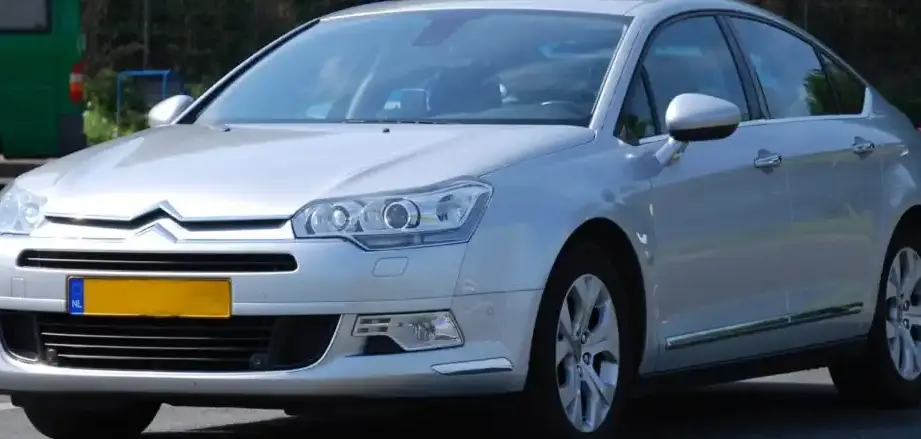
The Citroën C5 II (Phase I), produced between 2008 and 2009, marked a significant step forward in Citroën’s mid-size sedan lineup. The 2.0 16V (140 hp) Bioflex variant occupied a middle ground within the C5 II range, offering a more economical and flexible alternative to the higher-performance petrol engines and diesel options. Primarily aimed at European markets, this model blended comfort, practicality, and the ability to run on both petrol and E85 ethanol fuel. It was built on the PSA Group’s Platform 2, also known as the 1HX0 platform, which it shared with the Peugeot 407. This platform was designed to provide a comfortable ride and good handling characteristics.
Powertrain & Engine Architecture
The core of the C5 II 2.0 16V Bioflex is the RFJ (or sometimes EW10A) engine, a 1997cc inline-four cylinder petrol engine. This engine employs a multi-point fuel injection system and a double overhead camshaft (DOHC) valvetrain, operating with a compression ratio of 10.8:1. The ‘Bioflex’ designation signifies the engine’s capability to run on petrol, E85 ethanol, or any mixture of the two. This flexibility was a key selling point, especially in countries offering incentives for biofuel usage. The engine’s design prioritized refinement and fuel efficiency over outright performance. A five-speed manual transmission was the standard offering, engineered to provide smooth shifts and complement the engine’s torque curve. The engine management system was calibrated to automatically detect the ethanol content in the fuel and adjust engine parameters accordingly.
Driving Characteristics
The 140 horsepower output, combined with 200 Nm (147.51 lb.-ft.) of torque, delivered adequate performance for everyday driving. Acceleration was respectable, though not particularly quick. The emphasis was on providing a comfortable and relaxed driving experience. The five-speed manual transmission offered a reasonable spread of gears, but the engine lacked the low-end punch found in some of its turbocharged counterparts. Compared to the more powerful 2.0 16V petrol variants or the diesel options, the Bioflex version felt less eager to rev. However, running on E85 could provide a slight performance boost, albeit at the expense of increased fuel consumption. The gear ratios were tuned for fuel efficiency and smooth cruising, rather than aggressive acceleration.
Equipment & Trim Levels
The 2.0 16V Bioflex typically came equipped with a solid set of standard features. These included air conditioning, power windows, central locking, and an RDS stereo system. Higher trim levels, such as Exclusive, added features like automatic climate control, alloy wheels, and upgraded interior trim. Optional extras included a navigation system, leather upholstery, and parking sensors. Interior upholstery was generally cloth, prioritizing durability and comfort. The dashboard layout was functional and ergonomically designed, focusing on ease of use. The overall interior ambiance was one of understated elegance and practicality.
Chassis & Braking
The C5 II featured a comfortable and compliant suspension setup. The front suspension utilized a double wishbone design, while the rear employed an independent multi-link system. This combination provided a good balance between ride comfort and handling. Braking duties were handled by ventilated discs at the front and solid discs at the rear, equipped with an Anti-lock Braking System (ABS). The suspension was tuned for comfort, resulting in a softer ride compared to sportier rivals. Stabilizer bars were fitted to both the front and rear axles to minimize body roll during cornering. The steering was hydraulic power-assisted, providing a light and responsive feel.
Market Reception & Comparison
The C5 II 2.0 16V Bioflex was generally well-received by automotive critics as a practical and economical family car. Its ability to run on E85 was viewed as a positive attribute, particularly in environmentally conscious markets. However, some reviewers noted that the engine lacked the refinement and performance of some of its competitors. Compared to the diesel versions, the Bioflex offered lower torque but a potentially lower tax burden in some regions due to the biofuel capability. Fuel economy was competitive with other petrol engines in its class, but significantly lower when running on E85. The Bioflex model appealed to buyers seeking a balance between economy, practicality, and environmental responsibility.
Legacy
The Citroën C5 II 2.0 16V Bioflex, while not the most exciting variant in the range, proved to be a reliable and practical choice for many buyers. The RFJ engine is generally considered to be durable, with good long-term reliability. In the used car market, these models represent a relatively affordable entry point into C5 II ownership. Maintenance costs are generally reasonable, although sourcing parts for the E85-specific components may occasionally present a challenge. The Bioflex variant remains a testament to Citroën’s commitment to offering alternative fuel options and providing comfortable, family-friendly transportation. Its ability to run on renewable fuels continues to appeal to environmentally conscious drivers, and its overall reliability ensures it remains a viable option in the used car market.