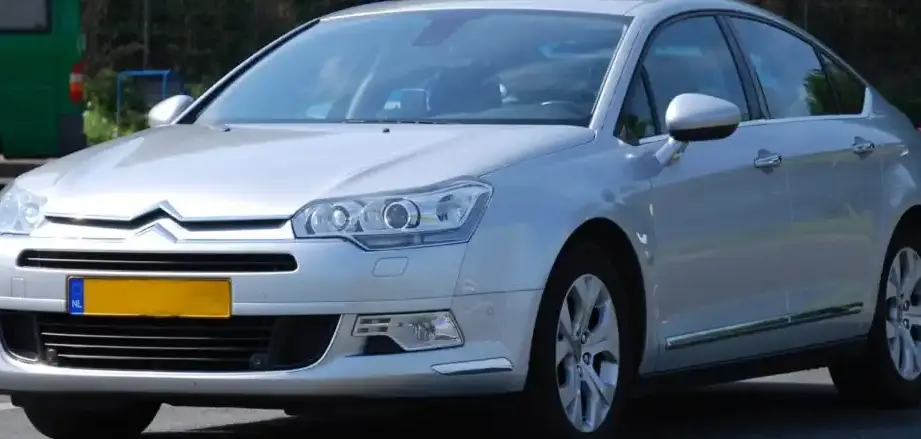
The Citroën C5 II (Phase I), produced from 2008 to 2010, represented a significant step forward for Citroën’s flagship sedan. The 2.0 HDi 163 Automatic variant, introduced in 2009, occupied a middle ground within the C5 II range, offering a balance between performance, fuel efficiency, and comfort. This model was primarily aimed at European markets, where diesel engines and automatic transmissions were increasingly popular for long-distance touring and daily commuting. It was positioned as a more refined and practical alternative to sportier or more basic trims, appealing to drivers seeking a comfortable and economical grand tourer.
Technical Specifications
| Brand | Citroen |
| Model | C5 |
| Generation | C5 II (Phase I, 2008) |
| Type (Engine) | 2.0 HDi (163 Hp) FAP Automatic |
| Start of production | 2009 |
| End of production | 2010 |
| Powertrain Architecture | Internal Combustion engine |
| Body type | Sedan |
| Seats | 5 |
| Doors | 4 |
| Fuel consumption (urban) | 8.9 l/100 km (26.4 US mpg, 31.7 UK mpg, 11.2 km/l) |
| Fuel consumption (extra urban) | 5.6 l/100 km (42 US mpg, 50.4 UK mpg, 17.9 km/l) |
| Fuel consumption (combined) | 6.8 l/100 km (34.6 US mpg, 41.5 UK mpg, 14.7 km/l) |
| CO2 emissions | 179 g/km |
| Fuel Type | Diesel |
| Acceleration 0 – 100 km/h | 10 sec |
| Acceleration 0 – 62 mph | 10 sec |
| Acceleration 0 – 60 mph | 9.5 sec |
| Maximum speed | 210 km/h (130.49 mph) |
| Emission standard | Euro 5 |
| Weight-to-power ratio | 9.9 kg/Hp, 101.3 Hp/tonne |
| Weight-to-torque ratio | 4.7 kg/Nm, 211.3 Nm/tonne |
| Power | 163 Hp @ 3750 rpm |
| Power per litre | 81.6 Hp/l |
| Torque | 340 Nm @ 2000 rpm (250.77 lb.-ft. @ 2000 rpm) |
| Maximum engine speed | 4200 rpm |
| Engine layout | Front, Transverse |
| Engine Model/Code | RHH DW10CTED4 |
| Engine displacement | 1997 cm3 (121.86 cu. in.) |
| Number of cylinders | 4 |
| Engine configuration | Inline |
| Cylinder Bore | 85 mm (3.35 in.) |
| Piston Stroke | 88 mm (3.46 in.) |
| Compression ratio | 16:1 |
| Number of valves per cylinder | 4 |
| Fuel injection system | Diesel Commonrail |
| Engine aspiration | Turbocharger, Intercooler |
| Valvetrain | DOHC |
| Engine oil capacity | 5 l (5.28 US qt | 4.4 UK qt) |
| Coolant | 11.5 l (12.15 US qt | 10.12 UK qt) |
| Kerb Weight | 1609 kg (3547.24 lbs.) |
| Max. weight | 2190 kg (4828.12 lbs.) |
| Max load | 581 kg (1280.89 lbs.) |
| Trunk (boot) space – minimum | 439 l (15.5 cu. ft.) |
| Fuel tank capacity | 71 l (18.76 US gal | 15.62 UK gal) |
| Max. roof load | 80 kg (176.37 lbs.) |
| Permitted trailer load with brakes (12%) | 1100 kg (2425.08 lbs.) |
| Permitted trailer load without brakes | 750 kg (1653.47 lbs.) |
| Permitted towbar download | 57 kg (125.66 lbs.) |
| Length | 4779 mm (188.15 in.) |
| Width | 1860 mm (73.23 in.) |
| Width including mirrors | 2096 mm (82.52 in.) |
| Height | 1451-1458 mm (57.13 – 57.4 in.) |
| Wheelbase | 2815 mm (110.83 in.) |
| Front track | 1586 mm (62.44 in.) |
| Rear (Back) track | 1557 mm (61.3 in.) |
| Front overhang | 1054 mm (41.5 in.) |
| Rear overhang | 910 mm (35.83 in.) |
| Minimum turning circle | 11.7 m (38.39 ft.) |
| Drivetrain Architecture | Front wheel drive |
| Number of gears and type of gearbox | 6 gears, automatic transmission |
| Front suspension | Double wishbone |
| Rear suspension | Independent multi-link suspension |
| Front brakes | Ventilated discs |
| Rear brakes | Disc |
| Assisting systems | ABS (Anti-lock braking system) |
| Steering type | Steering rack and pinion |
| Power steering | Hydraulic Steering |
| Tires size | 225/55 R17 |
| Wheel rims size | 17 |
Powertrain & Engine Architecture
The heart of the C5 II 2.0 HDi 163 Automatic is the DW10CTED4 engine, a 1997cc four-cylinder diesel. This engine, a product of PSA Peugeot Citroën’s development, utilizes a common rail direct injection system, delivering fuel at extremely high pressure for optimized combustion. The RHH engine code specifically denotes a version equipped with a Diesel Particulate Filter (DPF), or FAP in French (Filtre à Particules), to meet increasingly stringent Euro 5 emissions standards. The engine features a single overhead camshaft (SOHC) design operating four valves per cylinder (DOHC), and is turbocharged with an intercooler to enhance power and efficiency. The automatic transmission is a six-speed unit, providing smooth gear changes and contributing to the car’s relaxed cruising character. This transmission was designed to handle the engine’s 340 Nm (250.77 lb.-ft.) of torque, available from just 2000 rpm.
Driving Characteristics
The 2.0 HDi 163 Automatic offered a comfortable and refined driving experience. While not a performance-oriented variant, the engine provided adequate power for everyday driving and long-distance journeys. Acceleration from 0-60 mph took around 9.5 seconds, and top speed was rated at 130.49 mph. The automatic transmission, while smooth, could feel slightly hesitant at times, particularly during quick overtaking maneuvers. Compared to the manual transmission version of the same engine, the automatic offered less direct control, but greater convenience. The 163 hp output positioned it between the lower-powered 1.6 HDi models and the more potent 2.2 HDi variants. The gear ratios were tuned for fuel efficiency, prioritizing comfortable cruising over outright acceleration.
Equipment & Trim Levels
The 2.0 HDi 163 Automatic typically came equipped with a generous level of standard features. These included air conditioning, power windows, central locking, and an integrated audio system. Higher trim levels, such as Exclusive, added features like leather upholstery, automatic headlights and wipers, parking sensors, and a more advanced infotainment system. Optional extras included a panoramic sunroof, navigation system, and upgraded alloy wheels. Interior upholstery was generally cloth on base models, with leather available as an upgrade. The dashboard layout was functional and ergonomically designed, prioritizing ease of use.
Chassis & Braking
The C5 II featured a sophisticated suspension system designed for ride comfort. The front suspension utilized a double wishbone setup, while the rear employed an independent multi-link configuration. This combination provided a smooth and controlled ride, even on uneven surfaces. The 2.0 HDi Automatic models were equipped with ventilated disc brakes at the front and solid discs at the rear. Anti-lock Braking System (ABS) was standard, enhancing safety and stability during braking. The steering was hydraulic power-assisted, providing a responsive and precise feel.
Market Reception & Comparison
The Citroën C5 II 2.0 HDi 163 Automatic was generally well-received by automotive critics. It was praised for its comfortable ride, fuel efficiency, and refined interior. However, some reviewers noted the automatic transmission could be slow to respond at times. Compared to the 1.6 HDi models, the 2.0 HDi offered significantly more power and torque, making it a better choice for long-distance driving and carrying passengers. Against the 2.2 HDi, it offered a compromise between performance and fuel economy, appealing to buyers who didn’t require the extra power of the larger engine. Fuel economy figures of around 34.6 US mpg combined made it an attractive option for cost-conscious drivers.
Legacy
The DW10CTED4 engine, in its various iterations, proved to be a reliable and durable powerplant. While the Diesel Particulate Filter (DPF) could require maintenance over time, the engine itself was generally robust. Today, the C5 II 2.0 HDi 163 Automatic can be found as an affordable used car, offering a comfortable and economical option for those seeking a spacious and well-equipped sedan. Its reputation for reliability and fuel efficiency continues to make it a popular choice among used car buyers, particularly those looking for a long-distance cruiser.