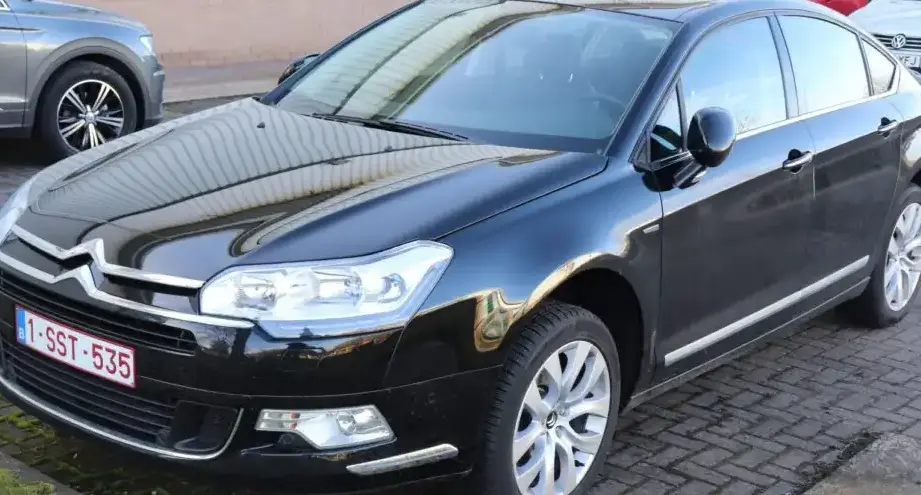
Technical Specifications
| Brand | Citroen |
| Model | C5 |
| Generation | C5 II (Phase II, 2012) |
| Type (Engine) | 1.6 e-HDi (114 Hp) Airdream EGS |
| Start of production | 2012 |
| End of production | 2015 |
| Powertrain Architecture | Internal Combustion engine |
| Body type | Sedan |
| Seats | 5 |
| Doors | 4 |
| Fuel consumption (urban) | 5.2 l/100 km (45.2 US mpg, 54.3 UK mpg, 19.2 km/l) |
| Fuel consumption (extra urban) | 4.1 l/100 km (57.4 US mpg, 68.9 UK mpg, 24.4 km/l) |
| Fuel consumption (combined) | 4.5 l/100 km (52.3 US mpg, 62.8 UK mpg, 22.2 km/l) |
| CO2 emissions | 117 g/km |
| Fuel Type | Diesel |
| Acceleration 0 – 100 km/h | 12.6 sec |
| Acceleration 0 – 62 mph | 12.6 sec |
| Acceleration 0 – 60 mph | 12 sec |
| Maximum speed | 190 km/h (118.06 mph) |
| Emission standard | Euro 5 |
| Weight-to-power ratio | 13.4 kg/Hp, 74.8 Hp/tonne |
| Weight-to-torque ratio | 5.6 kg/Nm, 177 Nm/tonne |
| Power | 114 Hp @ 3600 rpm |
| Power per litre | 73.1 Hp/l |
| Torque | 270 Nm @ 1750 rpm (199.14 lb.-ft. @ 1750 rpm) |
| Engine layout | Front, Transverse |
| Engine Model/Code | 9HR DV6C |
| Engine displacement | 1560 cm3 (95.2 cu. in.) |
| Number of cylinders | 4 |
| Engine configuration | Inline |
| Cylinder Bore | 75 mm (2.95 in.) |
| Piston Stroke | 88.3 mm (3.48 in.) |
| Compression ratio | 16:1 |
| Number of valves per cylinder | 2 |
| Fuel injection system | Diesel Commonrail |
| Engine aspiration | Turbocharger, Intercooler |
| Engine oil capacity | 3.7 l (3.91 US qt | 3.26 UK qt) |
| Kerb Weight | 1525 kg (3362.05 lbs.) |
| Max. weight | 2062 kg (4545.93 lbs.) |
| Max load | 537 kg (1183.88 lbs.) |
| Trunk (boot) space – minimum | 439 l (15.5 cu. ft.) |
| Fuel tank capacity | 71 l (18.76 US gal | 15.62 UK gal) |
| Max. roof load | 80 kg (176.37 lbs.) |
| Permitted trailer load with brakes (12%) | 1340 kg (2954.19 lbs.) |
| Permitted trailer load without brakes | 750 kg (1653.47 lbs.) |
| Length | 4779 mm (188.15 in.) |
| Width | 1860 mm (73.23 in.) |
| Width including mirrors | 2096 mm (82.52 in.) |
| Height | 1451-1458 mm (57.13 – 57.4 in.) |
| Wheelbase | 2815 mm (110.83 in.) |
| Front track | 1586 mm (62.44 in.) |
| Rear (Back) track | 1557 mm (61.3 in.) |
| Front overhang | 1054 mm (41.5 in.) |
| Rear overhang | 910 mm (35.83 in.) |
| Minimum turning circle | 11.5 m (37.73 ft.) |
| Drivetrain Architecture | Front wheel drive |
| Drive wheel | Front wheel drive |
| Number of gears and type of gearbox | 6 gears, automatic transmission EGS |
| Front suspension | Independent multi-link suspension |
| Rear suspension | Independent multi-link suspension |
| Front brakes | Ventilated discs |
| Rear brakes | Disc |
| Assisting systems | ABS (Anti-lock braking system) |
| Steering type | Steering rack and pinion |
| Power steering | Electric Steering |
| Tires size | 225/60 R16 |
| Wheel rims size | 16 |
The Citroën C5 II Phase II, launched in 2012, continued the C5’s reputation for ride comfort and practicality. The 1.6 e-HDi Airdream EGS variant, powered by the DV6C engine, was a key offering for buyers seeking a fuel-efficient and relatively affordable large family car. The “e-HDi” designation signified Citroën’s implementation of stop-start technology to further enhance fuel economy. The “Airdream” branding highlighted the model’s aerodynamic efficiency and low emissions. This version was positioned as a mid-range option, offering a step up from the base models in terms of equipment but remaining below the more powerful and luxurious trims.
Powertrain & Engine Architecture
The heart of the C5 1.6 e-HDi is the PSA Group’s DV6C engine, specifically the 9HR variant. This 1.6-liter, four-cylinder diesel engine utilizes a common rail direct injection system, delivering fuel at extremely high pressure for optimized combustion. A turbocharger with an intercooler is employed to boost power and torque. The engine produces 114 horsepower at 3600 rpm and 270 Nm (199 lb-ft) of torque at 1750 rpm. The engine features a 16:1 compression ratio and 2 valves per cylinder. The EGS (Electronically Controlled Gearbox) transmission is a semi-automatic system, essentially a conventional manual gearbox with automated clutch and gear shifting. It differs from a traditional torque converter automatic, offering quicker shifts but sometimes exhibiting less smoothness. The EGS transmission has 6 forward gears.
Driving Characteristics
The 1.6 e-HDi with the EGS transmission delivers adequate, but not exhilarating, performance. Acceleration from 0-62 mph takes around 12.6 seconds, and the top speed is 190 km/h (118 mph). The EGS transmission, while improving convenience, can feel somewhat jerky during low-speed maneuvers and gear changes. Compared to the manual versions of the 1.6 HDi, the EGS offers ease of use, particularly in urban traffic, but sacrifices some responsiveness. The higher-output 2.0 HDi models provide significantly more power and a more refined driving experience, but at the cost of increased fuel consumption and purchase price. The gear ratios are tuned for fuel efficiency, meaning the engine can feel strained when accelerating quickly or climbing hills.
Equipment & Trim Levels
The C5 1.6 e-HDi Airdream EGS typically came equipped with features such as air conditioning, electric front and rear windows, a CD/radio stereo system, and alloy wheels. Higher trim levels added features like automatic headlights and rain-sensing wipers, parking sensors, a navigation system, and leather upholstery. Interior upholstery was generally cloth, with options for partial leather. The dashboard layout was functional and ergonomically designed, prioritizing ease of use. Optional extras included a panoramic sunroof, xenon headlights, and a more advanced audio system.
Chassis & Braking
The C5 II features independent multi-link suspension on both the front and rear axles, contributing to its renowned ride comfort. The 1.6 e-HDi variant typically used ventilated disc brakes on the front wheels and solid discs on the rear. ABS (Anti-lock Braking System) was standard. The suspension was tuned to prioritize comfort over sporty handling, resulting in a smooth and composed ride, even on uneven surfaces. Stabilizer bars were fitted to both axles to reduce body roll during cornering.
Market Reception & Comparison
The C5 1.6 e-HDi Airdream EGS was generally well-received by critics for its fuel efficiency and comfortable ride. However, the EGS transmission received mixed reviews, with some testers finding it clunky and unresponsive. Compared to competitors like the Ford Mondeo and Volkswagen Passat, the C5 offered a unique blend of comfort and affordability. Fuel economy was a strong point, with combined figures around 52.3 US mpg. Reliability was generally good, although some owners reported issues with the EGS transmission and the diesel particulate filter (DPF).
Legacy
The 1.6 e-HDi engine and EGS transmission proved to be relatively durable, although the DPF system required regular maintenance to prevent clogging. In the used car market, the C5 1.6 e-HDi Airdream EGS represents a good value proposition for buyers seeking a comfortable and fuel-efficient large family car. However, potential buyers should be aware of the potential for issues with the EGS transmission and the DPF, and ensure that the vehicle has been properly maintained. The C5 II, in general, remains a popular choice for those prioritizing comfort and practicality over outright performance.