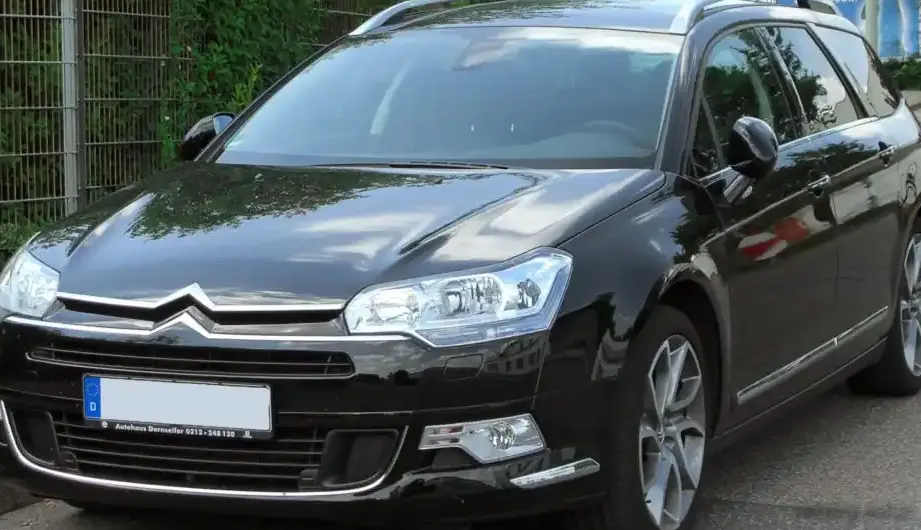
The Citroën C5 II Tourer 1.6 THP (156 hp) represents a compelling blend of practicality, comfort, and performance within the second generation of Citroën’s flagship family car. Produced between 2009 and 2010 as part of the Phase I refresh of the C5 II series (internally designated X7), this variant occupied a mid-range position in the Tourer (estate/wagon) body style lineup. It aimed to provide a more engaging driving experience than the diesel options while maintaining the C5’s renowned ride quality and spaciousness. The C5 II Tourer, built on the PSA Group’s Platform 4 (also known as the 1HX0 platform), was designed to compete with vehicles like the Ford Mondeo Estate, Volkswagen Passat Variant, and Peugeot 407 SW.
Technical Specifications
| Brand | Citroen |
| Model | C5 |
| Generation | C5 II Tourer (Phase I, 2008) |
| Type (Engine) | 1.6 THP (156 Hp) |
| Start of production | 2009 |
| End of production | 2010 |
| Powertrain Architecture | Internal Combustion engine |
| Body type | Station wagon (estate) |
| Seats | 5 |
| Doors | 5 |
| Fuel consumption (urban) | 9.9 l/100 km (23.8 US mpg, 28.5 UK mpg, 10.1 km/l) |
| Fuel consumption (extra urban) | 5.6 l/100 km (42 US mpg, 50.4 UK mpg, 17.9 km/l) |
| Fuel consumption (combined) | 7.2 l/100 km (32.7 US mpg, 39.2 UK mpg, 13.9 km/l) |
| CO2 emissions | 169 g/km |
| Fuel Type | Petrol (Gasoline) |
| Acceleration 0 – 100 km/h | 9 sec |
| Acceleration 0 – 62 mph | 9 sec |
| Acceleration 0 – 60 mph | 8.6 sec |
| Maximum speed | 210 km/h (130.49 mph) |
| Emission standard | Euro 5 |
| Weight-to-power ratio | 9.6 kg/Hp, 103.8 Hp/tonne |
| Weight-to-torque ratio | 6.3 kg/Nm, 159.7 Nm/tonne |
| Power | 156 Hp @ 6000 rpm |
| Power per litre | 97.6 Hp/l |
| Torque | 240 Nm @ 1400 rpm (177.01 lb.-ft. @ 1400 rpm) |
| Engine layout | Front, Transverse |
| Engine Model/Code | 5FV EP6DT |
| Engine displacement | 1598 cm3 (97.52 cu. in.) |
| Number of cylinders | 4 |
| Engine configuration | Inline |
| Cylinder Bore | 77 mm (3.03 in.) |
| Piston Stroke | 85.8 mm (3.38 in.) |
| Compression ratio | 10.5:1 |
| Number of valves per cylinder | 4 |
| Fuel injection system | Direct injection |
| Engine aspiration | Turbocharger, Intercooler |
| Valvetrain | DOHC |
| Engine oil capacity | 4.25 l (4.49 US qt | 3.74 UK qt) |
| Coolant | 6.2 l (6.55 US qt | 5.46 UK qt) |
| Kerb Weight | 1503 kg (3313.55 lbs.) |
| Max. weight | 2167 kg (4777.42 lbs.) |
| Max load | 664 kg (1463.87 lbs.) |
| Trunk (boot) space – minimum | 505 l (17.83 cu. ft.) |
| Trunk (boot) space – maximum | 1462 l (51.63 cu. ft.) |
| Fuel tank capacity | 71 l (18.76 US gal | 15.62 UK gal) |
| Max. roof load | 80 kg (176.37 lbs.) |
| Permitted trailer load with brakes (12%) | 1500 kg (3306.93 lbs.) |
| Permitted trailer load without brakes | 750 kg (1653.47 lbs.) |
| Permitted towbar download | 73 kg (160.94 lbs.) |
| Length | 4829 mm (190.12 in.) |
| Width | 1860 mm (73.23 in.) |
| Width including mirrors | 2096 mm (82.52 in.) |
| Height | 1491-1495 mm (58.7 – 58.86 in.) |
| Wheelbase | 2815 mm (110.83 in.) |
| Front track | 1586 mm (62.44 in.) |
| Rear (Back) track | 1557 mm (61.3 in.) |
| Front overhang | 1054 mm (41.5 in.) |
| Rear overhang | 960 mm (37.8 in.) |
| Minimum turning circle | 11.7 m (38.39 ft.) |
| Drivetrain Architecture | The Internal combustion engine (ICE) drives the front wheels of the vehicle. |
| Drive wheel | Front wheel drive |
| Number of gears and type of gearbox | 6 gears, manual transmission |
| Front suspension | Double wishbone |
| Rear suspension | Independent multi-link suspension |
| Front brakes | Ventilated discs |
| Rear brakes | Disc |
| Assisting systems | ABS (Anti-lock braking system) |
| Steering type | Steering rack and pinion |
| Power steering | Hydraulic Steering |
| Tires size | 225/60 R16 |
| Wheel rims size | 16 |
INTRODUCTION
The Citroën C5 II Tourer 1.6 THP 156, launched in 2009, was a key variant within the refreshed Phase I range of the C5 II. It aimed to broaden the appeal of the C5 Tourer by offering a petrol engine option that provided a balance between performance and fuel economy. The ‘THP’ designation signifies the engine’s use of direct injection and a twin-scroll turbocharger, technologies developed in partnership with BMW. This engine was a significant departure from Citroën’s traditionally diesel-focused European market, offering a more refined and responsive driving experience. The C5 II Tourer, in general, was designed to be a comfortable and practical family vehicle, emphasizing ride quality and interior space. This 1.6 THP variant aimed to attract buyers who preferred the characteristics of a petrol engine without sacrificing the utility of a station wagon.
Powertrain & Engine Architecture
At the heart of this C5 Tourer lies the PSA Group’s 5FV (EP6DT) 1.6-liter turbocharged four-cylinder petrol engine. This engine is a member of the Prince engine family, co-developed with BMW. It features direct fuel injection, a twin-scroll turbocharger, and a double overhead camshaft (DOHC) valvetrain with four valves per cylinder. The direct injection system, operating at pressures up to 120 bar, ensures precise fuel delivery for optimal combustion and efficiency. The twin-scroll turbocharger minimizes turbo lag and improves responsiveness across the rev range. The engine produces 156 horsepower at 6000 rpm and 240 Nm (177 lb-ft) of torque at 1400 rpm. The engine is transversely mounted at the front of the vehicle. The transmission is a 6-speed manual gearbox, chosen for its efficiency and driver engagement. While an automatic transmission was available on other C5 II variants, it wasn’t offered with this specific 1.6 THP engine.
Driving Characteristics
The 1.6 THP engine provides a noticeable step up in performance compared to the base-level petrol engines available in the C5 II range. Acceleration from 0-100 km/h (0-62 mph) takes around 9 seconds, making it feel reasonably brisk in everyday driving situations. The turbocharger delivers a strong mid-range punch, making overtaking maneuvers relatively effortless. The 6-speed manual gearbox is well-matched to the engine’s characteristics, offering precise shifts and allowing the driver to keep the engine within its optimal power band. Compared to the higher-output 2.0-liter petrol or diesel variants, the 1.6 THP feels less powerful, but it compensates with a lighter front end and a more eager response. The C5’s renowned hydropneumatic suspension (depending on trim level) contributes to a remarkably comfortable ride, absorbing bumps and imperfections in the road with ease. The steering is light and precise, although it lacks the ultimate feel of some competitors.
Equipment & Trim Levels
The 1.6 THP variant of the C5 II Tourer typically came equipped with a respectable level of standard features. These generally included air conditioning, electric front and rear windows, a CD stereo with auxiliary input, alloy wheels, and ABS brakes. Higher trim levels, such as Exclusive, added features like automatic climate control, rain-sensing wipers, parking sensors, and a more luxurious interior trim. Interior upholstery was typically cloth, with leather options available as an upgrade. The dashboard layout was functional and ergonomically designed, with a focus on ease of use. Optional extras included a navigation system, a panoramic sunroof, and xenon headlights.
Chassis & Braking
The C5 II Tourer features a double wishbone front suspension and an independent multi-link rear suspension, contributing to its excellent ride quality and handling. Depending on the trim level, some models were equipped with Citroën’s Hydractive III+ suspension system, which uses computer-controlled hydraulic spheres to adjust the damping characteristics in real-time, further enhancing ride comfort. Braking duties are handled by ventilated discs at the front and solid discs at the rear. ABS (Anti-lock Braking System) is standard, providing enhanced stopping power and stability. The steering is a rack and pinion system with hydraulic power assistance.
Market Reception & Comparison
The C5 II Tourer 1.6 THP was generally well-received by automotive critics. It was praised for its comfortable ride, spacious interior, and refined engine. However, some reviewers noted that the engine, while capable, lacked the outright performance of some of its rivals. Fuel economy was considered respectable, but not class-leading. Compared to the diesel variants, the 1.6 THP offered a more responsive and refined driving experience, but at the expense of slightly higher fuel consumption. Compared to the 2.0-liter petrol engine, the 1.6 THP provided a better balance between performance and economy, making it a more attractive option for buyers who didn’t require the extra power.
Legacy
The 5FV (EP6DT) 1.6 THP engine, while generally reliable, has been known to exhibit some issues related to carbon buildup on the intake valves, particularly if not regularly driven on longer journeys. Regular servicing and the use of quality fuel are essential to mitigate this risk. The C5 II Tourer 1.6 THP remains a relatively affordable and practical used car option today. Its comfortable ride, spacious interior, and decent fuel economy make it a good choice for families. However, potential buyers should be aware of the potential carbon buildup issue and ensure that the vehicle has been well-maintained.