Technical Specifications
| Brand | Citroen |
| Model | C5 |
| Generation | C5 II Tourer (Phase I, 2008) |
| Type (Engine) | 1.6 VTi (120 Hp) EGS |
| Start of production | 2010 |
| End of production | 2012 |
| Powertrain Architecture | Internal Combustion engine |
| Body type | Station wagon (estate) |
| Seats | 5 |
| Doors | 5 |
| Fuel consumption (urban) | 8.5 l/100 km (27.7 US mpg, 33.2 UK mpg, 11.8 km/l) |
| Fuel consumption (extra urban) | 5.2 l/100 km (45.2 US mpg, 54.3 UK mpg, 19.2 km/l) |
| Fuel consumption (combined) | 6.4 l/100 km (36.8 US mpg, 44.1 UK mpg, 15.6 km/l) |
| CO2 emissions | 149 g/km |
| Fuel Type | Petrol (Gasoline) |
| Acceleration 0 – 100 km/h | 12.9 sec |
| Acceleration 0 – 62 mph | 12.9 sec |
| Acceleration 0 – 60 mph | 12.3 sec |
| Maximum speed | 194 km/h (120.55 mph) |
| Emission standard | Euro 5 |
| Weight-to-power ratio | 12.5 kg/Hp, 80.1 Hp/tonne |
| Weight-to-torque ratio | 9.4 kg/Nm, 106.8 Nm/tonne |
| Power | 120 Hp @ 6000 rpm |
| Power per litre | 75.1 Hp/l |
| Torque | 160 Nm @ 4250 rpm (118.01 lb.-ft. @ 4250 rpm) |
| Engine layout | Front, Transverse |
| Engine Model/Code | 5FS EP6C |
| Engine displacement | 1598 cm3 (97.52 cu. in.) |
| Number of cylinders | 4 |
| Engine configuration | Inline |
| Cylinder Bore | 77 mm (3.03 in.) |
| Piston Stroke | 85.8 mm (3.38 in.) |
| Compression ratio | 11:1 |
| Number of valves per cylinder | 4 |
| Fuel injection system | Multi-port manifold injection |
| Engine aspiration | Naturally aspirated engine |
| Valvetrain | DOHC |
| Engine oil capacity | 4.25 l (4.49 US qt | 3.74 UK qt) |
| Kerb Weight | 1498 kg (3302.52 lbs.) |
| Max. weight | 2133 kg (4702.46 lbs.) |
| Max load | 635 kg (1399.94 lbs.) |
| Trunk (boot) space – minimum | 505 l (17.83 cu. ft.) |
| Trunk (boot) space – maximum | 1462 l (51.63 cu. ft.) |
| Fuel tank capacity | 71 l (18.76 US gal | 15.62 UK gal) |
| Max. roof load | 80 kg (176.37 lbs.) |
| Permitted trailer load with brakes (12%) | 1600 kg (3527.4 lbs.) |
| Permitted trailer load without brakes | 750 kg (1653.47 lbs.) |
| Permitted towbar download | 73 kg (160.94 lbs.) |
| Length | 4829 mm (190.12 in.) |
| Width | 1860 mm (73.23 in.) |
| Width including mirrors | 2096 mm (82.52 in.) |
| Height | 1491-1495 mm (58.7 – 58.86 in.) |
| Wheelbase | 2815 mm (110.83 in.) |
| Front track | 1586 mm (62.44 in.) |
| Rear (Back) track | 1557 mm (61.3 in.) |
| Front overhang | 1054 mm (41.5 in.) |
| Rear overhang | 960 mm (37.8 in.) |
| Minimum turning circle | 11.7 m (38.39 ft.) |
| Drivetrain Architecture | The Internal combustion engine (ICE) drives the front wheels of the vehicle. |
| Drive wheel | Front wheel drive |
| Number of gears and type of gearbox | 6 gears, automatic transmission EGS |
| Front suspension | Double wishbone |
| Rear suspension | Independent multi-link suspension |
| Front brakes | Ventilated discs |
| Rear brakes | Disc |
| Assisting systems | ABS (Anti-lock braking system) |
| Steering type | Steering rack and pinion |
| Power steering | Hydraulic Steering |
| Tires size | 225/60 R16 |
| Wheel rims size | 16 |
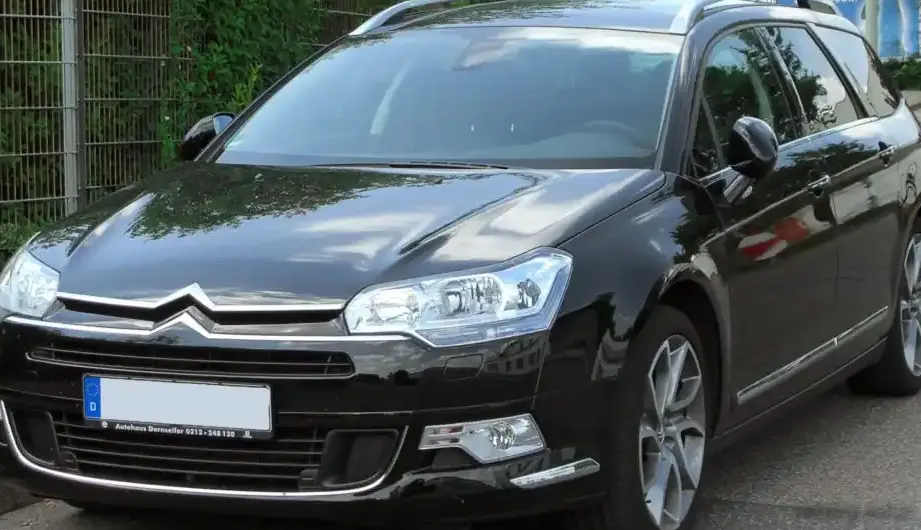
The Citroën C5 II Tourer 1.6 VTi (120 hp) EGS, produced between 2010 and 2012, occupied a mid-range position within the second-generation (X7) C5 Tourer lineup. Designed as a more economical alternative to the higher-powered petrol and diesel options, this model aimed to strike a balance between comfort, practicality, and fuel efficiency for family buyers. It falls within the Phase I refresh of the C5 II, which brought subtle styling updates and interior refinements. The C5 II Tourer, as a whole, served as Citroën’s flagship in the large family car segment, primarily competing with vehicles like the Ford Mondeo, Volkswagen Passat, and Peugeot 508 in the European market.
Powertrain & Engine Architecture
The C5 II Tourer 1.6 VTi utilizes the PSA Group’s 5FS EP6C engine, a 1.6-liter inline-four cylinder petrol engine. This engine is naturally aspirated, featuring multi-point fuel injection and a double overhead camshaft (DOHC) valvetrain. It produces 120 horsepower at 6000 rpm and 160 Nm (118 lb-ft) of torque at 4250 rpm. The engine’s compression ratio is 11:1. Paired with this engine is a six-speed Electronically Governed Sequential (EGS) automatic transmission. This transmission, while marketed as automatic, is technically an automated manual gearbox – a conventional manual transmission with actuators controlling the clutch and gear changes. It offered a smoother, more convenient driving experience than a traditional manual, but lacked the outright responsiveness of a conventional torque-converter automatic.
Driving Characteristics
The 1.6 VTi EGS powertrain delivered adequate, but not particularly exhilarating, performance. Acceleration from 0-100 km/h (0-62 mph) took approximately 12.9 seconds, and top speed was rated at 194 km/h (120.55 mph). The EGS transmission, while offering convenience, could sometimes exhibit hesitant shifts, particularly at lower speeds. Compared to the more powerful 2.0-liter petrol or 2.0-liter HDi diesel variants, the 1.6 VTi felt noticeably slower, especially when fully loaded. However, the lighter engine weight contributed to improved handling balance compared to the heavier diesel models. The gear ratios were tuned for fuel efficiency rather than outright performance, prioritizing comfortable cruising over spirited driving.
Equipment & Trim Levels
The 1.6 VTi EGS trim typically included standard features such as air conditioning, electric front and rear windows, a CD stereo with auxiliary input, and alloy wheels. Safety equipment included ABS, electronic brakeforce distribution, and front airbags. Higher trim levels, often denoted by ‘Exclusive’ or ‘Sensium’ designations, added features like automatic headlights and wipers, rear parking sensors, and upgraded interior trim materials. Optional extras included a panoramic sunroof, leather upholstery, and a navigation system.
Chassis & Braking
The C5 II Tourer featured a comfortable and refined chassis. The front suspension utilized a double wishbone setup, while the rear employed an independent multi-link system. This configuration provided a good balance of ride comfort and handling. The 1.6 VTi models typically used ventilated disc brakes at the front and solid discs at the rear. Hydraulic power steering provided light and precise steering feel. Stabilizer bars were fitted to both the front and rear axles to reduce body roll during cornering.
Market Reception & Comparison
The C5 II Tourer 1.6 VTi EGS was generally well-received as a practical and comfortable family car. Critics praised its spacious interior, comfortable ride, and relatively low running costs. However, the EGS transmission received mixed reviews, with some testers finding it jerky and unresponsive. Compared to the diesel variants, the 1.6 VTi offered a lower purchase price but higher fuel consumption. Against competitors like the Ford Mondeo and Volkswagen Passat, the C5 II Tourer stood out for its unique styling and emphasis on ride comfort.
Legacy
The 5FS EP6C engine, while generally reliable, is known to require regular maintenance, particularly regarding the timing chain. The EGS transmission, being a more complex system than a traditional automatic, can be prone to issues if not properly maintained. Today, the C5 II Tourer 1.6 VTi EGS represents an affordable entry point into the large family car segment. Parts availability is generally good, and the car’s relatively simple mechanicals make it a viable option for DIY mechanics. However, potential buyers should be aware of the potential issues with the timing chain and EGS transmission and ensure a thorough inspection before purchase.