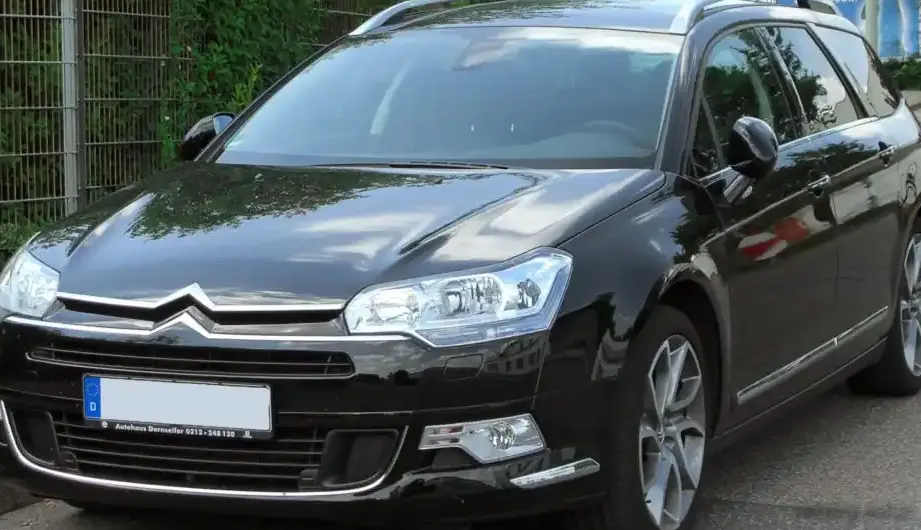
The Citroën C5 II Tourer 2.0 16V, produced between 2008 and 2009, represents a mid-range offering within the second generation (X7) C5 Tourer lineup. Positioned as a practical and comfortable family estate car, this variant aimed to balance performance with fuel efficiency, appealing to buyers seeking a spacious vehicle for long journeys. The C5 II, launched in 2004, was Citroën’s flagship model, intended to compete with vehicles like the Ford Mondeo and Volkswagen Passat. The Tourer body style, or station wagon, offered increased cargo capacity and versatility compared to the sedan version. This specific 2.0-liter engine and five-speed manual transmission combination was a popular choice in European markets, offering a compromise between the base 1.6-liter engine and the more powerful 2.2-liter options.
Technical Specifications
| Brand | Citroen |
| Model | C5 |
| Generation | C5 II Tourer (Phase I, 2008) |
| Type (Engine) | 2.0 16V (140 Hp) |
| Start of production | 2008 |
| End of production | 2009 |
| Powertrain Architecture | Internal Combustion engine |
| Body type | Station wagon (estate) |
| Seats | 5 |
| Doors | 5 |
| Fuel consumption (urban) | 12.1 l/100 km (19.4 US mpg, 23.3 UK mpg, 8.3 km/l) |
| Fuel consumption (extra urban) | 6.4 l/100 km (36.8 US mpg, 44.1 UK mpg, 15.6 km/l) |
| Fuel consumption (combined) | 8.5 l/100 km (27.7 US mpg, 33.2 UK mpg, 11.8 km/l) |
| CO2 emissions | 200 g/km |
| Fuel Type | Petrol (Gasoline) |
| Acceleration 0 – 100 km/h | 11.2 sec |
| Acceleration 0 – 62 mph | 11.2 sec |
| Acceleration 0 – 60 mph | 10.6 sec |
| Maximum speed | 206 km/h (128 mph) |
| Emission standard | Euro 4 |
| Weight-to-power ratio | 11.3 kg/Hp, 88.7 Hp/tonne |
| Weight-to-torque ratio | 7.9 kg/Nm, 126.7 Nm/tonne |
| Power | 140 Hp @ 6000 rpm |
| Power per litre | 70.1 Hp/l |
| Torque | 200 Nm @ 4000 rpm (147.51 lb.-ft. @ 4000 rpm) |
| Engine layout | Front, Transverse |
| Engine Model/Code | RFJ EW10A |
| Engine displacement | 1997 cm3 (121.86 cu. in.) |
| Number of cylinders | 4 |
| Engine configuration | Inline |
| Cylinder Bore | 85 mm (3.35 in.) |
| Piston Stroke | 88 mm (3.46 in.) |
| Compression ratio | 10.8:1 |
| Number of valves per cylinder | 4 |
| Fuel injection system | Multi-port manifold injection |
| Engine aspiration | Naturally aspirated engine |
| Engine oil capacity | 5 l (5.28 US qt | 4.4 UK qt) |
| Coolant | 9.4 l (9.93 US qt | 8.27 UK qt) |
| Kerb Weight | 1578 kg (3478.89 lbs.) |
| Max. weight | 2183 kg (4812.69 lbs.) |
| Max load | 605 kg (1333.8 lbs.) |
| Trunk (boot) space – minimum | 505 l (17.83 cu. ft.) |
| Trunk (boot) space – maximum | 1462 l (51.63 cu. ft.) |
| Fuel tank capacity | 71 l (18.76 US gal | 15.62 UK gal) |
| Max. roof load | 80 kg (176.37 lbs.) |
| Permitted trailer load with brakes (12%) | 1500 kg (3306.93 lbs.) |
| Permitted trailer load without brakes | 750 kg (1653.47 lbs.) |
| Permitted towbar download | 72 kg (158.73 lbs.) |
| Length | 4829 mm (190.12 in.) |
| Width | 1860 mm (73.23 in.) |
| Width including mirrors | 2096 mm (82.52 in.) |
| Height | 1491-1495 mm (58.7 – 58.86 in.) |
| Wheelbase | 2815 mm (110.83 in.) |
| Front track | 1586 mm (62.44 in.) |
| Rear (Back) track | 1557 mm (61.3 in.) |
| Front overhang | 1054 mm (41.5 in.) |
| Rear overhang | 960 mm (37.8 in.) |
| Minimum turning circle | 11.7 m (38.39 ft.) |
| Drivetrain Architecture | The Internal combustion engine (ICE) drives the front wheels of the vehicle. |
| Drive wheel | Front wheel drive |
| Number of gears and type of gearbox | 5 gears, manual transmission |
| Front suspension | Double wishbone |
| Rear suspension | Independent multi-link suspension |
| Front brakes | Ventilated discs |
| Rear brakes | Disc |
| Assisting systems | ABS (Anti-lock braking system) |
| Steering type | Steering rack and pinion |
| Power steering | Hydraulic Steering |
| Tires size | 225/55 R17 |
| Wheel rims size | 17 |
Powertrain & Engine Architecture
The C5 II Tourer 2.0 16V utilizes the EW10A engine, a naturally aspirated, inline-four cylinder petrol engine developed by PSA Peugeot Citroën. This engine, designated RFJ in Citroën’s nomenclature, features a displacement of 1997cc. It employs multi-point fuel injection and a dual overhead camshaft (DOHC) valvetrain with four valves per cylinder. The engine’s design prioritized smooth operation and reasonable fuel economy over outright performance. The five-speed manual transmission, a common unit in PSA vehicles of the era, provides a relatively conventional gear ratio spread. The transmission is front-wheel drive, typical for vehicles in this class and market segment.
Driving Characteristics
The 140 horsepower and 200 Nm (147.51 lb-ft) of torque offered by this engine configuration provided adequate, but not exhilarating, performance. Acceleration from 0-60 mph took approximately 10.6 seconds, and the top speed was around 128 mph. The engine felt most comfortable in the mid-range, offering sufficient power for overtaking maneuvers on highways. Compared to the more powerful 2.2-liter variants, the 2.0-liter felt less strained during acceleration, but lacked the same level of responsiveness. The manual transmission allowed for greater driver control compared to the optional automatic, and contributed to slightly improved fuel economy. The gear ratios were well-suited for cruising, but required frequent shifting when navigating hilly terrain.
Equipment & Trim Levels
The 2.0 16V variant of the C5 II Tourer typically came equipped with features such as air conditioning, power windows, central locking, and an RDS stereo system. Higher trim levels, such as Exclusive, added features like leather upholstery, automatic climate control, rain-sensing wipers, and parking sensors. Safety features included ABS brakes, front airbags, and side airbags. Optional extras included a panoramic sunroof, satellite navigation, and a premium sound system. Interior upholstery was generally cloth on the base models, with leather available as an upgrade.
Chassis & Braking
The C5 II Tourer featured a comfortable and refined chassis. The front suspension utilized a double wishbone setup, while the rear employed an independent multi-link suspension. This configuration provided a good balance between ride comfort and handling. The braking system consisted of ventilated discs on the front wheels and solid discs on the rear. ABS was standard, providing enhanced braking performance in emergency situations. The steering was hydraulic power-assisted, offering a light and precise feel.
Market Reception & Comparison
The Citroën C5 II Tourer 2.0 16V was generally well-received by automotive critics. It was praised for its comfortable ride, spacious interior, and practical estate car body style. However, some critics noted that the engine lacked the punch of its rivals, and the styling was considered somewhat conservative. Compared to the 2.2-liter variants, the 2.0-liter offered better fuel economy, but at the expense of performance. The 1.6-liter engine, while more affordable, was often criticized for being underpowered. The C5 II Tourer competed directly with vehicles like the Ford Mondeo Estate, Volkswagen Passat Estate, and Peugeot 407 SW.
Legacy
The EW10A engine, used in the C5 II Tourer 2.0 16V, is generally considered to be a reliable unit, provided it is properly maintained. Common issues include oil leaks and occasional problems with the ignition system. The five-speed manual transmission is also relatively robust. Today, these vehicles are readily available on the used car market at affordable prices. They represent a practical and comfortable option for buyers seeking a spacious estate car, but potential buyers should be aware of the age-related issues that may arise with older vehicles. The C5 II Tourer, particularly this 2.0-liter variant, remains a popular choice for those seeking a comfortable and reliable family car.