Technical Specifications
| Brand | Citroen |
| Model | C5 |
| Generation | C5 II Tourer (Phase I, 2008) |
| Type (Engine) | 2.0 16V (140 Hp) Automatic |
| Start of production | 2008 |
| End of production | 2009 |
| Powertrain Architecture | Internal Combustion engine |
| Body type | Station wagon (estate) |
| Seats | 5 |
| Doors | 5 |
| Fuel consumption (urban) | 12.8 l/100 km (18.4 US mpg, 22.1 UK mpg, 7.8 km/l) |
| Fuel consumption (extra urban) | 6.8 l/100 km (34.6 US mpg, 41.5 UK mpg, 14.7 km/l) |
| Fuel consumption (combined) | 9 l/100 km (26.1 US mpg, 31.4 UK mpg, 11.1 km/l) |
| CO2 emissions | 214 g/km |
| Fuel Type | Petrol (Gasoline) |
| Acceleration 0 – 100 km/h | 13.1 sec |
| Acceleration 0 – 62 mph | 13.1 sec |
| Acceleration 0 – 60 mph | 12.4 sec |
| Maximum speed | 203 km/h (126.14 mph) |
| Emission standard | Euro 4 |
| Weight-to-power ratio | 11.6 kg/Hp, 86.5 Hp/tonne |
| Weight-to-torque ratio | 8.1 kg/Nm, 123.5 Nm/tonne |
| Power | 140 Hp @ 6000 rpm |
| Power per litre | 70.1 Hp/l |
| Torque | 200 Nm @ 4000 rpm (147.51 lb.-ft. @ 4000 rpm) |
| Engine layout | Front, Transverse |
| Engine Model/Code | RFJ EW10A |
| Engine displacement | 1997 cm3 (121.86 cu. in.) |
| Number of cylinders | 4 |
| Engine configuration | Inline |
| Cylinder Bore | 85 mm (3.35 in.) |
| Piston Stroke | 88 mm (3.46 in.) |
| Compression ratio | 10.8:1 |
| Number of valves per cylinder | 4 |
| Fuel injection system | Multi-port manifold injection |
| Engine aspiration | Naturally aspirated engine |
| Engine oil capacity | 5 l (5.28 US qt | 4.4 UK qt) |
| Coolant | 9.8 l (10.36 US qt | 8.62 UK qt) |
| Kerb Weight | 1619 kg (3569.28 lbs.) |
| Max. weight | 2224 kg (4903.08 lbs.) |
| Max load | 605 kg (1333.8 lbs.) |
| Trunk (boot) space – minimum | 505 l (17.83 cu. ft.) |
| Trunk (boot) space – maximum | 1462 l (51.63 cu. ft.) |
| Fuel tank capacity | 71 l (18.76 US gal | 15.62 UK gal) |
| Max. roof load | 80 kg (176.37 lbs.) |
| Permitted trailer load with brakes (12%) | 1500 kg (3306.93 lbs.) |
| Permitted trailer load without brakes | 750 kg (1653.47 lbs.) |
| Permitted towbar download | 72 kg (158.73 lbs.) |
| Length | 4829 mm (190.12 in.) |
| Width | 1860 mm (73.23 in.) |
| Width including mirrors | 2096 mm (82.52 in.) |
| Height | 1491-1495 mm (58.7 – 58.86 in.) |
| Wheelbase | 2815 mm (110.83 in.) |
| Front track | 1586 mm (62.44 in.) |
| Rear (Back) track | 1557 mm (61.3 in.) |
| Front overhang | 1054 mm (41.5 in.) |
| Rear overhang | 960 mm (37.8 in.) |
| Minimum turning circle | 11.7 m (38.39 ft.) |
| Drivetrain Architecture | The Internal combustion engine (ICE) drives the front wheels of the vehicle. |
| Drive wheel | Front wheel drive |
| Number of gears and type of gearbox | 4 gears, automatic transmission |
| Front suspension | Double wishbone |
| Rear suspension | Independent multi-link suspension |
| Front brakes | Ventilated discs |
| Rear brakes | Disc |
| Assisting systems | ABS (Anti-lock braking system) |
| Steering type | Steering rack and pinion |
| Power steering | Hydraulic Steering |
| Tires size | 225/55 R17 |
| Wheel rims size | 17 |
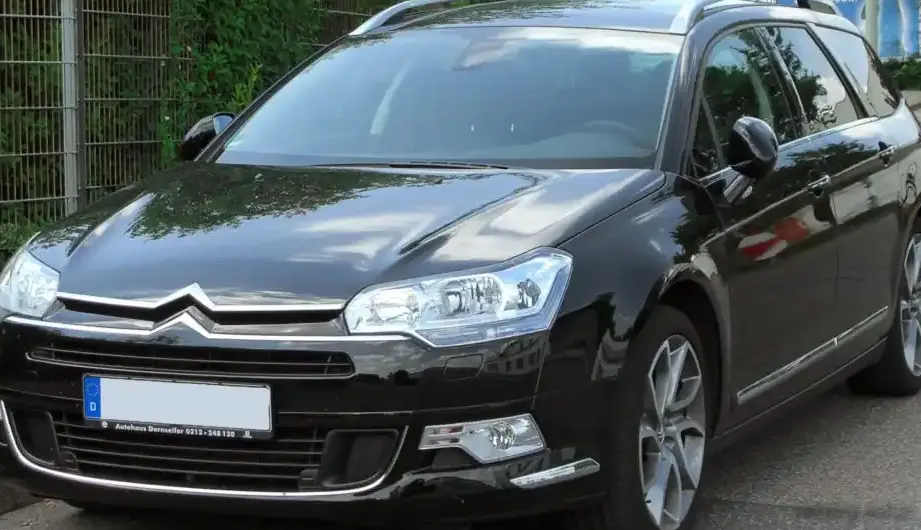
The Citroen C5 II Tourer, specifically the 2.0 16V (140 hp) automatic variant produced between 2008 and 2009, represents a compelling blend of comfort, practicality, and technology within the mid-size station wagon segment. Positioned as a mid-range offering within the broader C5 II Tourer lineup, this version aimed to provide a more accessible entry point to the model’s renowned hydropneumatic suspension and spacious interior, while still delivering adequate performance for everyday driving. It falls within the first phase (Phase I) of the C5 II generation (2004-2010), built on the PSA Group’s Platform 2. This variant was primarily marketed in Europe, where station wagons remained a popular body style, offering a comfortable and refined alternative to more mainstream competitors.
Powertrain & Engine Architecture
At the heart of this C5 Tourer variant lies the PSA Group’s EW10A engine, a 2.0-liter (1997 cc) inline-four cylinder petrol engine. Designated with the engine code RFJ, this unit features a 16-valve (four valves per cylinder) configuration and a compression ratio of 10.8:1. Fuel delivery is managed by a multi-port fuel injection system, providing a balance between efficiency and performance. The engine produces 140 horsepower at 6000 rpm and 200 Nm (147.51 lb-ft) of torque at 4000 rpm. The engine is transversely mounted in the front of the vehicle. Paired with this engine is a four-speed automatic transmission, designed for smooth and comfortable gear changes. While not offering the sportiness of a manual transmission, it catered to drivers prioritizing ease of use, particularly in urban environments.
Driving Characteristics
The 2.0 16V automatic C5 Tourer delivers a comfortable, rather than exhilarating, driving experience. Acceleration from 0-100 km/h (0-62 mph) takes approximately 13.1 seconds, and 0-60 mph in 12.4 seconds, making it adequate for most everyday driving situations but not particularly quick. The automatic transmission, while smooth, can feel somewhat dated by modern standards, with noticeable shifts and a tendency to hunt for gears on inclines. The gear ratios are optimized for fuel efficiency and cruising comfort rather than outright performance. Compared to the more powerful 2.2-liter petrol or the torquey 2.0 HDi diesel variants, this version feels noticeably less responsive. However, it offers a more refined and quieter driving experience than the diesel, and is generally more affordable to maintain.
Equipment & Trim Levels
The 2.0 16V automatic C5 Tourer typically came equipped with a reasonable level of standard features. These included air conditioning, power windows, central locking, a CD stereo system, and ABS brakes. Interior upholstery was generally cloth, with options for leather upgrades. Higher trim levels, often denoted by additions like “Exclusive” or “Luxe,” added features such as automatic climate control, rain-sensing wipers, parking sensors, and upgraded audio systems. The dashboard layout was characterized by a driver-focused design with intuitive controls. Optional extras included a panoramic sunroof, navigation system, and xenon headlights.
Chassis & Braking
The C5 II Tourer’s chassis is notable for its hydropneumatic suspension system, a Citroen hallmark. This system provides an exceptionally smooth and comfortable ride, absorbing bumps and imperfections in the road surface with ease. The 2.0 16V variant typically featured a steel suspension setup, although the hydropneumatic system was standard. Braking duties are handled by ventilated discs on the front wheels and solid discs on the rear. ABS (Anti-lock Braking System) is standard, enhancing safety and control during emergency braking. The steering is rack and pinion with hydraulic power assistance, providing a light and responsive feel.
Market Reception & Comparison
The 2.0 16V automatic C5 Tourer received generally positive reviews for its comfort, spaciousness, and ride quality. Critics praised the hydropneumatic suspension for its ability to deliver a smooth and refined driving experience. However, the engine was often criticized for being underpowered, particularly when fully loaded. Fuel economy, at around 9 l/100 km (26.1 US mpg), was considered average for its class. Compared to the 2.0 HDi diesel variant, the petrol version offered less torque and higher fuel consumption, but was generally quieter and more refined. The petrol engine also tended to be more reliable than the early iterations of the HDi diesel, which were prone to diesel particulate filter issues.
Legacy
The 2.0 16V automatic C5 II Tourer has proven to be a relatively reliable vehicle, with the EW10A engine being known for its durability. However, the hydropneumatic suspension system requires regular maintenance and can be expensive to repair if neglected. In the used car market, this variant represents a good value proposition for buyers seeking a comfortable and spacious station wagon. While not the most exciting or powerful option, it offers a compelling blend of practicality, comfort, and affordability. Parts availability is generally good, although specialist knowledge may be required for servicing the hydropneumatic suspension.