
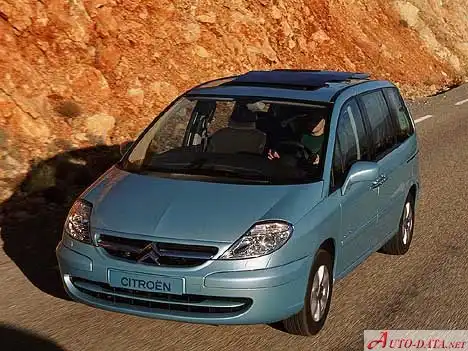
The Citroën C8 2.0 HDi 16V (109 hp) FAP, produced between 2002 and 2006, represents a key variant within the first generation (Phase I) of Citroën’s large MPV offering. Sharing a platform – the PSA Group’s 1HX0 – with the Peugeot 807 and Fiat Ulysse, the C8 aimed to provide a comfortable and spacious family vehicle. This particular engine and transmission combination occupied a mid-range position in the C8 lineup, offering a balance between fuel economy, practicality, and affordability. It was designed to appeal to families seeking a versatile vehicle for long journeys and everyday use, primarily in the European market.
Technical Specifications
| Brand | Citroën |
| Model | C8 |
| Generation | C8 (Phase I) |
| Type (Engine) | 2.0 HDi 16V (109 Hp) FAP |
| Start of production | 2002 |
| End of production | 2006 |
| Powertrain Architecture | Internal Combustion engine |
| Body type | Minivan, MPV |
| Seats | 7 |
| Doors | 5 |
| Fuel consumption (urban) | 9.4 l/100 km (25 US mpg, 30.1 UK mpg, 10.6 km/l) |
| Fuel consumption (extra urban) | 5.9 l/100 km (39.9 US mpg, 47.9 UK mpg, 16.9 km/l) |
| Fuel consumption (combined) | 7.2 l/100 km (32.7 US mpg, 39.2 UK mpg, 13.9 km/l) |
| CO2 emissions | 189 g/km |
| Fuel Type | Diesel |
| Acceleration 0 – 100 km/h | 14.6 sec |
| Acceleration 0 – 62 mph | 14.6 sec |
| Acceleration 0 – 60 mph | 13.9 sec |
| Maximum speed | 174 km/h (108.12 mph) |
| Emission standard | Euro 3 |
| Weight-to-power ratio | 15.7 kg/Hp, 63.7 Hp/tonne |
| Weight-to-torque ratio | 6.3 kg/Nm, 157.9 Nm/tonne |
| Power | 109 Hp @ 4000 rpm |
| Power per litre | 54.6 Hp/l |
| Torque | 270 Nm @ 1750 rpm (199.14 lb.-ft. @ 1750 rpm) |
| Engine layout | Front, Transverse |
| Engine Model/Code | RHW DW10ATED4 |
| Engine displacement | 1997 cm3 (121.86 cu. in.) |
| Number of cylinders | 4 |
| Engine configuration | Inline |
| Cylinder Bore | 85 mm (3.35 in.) |
| Piston Stroke | 88 mm (3.46 in.) |
| Compression ratio | 17.3:1 |
| Number of valves per cylinder | 4 |
| Fuel injection system | Diesel Commonrail |
| Engine aspiration | Turbocharger, Intercooler |
| Valvetrain | DOHC |
| Engine oil capacity | 4.8 l (5.07 US qt, 4.22 UK qt) |
| Coolant | 9.5 l (10.04 US qt, 8.36 UK qt) |
| Kerb Weight | 1710 kg (3769.9 lbs.) |
| Max. weight | 2505 kg (5522.58 lbs.) |
| Max load | 795 kg (1752.67 lbs.) |
| Trunk (boot) space – minimum | 225 l (7.95 cu. ft.) |
| Trunk (boot) space – maximum | 2948 l (104.11 cu. ft.) |
| Fuel tank capacity | 80 l (21.13 US gal, 17.6 UK gal) |
| Max. roof load | 100 kg (220.46 lbs.) |
| Length | 4727 mm (186.1 in.) |
| Width | 1854 mm (72.99 in.) |
| Width with mirrors folded | 1952 mm (76.85 in.) |
| Width including mirrors | 2205 mm (86.81 in.) |
| Height | 1766-1856 mm (69.53 – 73.07 in.) |
| Wheelbase | 2823 mm (111.14 in.) |
| Front track | 1570 mm (61.81 in.) |
| Rear (Back) track | 1548 mm (60.94 in.) |
| Front overhang | 1013 mm (39.88 in.) |
| Rear overhang | 891 mm (35.08 in.) |
| Minimum turning circle | 11.62 m (38.12 ft.) |
| Drivetrain Architecture | Front wheel drive |
| Number of gears | 5 |
| Gearbox type | Manual transmission |
| Front suspension | Independent, McPherson with coil spring and anti-roll bar |
| Rear suspension | Semi-independent, coil spring |
| Front brakes | Ventilated discs |
| Rear brakes | Disc |
| Assisting systems | ABS (Anti-lock braking system) |
| Steering type | Steering rack and pinion |
| Power steering | Hydraulic |
| Tires size | 205/65 R15 |
| Wheel rims size | 6.5J x 15 |
Powertrain & Engine Architecture
The heart of this C8 variant is the DW10ATED4 engine, a 2.0-liter, four-cylinder diesel engine. This engine, commonly found in PSA Group vehicles, utilizes a common rail direct injection system, delivering fuel at extremely high pressure for improved combustion efficiency and reduced emissions. The ‘16V’ designation indicates a four-valve-per-cylinder configuration, enhancing breathing and contributing to the engine’s power output. A turbocharger with an intercooler further boosts performance by forcing more air into the cylinders. The engine code ‘RHW’ specifically identifies this version, often associated with the inclusion of a Diesel Particulate Filter (DPF), denoted by the ‘FAP’ in the model name. This filter was crucial for meeting increasingly stringent European emission standards. The five-speed manual transmission was the standard offering for this trim level, chosen for its balance of cost-effectiveness and driver control.
Driving Characteristics
The 109 hp output, coupled with 270 Nm of torque, provided adequate, though not exhilarating, performance for the C8. Acceleration from 0-60 mph took around 13.9 seconds, and top speed was limited to 174 km/h (108 mph). The engine’s torque peak at 1750 rpm meant that usable power was available from relatively low engine speeds, making it well-suited for carrying passengers and luggage. Compared to the more powerful 2.2 HDi variants, this engine felt less strained during highway cruising and overtaking maneuvers. However, it required more deliberate downshifts to maintain speed when fully loaded. The five-speed manual gearbox offered a reasonable spread of ratios, but the shift quality wasn’t particularly sporty. The focus was on smooth, comfortable operation rather than engaging driving dynamics.
Equipment & Trim Levels
The 2.0 HDi 16V FAP trim typically included features such as air conditioning, power windows, central locking, and an RDS radio. Interior upholstery was generally cloth, with a functional, if not luxurious, design. Optional extras included features like alloy wheels, rear parking sensors, and a more advanced audio system. Higher trim levels, such as the Exclusive, added features like leather upholstery, automatic climate control, and a sunroof. The C8 prioritized practicality and space, with a flexible seating arrangement allowing for up to seven passengers. The rear seats could be folded flat or removed entirely to maximize cargo capacity.
Chassis & Braking
The C8’s chassis featured an independent McPherson strut suspension at the front and a semi-independent coil spring suspension at the rear. This setup prioritized ride comfort, absorbing bumps and imperfections in the road surface effectively. Front brakes were ventilated discs, providing good stopping power, while rear brakes were solid discs. ABS (Anti-lock Braking System) was standard, enhancing safety during emergency braking situations. The steering was hydraulic power-assisted, offering light and easy steering feel, particularly useful for maneuvering in tight spaces.
Market Reception & Comparison
The Citroën C8 2.0 HDi 16V FAP was generally well-received by critics as a practical and spacious MPV. Its fuel economy – around 32.7 US mpg combined – was a significant selling point, particularly in Europe where diesel fuel was often cheaper than gasoline. Compared to the more powerful 2.2 HDi variants, the 2.0 HDi offered a lower purchase price and slightly better fuel economy, but at the expense of performance. The 2.2 HDi was favored by those who frequently carried a full load of passengers or towed trailers. Reliability was generally good, although the DPF (Diesel Particulate Filter) could be prone to clogging if the vehicle was primarily used for short journeys.
Legacy
The Citroën C8 2.0 HDi 16V FAP remains a relatively common sight on European roads today. The DW10ATED4 engine, while not known for being particularly refined, is generally considered durable and reliable if properly maintained. The DPF can still be a potential issue for owners, requiring periodic cleaning or replacement. In the used car market, this variant represents a good value proposition for families seeking a spacious and economical MPV. Its practicality and relatively low running costs continue to make it an appealing option, despite its age.
