
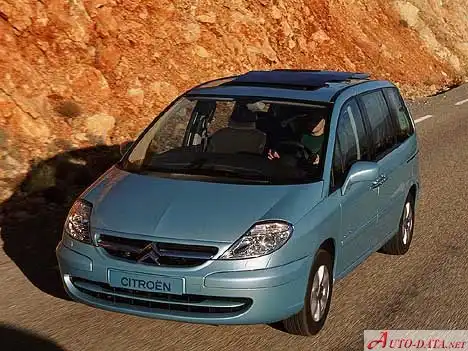
The Citroën C8 2.0 HDi 16V (109 hp) FAP Automatic, produced between 2002 and 2006, represents a key variant within the first generation (Phase I) of Citroën’s large MPV offering. Part of the U6 platform shared with the Peugeot 807 and Fiat Ulysse, the C8 aimed to provide a comfortable and spacious family vehicle. This particular engine and transmission combination occupied a mid-range position in the C8 lineup, offering a balance between fuel economy, usability, and price. It was designed to appeal to families prioritizing practicality and comfort over outright performance, particularly in European markets where MPVs were highly popular.
Technical Specifications
| Brand | Citroen |
| Model | C8 |
| Generation | C8 (Phase I) |
| Type (Engine) | 2.0 HDi 16V (109 Hp) FAP Automatic |
| Start of production | 2002 |
| End of production | 2006 |
| Powertrain Architecture | Internal Combustion engine |
| Body type | Minivan, MPV |
| Seats | 7 |
| Doors | 5 |
| Fuel consumption (urban) | 10.8 l/100 km (21.8 US mpg, 26.2 UK mpg, 9.3 km/l) |
| Fuel consumption (extra urban) | 6.4 l/100 km (36.8 US mpg, 44.1 UK mpg, 15.6 km/l) |
| Fuel consumption (combined) | 8 l/100 km (29.4 US mpg, 35.3 UK mpg, 12.5 km/l) |
| Fuel Type | Diesel |
| Acceleration 0 – 100 km/h | 16.6 sec |
| Acceleration 0 – 62 mph | 16.6 sec |
| Acceleration 0 – 60 mph | 15.8 sec |
| Maximum speed | 168 km/h (104.39 mph) |
| Emission standard | Euro 3 |
| Weight-to-power ratio | 16.2 kg/Hp, 61.6 Hp/tonne |
| Weight-to-torque ratio | 6.6 kg/Nm, 152.5 Nm/tonne |
| Power | 109 Hp @ 4000 rpm |
| Power per litre | 54.6 Hp/l |
| Torque | 270 Nm @ 1750 rpm (199.14 lb.-ft. @ 1750 rpm) |
| Engine layout | Front, Transverse |
| Engine Model/Code | RHW DW10ATED4 |
| Engine displacement | 1997 cm3 (121.86 cu. in.) |
| Number of cylinders | 4 |
| Engine configuration | Inline |
| Cylinder Bore | 85 mm (3.35 in.) |
| Piston Stroke | 88 mm (3.46 in.) |
| Compression ratio | 18:1 |
| Number of valves per cylinder | 4 |
| Fuel injection system | Diesel Commonrail |
| Engine aspiration | Turbocharger, Intercooler |
| Valvetrain | DOHC |
| Engine oil capacity | 4.8 l (5.07 US qt | 4.22 UK qt) |
| Coolant | 9.5 l (10.04 US qt | 8.36 UK qt) |
| Kerb Weight | 1770 kg (3902.18 lbs.) |
| Max. weight | 2575 kg (5676.9 lbs.) |
| Max load | 805 kg (1774.72 lbs.) |
| Trunk (boot) space – minimum | 225 l (7.95 cu. ft.) |
| Trunk (boot) space – maximum | 2948 l (104.11 cu. ft.) |
| Fuel tank capacity | 80 l (21.13 US gal | 17.6 UK gal) |
| Max. roof load | 100 kg (220.46 lbs.) |
| Length | 4727 mm (186.1 in.) |
| Width | 1854 mm (72.99 in.) |
| Width with mirrors folded | 1952 mm (76.85 in.) |
| Width including mirrors | 2205 mm (86.81 in.) |
| Height | 1766-1856 mm (69.53 – 73.07 in.) |
| Wheelbase | 2823 mm (111.14 in.) |
| Front track | 1570 mm (61.81 in.) |
| Rear (Back) track | 1548 mm (60.94 in.) |
| Front overhang | 1013 mm (39.88 in.) |
| Rear overhang | 891 mm (35.08 in.) |
| Minimum turning circle | 11.62 m (38.12 ft.) |
| Drivetrain Architecture | Front wheel drive |
| Number of gears | 4 |
| Gearbox type | automatic transmission |
| Front suspension | Independent, type McPherson with coil spring and anti-roll bar |
| Rear suspension | Semi-independent, coil spring |
| Front brakes | Ventilated discs |
| Rear brakes | Disc |
| Assisting systems | ABS (Anti-lock braking system) |
| Steering type | Steering rack and pinion |
| Power steering | Hydraulic Steering |
| Tires size | 2015/65 R15 |
| Wheel rims size | 6.5J x 15 |
Powertrain & Engine Architecture
The heart of this C8 variant is the DW10ATED4 engine, a 2.0-liter, four-cylinder diesel engine. This engine, commonly found in PSA Group vehicles (Peugeot, Citroën), utilizes a common rail direct injection system, delivering fuel at extremely high pressure for improved combustion efficiency and reduced emissions. The ‘16V’ designation indicates a four-valve-per-cylinder configuration, enhancing breathing and contributing to the engine’s power output. A turbocharger with an intercooler further boosts performance by forcing more air into the cylinders. The engine code ‘RHW’ specifically identifies this version, often paired with a particulate filter (FAP) to meet Euro 3 emission standards. The FAP system, while effective in reducing particulate matter, required periodic regeneration cycles to prevent clogging. The automatic transmission is a four-speed unit, designed for smooth operation and ease of use, but not known for its particularly quick shifts or fuel efficiency compared to manual counterparts.
Driving Characteristics
The 109 hp output and four-speed automatic transmission resulted in a driving experience focused on comfort and usability rather than performance. Acceleration was leisurely, with a 0-60 mph time around 15.8 seconds. The engine delivered its peak torque of 270 Nm (199 lb-ft) at a relatively low 1750 rpm, providing adequate pulling power for everyday driving and when fully loaded with passengers and luggage. However, overtaking maneuvers required careful planning. The automatic transmission, while convenient, lacked the responsiveness of a manual gearbox, and the limited number of gears meant the engine often operated at higher revs during highway cruising. Compared to the more powerful 2.2 HDi or petrol variants, this 2.0 HDi Automatic felt noticeably slower and less refined.
Equipment & Trim Levels
The C8 2.0 HDi 16V Automatic typically came equipped with features considered standard for a mid-range MPV in the early 2000s. These included air conditioning, central locking, electric windows, and power steering. Interior upholstery was generally cloth, with options for upgraded materials. Higher trim levels offered features like alloy wheels, rear parking sensors, and a more sophisticated audio system. The C8 was designed with modularity in mind, offering flexible seating arrangements with individual, removable seats in the second and third rows. Optional extras included a panoramic sunroof, leather upholstery, and a DVD entertainment system for rear passengers.
Chassis & Braking
The C8’s chassis featured an independent McPherson strut suspension at the front and a semi-independent coil spring suspension at the rear. This setup prioritized ride comfort, absorbing bumps and providing a stable platform for passengers. Braking duties were handled by ventilated discs at the front and solid discs at the rear, equipped with an Anti-lock Braking System (ABS) as standard. The weight distribution, influenced by the engine and drivetrain layout, contributed to predictable handling, although the C8 was not designed for sporty driving. Stabilizer bars were fitted to both axles to reduce body roll during cornering.
Market Reception & Comparison
The Citroën C8 2.0 HDi 16V Automatic was generally well-received as a practical and comfortable family vehicle. Critics praised its spacious interior, flexible seating arrangements, and relatively fuel-efficient diesel engine. However, the performance of the 2.0 HDi engine, particularly when paired with the automatic transmission, was often criticized as being underwhelming. Compared to the more powerful engine options, the 2.0 HDi offered a lower purchase price and better fuel economy, making it an attractive option for budget-conscious buyers. The Peugeot 807 and Fiat Ulysse, sharing the same platform and powertrain, offered similar characteristics and were direct competitors.
Legacy
The DW10ATED4 engine, in its various iterations, proved to be a relatively reliable unit, although the FAP system could be prone to issues if not properly maintained. The four-speed automatic transmission, while durable, is not known for its efficiency or refinement by modern standards. Today, the C8 2.0 HDi 16V Automatic can be found as an affordable used MPV, appealing to those seeking a spacious and practical vehicle for family transport. Maintenance costs are generally reasonable, but potential buyers should be aware of the potential for FAP-related issues and the age-related wear and tear common to vehicles of this era. Its enduring appeal lies in its practicality and the sheer amount of space it offers, making it a viable option for those needing a versatile and affordable MPV.
