
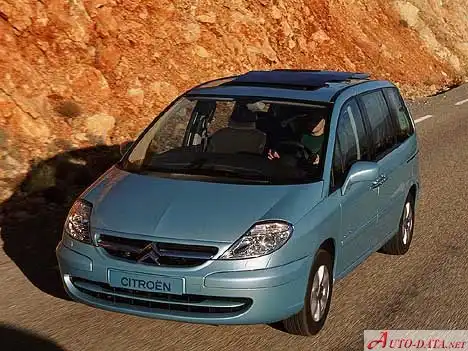
The Citroën C8 2.2 HDi 16V (128 hp) FAP, produced between 2002 and 2006, represents a key variant within the first generation (Phase I) of Citroën’s large MPV offering. Sharing a platform – the PSA Group’s PX platform, also known as 1HX0 – with the Peugeot 807 and Fiat Ulysse, the C8 aimed to provide a spacious and comfortable family vehicle. This particular engine and transmission combination occupied a mid-range position in the C8 lineup, offering a balance between fuel economy, performance, and price. It was designed to appeal to families needing seven-seat capacity and long-distance comfort, primarily in the European market.
Technical Specifications
| Brand | Citroën |
| Model | C8 |
| Generation | C8 (Phase I) |
| Type (Engine) | 2.2 HDi 16V (128 Hp) FAP |
| Start of production | 2002 |
| End of production | 2006 |
| Powertrain Architecture | Internal Combustion engine |
| Body type | Minivan, MPV |
| Seats | 7 |
| Doors | 5 |
| Fuel consumption (urban) | 10.1 l/100 km (23.3 US mpg, 28 UK mpg, 9.9 km/l) |
| Fuel consumption (extra urban) | 5.9 l/100 km (39.9 US mpg, 47.9 UK mpg, 16.9 km/l) |
| Fuel consumption (combined) | 7.4 l/100 km (31.8 US mpg, 38.2 UK mpg, 13.5 km/l) |
| CO2 emissions | 199 g/km |
| Fuel Type | Diesel |
| Acceleration 0 – 100 km/h | 13.6 sec |
| Acceleration 0 – 62 mph | 13.6 sec |
| Acceleration 0 – 60 mph | 12.9 sec |
| Maximum speed | 182 km/h (113.09 mph) |
| Emission standard | Euro 3 |
| Weight-to-power ratio | 13.7 kg/Hp, 73.1 Hp/tonne |
| Weight-to-torque ratio | 5.6 kg/Nm, 179.4 Nm/tonne |
| Power | 128 Hp @ 4000 rpm |
| Power per litre | 58.7 Hp/l |
| Torque | 314 Nm @ 2000 rpm (231.59 lb.-ft. @ 2000 rpm) |
| Engine layout | Front, Transverse |
| Engine Model/Code | 4HW DW12TED4 |
| Engine displacement | 2179 cm3 (132.97 cu. in.) |
| Number of cylinders | 4 |
| Engine configuration | Inline |
| Cylinder Bore | 85 mm (3.35 in.) |
| Piston Stroke | 96 mm (3.78 in.) |
| Compression ratio | 17.6:1 |
| Number of valves per cylinder | 4 |
| Fuel injection system | Diesel Commonrail |
| Engine aspiration | Turbocharger, Intercooler |
| Valvetrain | DOHC |
| Engine oil capacity | 4.8 l (5.07 US qt, 4.22 UK qt) |
| Coolant capacity | 11.3 l (11.94 US qt, 9.94 UK qt) |
| Kerb Weight | 1750 kg (3858.09 lbs.) |
| Max. weight | 2505 kg (5522.58 lbs.) |
| Max load | 755 kg (1664.49 lbs.) |
| Trunk (boot) space – minimum | 225 l (7.95 cu. ft.) |
| Trunk (boot) space – maximum | 2948 l (104.11 cu. ft.) |
| Fuel tank capacity | 80 l (21.13 US gal, 17.6 UK gal) |
| Max. roof load | 100 kg (220.46 lbs.) |
| Length | 4727 mm (186.1 in.) |
| Width | 1854 mm (72.99 in.) |
| Width with mirrors folded | 1952 mm (76.85 in.) |
| Width including mirrors | 2205 mm (86.81 in.) |
| Height | 1766-1856 mm (69.53 – 73.07 in.) |
| Wheelbase | 2823 mm (111.14 in.) |
| Front track | 1570 mm (61.81 in.) |
| Rear track | 1548 mm (60.94 in.) |
| Front overhang | 1013 mm (39.88 in.) |
| Rear overhang | 891 mm (35.08 in.) |
| Minimum turning circle | 11.62 m (38.12 ft.) |
| Drivetrain | Front wheel drive |
| Number of gears | 5 |
| Gearbox type | Manual transmission |
| Front suspension | Independent, McPherson with coil spring and anti-roll bar |
| Rear suspension | Semi-independent, coil spring |
| Front brakes | Ventilated discs |
| Rear brakes | Disc |
| Assisting systems | ABS (Anti-lock braking system) |
| Steering type | Steering rack and pinion |
| Power steering | Hydraulic |
| Tires size | 215/65 R15 |
| Wheel rims size | 6.5J x 15 |
Powertrain & Engine Architecture
The C8 2.2 HDi 16V utilizes the DW12TED4 engine, a four-cylinder diesel engine developed by PSA. This engine is a common-rail direct injection diesel, meaning fuel is delivered to the cylinders at extremely high pressure via a common rail system. The 16V designation indicates the engine features four valves per cylinder (DOHC valvetrain), enhancing breathing and contributing to improved power output. A turbocharger with an intercooler is employed to increase air density and boost power. The FAP (Filtre à Particules) or Diesel Particulate Filter, was standard equipment, designed to reduce particulate matter emissions and meet increasingly stringent European emission standards. The engine produces 128 horsepower at 4000 rpm and 314 Nm (231.59 lb-ft) of torque at 2000 rpm. The engine is transversely mounted in the front of the vehicle.
Driving Characteristics
The 2.2 HDi 16V, paired with a five-speed manual transmission, provided adequate, though not exhilarating, performance for the C8. Acceleration from 0-100 km/h (0-62 mph) took approximately 13.6 seconds, and top speed was around 182 km/h (113 mph). Compared to the more powerful 2.0 HDi variants or the petrol engines, this version prioritized fuel economy over outright speed. The torque delivery was relatively flat, making it suitable for carrying a full load of passengers and luggage. The five-speed gearbox was well-matched to the engine’s characteristics, but the relatively long gearing emphasized fuel efficiency at the expense of responsiveness. It wasn’t a sporty vehicle, but it offered a comfortable and relaxed driving experience, particularly on long journeys.
Equipment & Trim Levels
The C8 2.2 HDi 16V typically came equipped with features such as air conditioning, power windows, central locking, and an integrated radio/CD player. Higher trim levels added features like alloy wheels, rear parking sensors, and upgraded interior trim. Interior upholstery was generally cloth, with options for leather available. The C8’s modular interior allowed for flexible seating configurations, with individual seats that could be folded or removed to maximize cargo space. Optional extras included a panoramic sunroof, navigation system, and upgraded audio systems.
Chassis & Braking
The C8 utilized an independent McPherson strut suspension at the front and a semi-independent coil spring suspension at the rear. This setup provided a comfortable ride, although it wasn’t particularly sporty in handling. The front brakes were ventilated discs, while the rear brakes were solid discs. ABS (Anti-lock Braking System) was standard. The C8’s weight, exceeding 1750 kg (3858 lbs), meant that the braking system needed to work effectively to provide adequate stopping power.
Market Reception & Comparison
The Citroën C8 2.2 HDi 16V was generally well-received by critics as a practical and comfortable MPV. Its fuel economy was a strong point, particularly compared to petrol-powered rivals. However, some reviewers noted that the engine lacked the punch of more powerful alternatives. Compared to the 2.0 HDi versions, the 2.2 HDi offered slightly more power and torque, but at a higher price point. The 2.2 HDi was often seen as a good compromise for those needing a spacious MPV with reasonable running costs.
Legacy
The DW12TED4 engine, in general, proved to be a relatively reliable unit, although the FAP system could be prone to issues if not properly maintained. Regular servicing, including FAP regeneration, was crucial to ensure long-term reliability. Today, the C8 2.2 HDi 16V can be found on the used car market at affordable prices. While it may not offer the latest technology or performance, it remains a practical and spacious option for families needing a seven-seat vehicle. Its relatively simple mechanicals make it potentially easier and cheaper to maintain than more modern MPVs, but potential buyers should be aware of the potential issues with the FAP system and ensure a thorough inspection before purchase.
