
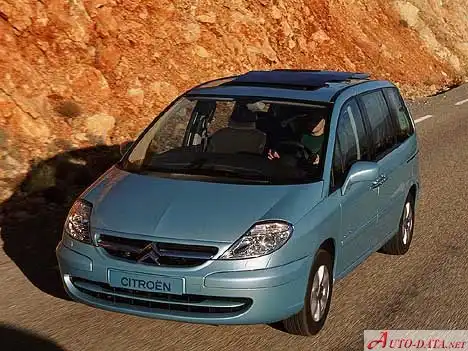
The Citroën C8 2.2 HDi Biturbo (170 hp) FAP Automatic, produced between 2007 and 2008, represents a significant iteration within the first phase (Phase I) of the C8 minivan range. Positioned as a mid-to-upper trim level, this variant aimed to balance fuel efficiency with respectable performance for a large MPV. The C8 itself was part of the first generation (often referred to as the X4 platform, shared with the Peugeot 807 and Fiat Ulysse), designed to compete in the European minivan market against established players like the Renault Espace and Volkswagen Sharan. This particular engine and transmission combination offered a more refined driving experience compared to lower-powered options, while remaining more accessible than the range-topping petrol variants.
Technical Specifications
| Brand | Citroen |
| Model | C8 |
| Generation | C8 (Phase I) |
| Type (Engine) | 2.2 HDi Biturbo (170 Hp) FAP Automatic |
| Start of production | 2007 |
| End of production | 2008 |
| Powertrain Architecture | Internal Combustion engine |
| Body type | Minivan, MPV |
| Seats | 7 |
| Doors | 5 |
| Fuel consumption (urban) | 11 l/100 km (21.4 US mpg, 25.7 UK mpg, 9.1 km/l) |
| Fuel consumption (extra urban) | 6.6 l/100 km (35.6 US mpg, 42.8 UK mpg, 15.2 km/l) |
| Fuel consumption (combined) | 8.2 l/100 km (28.7 US mpg, 34.4 UK mpg, 12.2 km/l) |
| CO2 emissions | 218 g/km |
| Fuel Type | Diesel |
| Acceleration 0 – 100 km/h | 10.8 sec |
| Acceleration 0 – 62 mph | 10.8 sec |
| Acceleration 0 – 60 mph | 10.3 sec |
| Maximum speed | 197 km/h (122.41 mph) |
| Emission standard | Euro 4 |
| Weight-to-power ratio | 10.7 kg/Hp, 93.5 Hp/tonne |
| Weight-to-torque ratio | 4.5 kg/Nm, 220 Nm/tonne |
| Power | 170 Hp @ 4000 rpm |
| Power per litre | 78 Hp/l |
| Torque | 400 Nm @ 1750 rpm (295.02 lb.-ft. @ 1750 rpm) |
| Engine layout | Front, Transverse |
| Engine Model/Code | 4HT DW12BTED4 |
| Engine displacement | 2179 cm3 (132.97 cu. in.) |
| Number of cylinders | 4 |
| Engine configuration | Inline |
| Cylinder Bore | 85 mm (3.35 in.) |
| Piston Stroke | 96 mm (3.78 in.) |
| Compression ratio | 16.6:1 |
| Number of valves per cylinder | 4 |
| Fuel injection system | Diesel Commonrail |
| Engine aspiration | BiTurbo, Intercooler |
| Valvetrain | DOHC |
| Engine oil capacity | 5.3 l (5.6 US qt | 4.66 UK qt) |
| Coolant | 9 l (9.51 US qt | 7.92 UK qt) |
| Kerb Weight | 1818 kg (4008 lbs.) |
| Max. weight | 2610 kg (5754.07 lbs.) |
| Max load | 792 kg (1746.06 lbs.) |
| Trunk (boot) space – minimum | 225 l (7.95 cu. ft.) |
| Trunk (boot) space – maximum | 2948 l (104.11 cu. ft.) |
| Fuel tank capacity | 80 l (21.13 US gal | 17.6 UK gal) |
| Max. roof load | 100 kg (220.46 lbs.) |
| Permitted trailer load with brakes (12%) | 1870 kg (4122.64 lbs.) |
| Permitted trailer load without brakes | 750 kg (1653.47 lbs.) |
| Permitted towbar download | 75 kg (165.35 lbs.) |
| Length | 4727 mm (186.1 in.) |
| Width | 1854 mm (72.99 in.) |
| Width with mirrors folded | 1952 mm (76.85 in.) |
| Width including mirrors | 2205 mm (86.81 in.) |
| Height | 1766-1856 mm (69.53 – 73.07 in.) |
| Wheelbase | 2823 mm (111.14 in.) |
| Front track | 1570 mm (61.81 in.) |
| Rear (Back) track | 1548 mm (60.94 in.) |
| Front overhang | 1013 mm (39.88 in.) |
| Rear overhang | 891 mm (35.08 in.) |
| Minimum turning circle | 11.62 m (38.12 ft.) |
| Drivetrain Architecture | Front wheel drive |
| Number of gears and type of gearbox | 6 gears, automatic transmission |
| Front suspension | Independent, type McPherson with coil spring and anti-roll bar |
| Rear suspension | Semi-independent, coil spring |
| Front brakes | Ventilated discs |
| Rear brakes | Disc |
| Assisting systems | ABS (Anti-lock braking system) |
| Steering type | Steering rack and pinion |
| Power steering | Hydraulic Steering |
| Tires size | 215/60 R16 |
| Wheel rims size | 6.5J x 15 |
Powertrain & Engine Architecture
The heart of this C8 variant is the 4HT DW12BTED4 engine, a 2.2-liter inline-four diesel. This engine is notable for its biturbo configuration – employing two turbochargers to minimize turbo lag and broaden the torque curve. The use of a common rail direct injection system, delivering fuel at extremely high pressure, contributes to efficient combustion and reduced emissions. The engine benefits from an intercooler, which cools the compressed air from the turbochargers, further increasing power output. The automatic transmission is a six-speed unit, designed to provide smooth shifts and optimize fuel economy. The FAP (Filtre à Particules) or Diesel Particulate Filter, was standard equipment to meet increasingly stringent European emission standards.
Driving Characteristics
The 170 hp and 400 Nm (295 lb-ft) of torque provided by the 2.2 HDi Biturbo engine delivered a reasonably sprightly performance for a large MPV. While not a sports car, the C8 could accelerate from 0-60 mph in around 10.3 seconds and reach a top speed of 122 mph. The automatic transmission, while offering convenience, did slightly diminish the responsiveness compared to the manual gearbox options. The biturbo setup helped to mitigate turbo lag, providing a more linear power delivery than single-turbo diesel engines. However, the C8’s substantial weight meant that the engine was often working hard, particularly when fully loaded with passengers and luggage. The gear ratios were tuned for comfortable cruising rather than outright acceleration.
Equipment & Trim Levels
The 2.2 HDi Biturbo Automatic trim typically included features such as air conditioning, power windows, central locking, and an integrated audio system. Higher-spec versions often added features like leather upholstery, parking sensors, and a navigation system. The interior design was functional and family-oriented, with a focus on practicality and space. The C8’s modular seating arrangement allowed for flexible configuration, accommodating up to seven passengers. Optional extras included a panoramic sunroof, upgraded audio systems, and metallic paint finishes.
Chassis & Braking
The C8 utilized an independent McPherson strut suspension at the front and a semi-independent coil spring suspension at the rear. This setup aimed to provide a comfortable ride quality, absorbing bumps and imperfections in the road surface. The front brakes were ventilated discs, offering good stopping power, while the rear brakes were solid discs. Anti-lock Braking System (ABS) was standard, enhancing safety during emergency braking maneuvers. The steering was a hydraulic rack and pinion system, providing a reasonable level of feedback and precision.
Market Reception & Comparison
The Citroën C8 2.2 HDi Biturbo Automatic was generally well-received by automotive critics as a practical and comfortable family vehicle. The engine was praised for its torque and fuel efficiency, although some reviewers noted that it could feel strained under heavy load. Compared to the lower-powered 1.8 HDi variants, the 2.2 HDi offered a noticeable improvement in performance. However, it was more expensive to purchase and maintain. Compared to petrol-powered C8s, the diesel offered superior fuel economy, making it a popular choice for long-distance travel. Reliability was generally good, although the complex FAP system could be prone to issues if not properly maintained.
Legacy
The Citroën C8 2.2 HDi Biturbo Automatic, while not a groundbreaking vehicle, remains a viable option in the used car market. The DW12BTED4 engine is known for its durability, provided it has been regularly serviced. The automatic transmission is generally reliable, but it’s important to check for smooth shifting and any signs of wear. The FAP system requires periodic regeneration, and failure to do so can lead to costly repairs. Today, these C8s represent a relatively affordable way to acquire a spacious and comfortable MPV, appealing to families and those requiring a versatile vehicle for carrying passengers and cargo.
