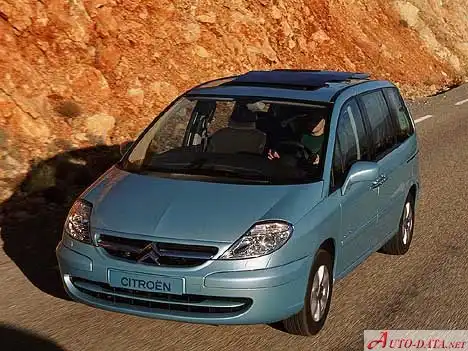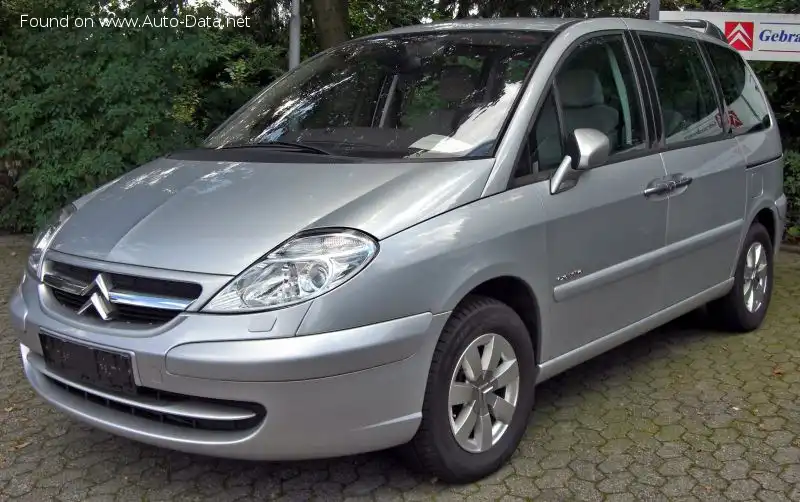
The Citroen C8 2.2 HDi Biturbo (170 hp) FAP Automatic, produced between 2008 and 2009, represents the second phase of Citroen’s large MPV offering. Part of the second-generation C8 (designated X7), this variant occupied a mid-to-upper position within the C8 lineup, offering a balance of performance, space, and comfort. It shared its platform and much of its mechanical underpinnings with the Peugeot 807 and Fiat Ulysse, a result of the joint venture between the three manufacturers known as PSA/Fiat. The C8 aimed to provide a practical and refined transportation solution for large families or those requiring significant cargo capacity, primarily targeting the European market.
Technical Specifications
| Brand | Citroen |
| Model | C8 |
| Generation | C8 (Phase II, 2008) |
| Type (Engine) | 2.2 HDi Biturbo (170 Hp) FAP Automatic |
| Start of production | 2008 |
| End of production | 2009 |
| Powertrain Architecture | Internal Combustion engine |
| Body type | Minivan, MPV |
| Seats | 7 |
| Doors | 5 |
| Fuel consumption (urban) | 11 l/100 km (21.4 US mpg, 25.7 UK mpg, 9.1 km/l) |
| Fuel consumption (extra urban) | 6.6 l/100 km (35.6 US mpg, 42.8 UK mpg, 15.2 km/l) |
| Fuel consumption (combined) | 8.2 l/100 km (28.7 US mpg, 34.4 UK mpg, 12.2 km/l) |
| CO2 emissions | 191 g/km |
| Fuel Type | Diesel |
| Acceleration 0 – 100 km/h | 10.8 sec |
| Acceleration 0 – 62 mph | 10.8 sec |
| Acceleration 0 – 60 mph | 10.3 sec |
| Maximum speed | 197 km/h (122.41 mph) |
| Emission standard | Euro 4 |
| Weight-to-power ratio | 10.7 kg/Hp, 93.5 Hp/tonne |
| Weight-to-torque ratio | 4.9 kg/Nm, 203.5 Nm/tonne |
| Power | 170 Hp @ 4000 rpm |
| Power per litre | 78 Hp/l |
| Torque | 370 Nm @ 1500 rpm (272.9 lb.-ft. @ 1500 rpm) |
| Engine layout | Front, Transverse |
| Engine Model/Code | 4HT DW12BTED4 |
| Engine displacement | 2179 cm3 (132.97 cu. in.) |
| Number of cylinders | 4 |
| Engine configuration | Inline |
| Cylinder Bore | 85 mm (3.35 in.) |
| Piston Stroke | 96 mm (3.78 in.) |
| Compression ratio | 16.6:1 |
| Number of valves per cylinder | 4 |
| Fuel injection system | Diesel Commonrail |
| Engine aspiration | BiTurbo, Intercooler |
| Valvetrain | DOHC |
| Engine oil capacity | 5.3 l (5.6 US qt | 4.66 UK qt) |
| Coolant | 9 l (9.51 US qt | 7.92 UK qt) |
| Kerb Weight | 1818 kg (4008 lbs.) |
| Max. weight | 2610 kg (5754.07 lbs.) |
| Max load | 792 kg (1746.06 lbs.) |
| Trunk (boot) space – minimum | 225 l (7.95 cu. ft.) |
| Trunk (boot) space – maximum | 2948 l (104.11 cu. ft.) |
| Fuel tank capacity | 80 l (21.13 US gal | 17.6 UK gal) |
| Max. roof load | 100 kg (220.46 lbs.) |
| Length | 4727 mm (186.1 in.) |
| Width | 1854 mm (72.99 in.) |
| Width including mirrors | 2194 mm (86.38 in.) |
| Height | 1766-1856 mm (69.53 – 73.07 in.) |
| Wheelbase | 2823 mm (111.14 in.) |
| Front track | 1570 mm (61.81 in.) |
| Rear (Back) track | 1548 mm (60.94 in.) |
| Front overhang | 1013 mm (39.88 in.) |
| Rear overhang | 891 mm (35.08 in.) |
| Minimum turning circle | 11.71 m (38.42 ft.) |
| Drivetrain Architecture | Front wheel drive |
| Number of gears | 6 |
| Gearbox type | automatic transmission |
| Front suspension | Independent, type McPherson with coil spring and anti-roll bar |
| Rear suspension | Semi-independent, coil spring |
| Front brakes | Ventilated discs |
| Rear brakes | Disc |
| Assisting systems | ABS (Anti-lock braking system) |
| Steering type | Steering rack and pinion |
| Power steering | Hydraulic Steering |
| Tires size | 215/60 R16 |
| Wheel rims size | 6.5J x 16 |
Powertrain & Engine Architecture
The heart of the C8 2.2 HDi Biturbo is the DW12BTED4 engine, a 2.2-liter inline-four diesel. This engine is notable for its use of a twin-turbocharger setup – hence the “Biturbo” designation. The two turbochargers work in sequence; a smaller turbocharger provides boost at low engine speeds for improved responsiveness, while a larger turbocharger takes over at higher speeds to deliver increased power. This configuration helps to mitigate turbo lag, a common issue with turbocharged engines. The engine utilizes a common rail direct injection system, delivering fuel at extremely high pressure for efficient combustion. The 16.6:1 compression ratio is typical for a diesel engine, contributing to its thermal efficiency. The engine is transversely mounted in the front of the vehicle, driving the front wheels. The automatic transmission is a six-speed unit, designed to provide smooth gear changes and optimize fuel economy.
Driving Characteristics
The 170 hp and 370 Nm (272.9 lb-ft) of torque offered by the 2.2 HDi Biturbo engine provided adequate performance for the C8, despite its considerable weight. Acceleration from 0-60 mph took around 10.3 seconds, and the top speed was approximately 122 mph. While not particularly sporty, the engine delivered strong low-end torque, making it well-suited for everyday driving and hauling passengers or cargo. The automatic transmission, while generally smooth, could sometimes feel hesitant during quick acceleration. Compared to the lower-powered 1.8L petrol versions, the 2.2 HDi Biturbo offered significantly more torque and better fuel economy. It also provided a more relaxed driving experience on long journeys, thanks to its higher gearing and greater pulling power. Compared to the 2.7 HDi V6, the 2.2 Biturbo offered a compromise between performance and economy, lacking the V6’s outright power but providing better fuel consumption.
Equipment & Trim Levels
The C8 2.2 HDi Biturbo Automatic typically came equipped with a generous level of standard features. These included air conditioning, power windows and mirrors, a CD stereo system, and ABS brakes. Higher trim levels added features such as leather upholstery, alloy wheels, a sunroof, and parking sensors. The interior was designed with practicality in mind, offering a spacious and comfortable cabin with flexible seating arrangements. The C8’s modular interior allowed for various seating configurations, with the ability to fold or remove seats to maximize cargo space. Optional extras included a DVD entertainment system for rear passengers and a navigation system.
Chassis & Braking
The C8 utilized an independent McPherson strut suspension at the front and a semi-independent coil spring suspension at the rear. This setup provided a comfortable ride, although it wasn’t particularly sporty. The front brakes were ventilated discs, while the rear brakes were solid discs. ABS (Anti-lock Braking System) was standard, enhancing safety during emergency braking. The steering was rack and pinion with hydraulic power assistance, providing a reasonably direct and responsive feel.
Market Reception & Comparison
The Citroen C8 2.2 HDi Biturbo Automatic was generally well-received by critics, who praised its spacious interior, comfortable ride, and fuel efficiency. However, some criticized its somewhat bland styling and the occasionally hesitant automatic transmission. Compared to rivals such as the Renault Espace and Volkswagen Sharan, the C8 offered a competitive package, particularly in terms of value for money. Fuel economy was a strong point, with combined figures around 34.4 mpg. Reliability was generally good, although some owners reported issues with the electronic parking brake and the diesel particulate filter (FAP).
Legacy
The Citroen C8 2.2 HDi Biturbo Automatic has proven to be a relatively reliable and durable vehicle. The DW12BTED4 engine, while complex, is generally robust when properly maintained. The automatic transmission has also proven to be fairly reliable. Today, these vehicles can be found on the used car market at affordable prices. They remain a practical choice for families or those needing a large, versatile vehicle. However, potential buyers should be aware of the potential for issues with the FAP and the electronic parking brake, and ensure that the vehicle has been regularly serviced.