
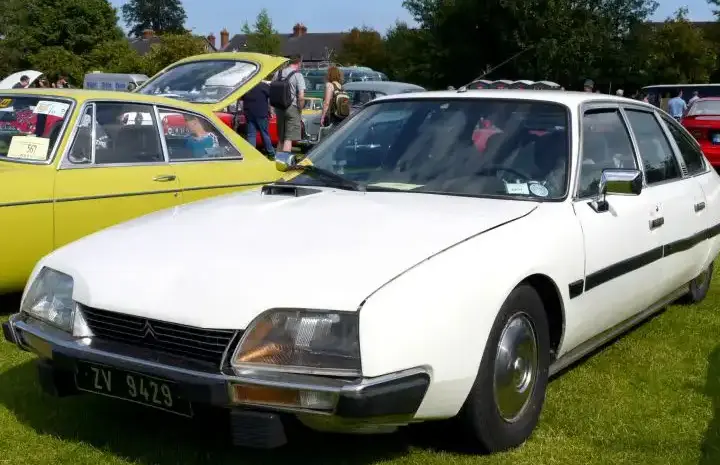
The Citroën CX 2400, produced between 1976 and 1980, represented a significant evolution in Citroën’s long history of innovative automotive engineering. Positioned as a mid-range offering within the CX series, the 2400 model aimed to provide a balance between performance, comfort, and affordability. It was a key component of the initial CX launch, built on the platform designated as the CX I, and served as a crucial stepping stone in establishing the CX as a successor to the iconic DS. The CX, as a whole, was intended to modernize Citroën’s image and offer a technologically advanced vehicle for the discerning European driver.
Technical Specifications
| Brand | Citroën |
| Model | CX |
| Generation | CX I |
| Type (Engine) | 2400 (116 Hp) |
| Start of production | 1976 |
| End of production | 1980 |
| Powertrain Architecture | Internal Combustion engine |
| Body type | Hatchback |
| Seats | 5 |
| Doors | 5 |
| Fuel Type | Petrol (Gasoline) |
| Acceleration 0 – 100 km/h | 11 sec |
| Acceleration 0 – 62 mph | 11 sec |
| Acceleration 0 – 60 mph | 10.5 sec |
| Maximum speed | 181 km/h (112.47 mph) |
| Weight-to-power ratio | 11.2 kg/Hp, 89.2 Hp/tonne |
| Weight-to-torque ratio | 7.2 kg/Nm, 138.5 Nm/tonne |
| Power | 116 Hp @ 5500 rpm |
| Power per litre | 49.4 Hp/l |
| Torque | 180 Nm @ 3000 rpm (132.76 lb.-ft. @ 3000 rpm) |
| Maximum engine speed | 5900 rpm |
| Engine layout | Front, Transverse |
| Engine Model/Code | M23.623 |
| Engine displacement | 2350 cm3 (143.41 cu. in.) |
| Number of cylinders | 4 |
| Engine configuration | Inline |
| Cylinder Bore | 93.5 mm (3.68 in.) |
| Piston Stroke | 85.5 mm (3.37 in.) |
| Compression ratio | 9:1 |
| Number of valves per cylinder | 2 |
| Fuel injection system | Carburettor |
| Engine aspiration | Naturally aspirated engine |
| Engine oil capacity | 5.3 l (5.6 US qt | 4.66 UK qt) |
| Coolant | 11 l (11.62 US qt | 9.68 UK qt) |
| Kerb Weight | 1300 kg (2866.01 lbs.) |
| Max. weight | 1790 kg (3946.27 lbs.) |
| Max load | 490 kg (1080.27 lbs.) |
| Trunk (boot) space – minimum | 325 l (11.48 cu. ft.) |
| Fuel tank capacity | 68 l (17.96 US gal | 14.96 UK gal) |
| Permitted trailer load without brakes | 650 kg (1433 lbs.) |
| Length | 4659 mm (183.43 in.) |
| Width | 1734 mm (68.27 in.) |
| Height | 1360 mm (53.54 in.) |
| Wheelbase | 2845 mm (112.01 in.) |
| Front track | 1474 mm (58.03 in.) |
| Rear (Back) track | 1360 mm (53.54 in.) |
| Front overhang | 1050 mm (41.34 in.) |
| Rear overhang | 764 mm (30.08 in.) |
| Ride height (ground clearance) | 155 mm (6.1 in.) |
| Drag coefficient (Cd) | 0.37 |
| Minimum turning circle | 11.80 m (38.71 ft.) |
| Drivetrain Architecture | The Internal combustion engine (ICE) drives the front wheels of the vehicle. |
| Drive wheel | Front wheel drive |
| Number of gears and type of gearbox | 4 gears, manual transmission |
| Front brakes | Ventilated discs |
| Rear brakes | Disc |
| Steering type | Steering rack and pinion |
| Wheel rims size | 5.5J x 14 |
Powertrain & Engine Architecture
The Citroën CX 2400 was powered by the M23.623 engine, a 2.4-liter inline-four cylinder petrol engine. This engine, a development of earlier Citroën designs, featured a cast iron block and an aluminum cylinder head. It utilized a single overhead camshaft (SOHC) valvetrain with two valves per cylinder. Fuel delivery was managed by a Solex C35 PHH carburetor, a common setup for the era. The engine produced 116 horsepower at 5,500 rpm and 180 Nm (132.76 lb-ft) of torque at 3,000 rpm. The engine was transversely mounted, a layout favored by Citroën for its packaging efficiency and contribution to improved handling. The CX 2400 was equipped with a four-speed manual transmission, delivering power to the front wheels.
Driving Characteristics
The CX 2400, with its 116 horsepower and manual transmission, offered a respectable, though not particularly sporty, driving experience. Acceleration from 0 to 60 mph took approximately 10.5 seconds, and it achieved a top speed of 181 km/h (112.47 mph). Compared to the later, more powerful CX 2500 or the fuel-efficient diesel variants, the 2400 provided a more balanced approach. The gear ratios were tuned for everyday usability, prioritizing smooth cruising and reasonable fuel economy over outright performance. The CX’s renowned hydropneumatic suspension, a hallmark of Citroën engineering, provided an exceptionally comfortable ride, absorbing bumps and imperfections in the road with ease. However, the steering, while precise, could feel somewhat heavy at low speeds.
Equipment & Trim Levels
The CX 2400, as an early model in the CX range, offered a relatively well-equipped interior for its time. Standard features included comfortable cloth seats, a comprehensive instrument panel, and a four-speed manual transmission. The interior design was modern and functional, reflecting Citroën’s commitment to ergonomics. Optional extras included upgraded upholstery, a sunroof, and a more sophisticated audio system. The trim level was generally consistent across the 2400 models, with variations primarily stemming from customer-selected options.
Chassis & Braking
The CX featured a monocoque chassis construction, providing a strong and rigid platform. The suspension system was, of course, the defining characteristic of the CX – a hydropneumatic system developed by Citroën. This system utilized self-leveling spheres and adjustable ride height, offering an unparalleled level of ride comfort. The front suspension employed independent double wishbones, while the rear utilized a trailing arm setup. Braking was provided by ventilated discs at the front and solid discs at the rear, offering adequate stopping power for the vehicle’s weight and performance. Steering was via a rack and pinion system, providing precise control.
Market Reception & Comparison
The Citroën CX 2400 was generally well-received by automotive critics, who praised its innovative suspension, comfortable ride, and modern design. However, some criticisms were leveled at its relatively modest performance compared to competitors, and the complexity of the hydropneumatic system raised concerns about long-term reliability and maintenance costs. Compared to the later CX 2500, the 2400 offered a more affordable entry point into the CX range, but at the expense of outright performance. The diesel variants, while less powerful, offered superior fuel economy, appealing to a different segment of the market.
Legacy
The Citroën CX 2400, while not the most powerful or technologically advanced variant of the CX, played a vital role in establishing the model as a worthy successor to the DS. The M23 engine proved to be reasonably durable, although regular maintenance was essential to ensure its longevity. Today, the CX 2400 is a sought-after classic car, appreciated by enthusiasts for its unique design, innovative engineering, and exceptional ride comfort. Finding well-maintained examples can be challenging, as the hydropneumatic system requires specialized knowledge and parts. However, for those willing to invest the time and effort, the CX 2400 offers a truly unique and rewarding driving experience.
