
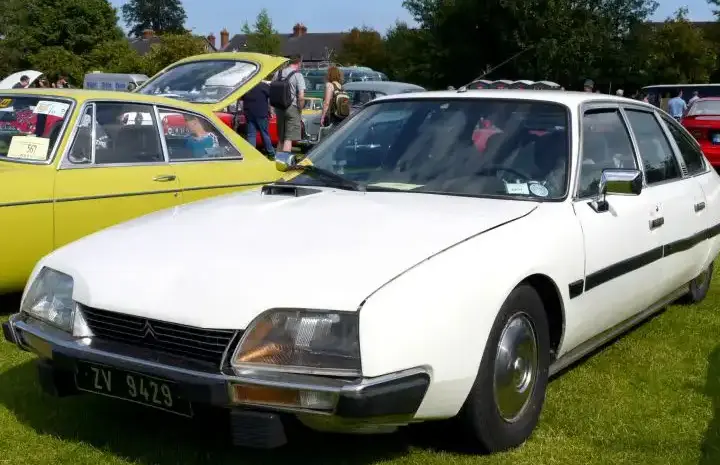
The Citroën CX 2500 D, produced between 1978 and 1982, represents the entry-level diesel variant of the groundbreaking CX series. Introduced as a successor to the Citroën DS, the CX continued the company’s tradition of innovative engineering and distinctive styling. The 2500 D, powered by a 2.5-liter naturally aspirated diesel engine producing 75 horsepower, occupied a unique position in the CX lineup, offering a balance of fuel economy and practicality for buyers seeking a comfortable and technologically advanced vehicle. It was part of the initial CX I generation, built on the platform that would see further refinements throughout the model’s lifespan.
Technical Specifications
| Brand | Citroën |
| Model | CX |
| Generation | CX I |
| Type (Engine) | 2500 D (75 Hp) |
| Start of production | 1978 |
| End of production | 1982 |
| Powertrain Architecture | Internal Combustion engine |
| Body type | Hatchback |
| Seats | 5 |
| Doors | 5 |
| Fuel Type | Diesel |
| Acceleration 0 – 100 km/h | 17.1 sec |
| Acceleration 0 – 62 mph | 17.1 sec |
| Acceleration 0 – 60 mph | 16.2 sec |
| Maximum speed | 156 km/h (96.93 mph) |
| Weight-to-power ratio | 18 kg/Hp, 55.6 Hp/tonne |
| Weight-to-torque ratio | 9 kg/Nm, 111.3 Nm/tonne |
| Power | 75 Hp @ 4250 rpm |
| Power per litre | 30 Hp/l |
| Torque | 150 Nm @ 2000 rpm (110.63 lb.-ft. @ 2000 rpm) |
| Engine layout | Front, Transverse |
| Engine Model/Code | M25-629 |
| Engine displacement | 2499 cm3 (152.5 cu. in.) |
| Number of cylinders | 4 |
| Engine configuration | Inline |
| Cylinder Bore | 93 mm (3.66 in.) |
| Piston Stroke | 92 mm (3.62 in.) |
| Compression ratio | 22.25:1 |
| Number of valves per cylinder | 2 |
| Fuel injection system | Precombustion chamber injection |
| Engine aspiration | Naturally aspirated |
| Engine oil capacity | 5.3 l (5.6 US qt | 4.66 UK qt) |
| Coolant | 12.3 l (13 US qt | 10.82 UK qt) |
| Kerb Weight | 1348 kg (2971.83 lbs) |
| Max. weight | 1800 kg (3968.32 lbs) |
| Max load | 452 kg (996.49 lbs) |
| Trunk (boot) space – minimum | 325 l (11.48 cu. ft.) |
| Fuel tank capacity | 68 l (17.96 US gal | 14.96 UK gal) |
| Permitted trailer load with brakes (12%) | 1300 kg (2866.01 lbs) |
| Permitted trailer load without brakes | 685 kg (1510.17 lbs) |
| Length | 4659 mm (183.43 in.) |
| Width | 1734 mm (68.27 in.) |
| Height | 1360 mm (53.54 in.) |
| Wheelbase | 2845 mm (112.01 in.) |
| Front track | 1474 mm (58.03 in.) |
| Rear (Back) track | 1360 mm (53.54 in.) |
| Front overhang | 1050 mm (41.34 in.) |
| Rear overhang | 764 mm (30.08 in.) |
| Ride height (ground clearance) | 155 mm (6.1 in.) |
| Drag coefficient (Cd) | 0.37 |
| Minimum turning circle | 11.80 m (38.71 ft.) |
| Drivetrain Architecture | The Internal combustion engine (ICE) drives the front wheels of the vehicle. |
| Drive wheel | Front wheel drive |
| Number of gears and type of gearbox | 5 gears, manual transmission |
| Front brakes | Ventilated discs |
| Rear brakes | Disc |
| Steering type | Steering rack and pinion |
| Wheel rims size | 5.5J x 14 |
Powertrain & Engine Architecture
The Citroën CX 2500 D was powered by the M25-629 engine, a 2.5-liter inline-four diesel. This engine utilized precombustion chamber injection, a system common in European diesel engines of the era. This system involved injecting fuel into a small precombustion chamber connected to the main cylinder, where it ignited and then ignited the main charge. This design aided in cold starting and reduced engine noise compared to direct injection systems. The engine produced 75 horsepower at 4250 rpm and 150 Nm (110.63 lb-ft) of torque at 2000 rpm. The engine was transversely mounted, contributing to the CX’s compact engine bay and maximizing interior space. The 2500 D was equipped with a five-speed manual transmission, chosen for its efficiency and suitability for the engine’s torque characteristics.
Driving Characteristics
The CX 2500 D offered a distinctly different driving experience compared to its gasoline-powered siblings. While lacking the outright acceleration of the CX 2000 or 2400, the diesel variant provided ample torque for relaxed cruising and everyday driving. The five-speed manual transmission allowed drivers to keep the engine within its optimal torque band, making it surprisingly capable on inclines and when carrying a load. The CX’s renowned hydropneumatic suspension, a hallmark of Citroën engineering, provided an exceptionally smooth and comfortable ride, regardless of road conditions. However, the 2500 D’s heavier engine and lower power output meant that it wasn’t as agile or responsive as the lighter, gasoline-powered models.
Equipment & Trim Levels
The CX 2500 D was generally equipped with a modest level of standard features. Interior upholstery typically consisted of durable cloth, and the dashboard featured a functional, if somewhat utilitarian, design. Power steering was standard, a necessity given the car’s size and weight. Optional extras included upgraded upholstery, a sunroof, and more advanced audio systems. The 2500 D represented the entry point into the CX range, and as such, it was positioned as a practical and economical choice for buyers prioritizing comfort and fuel efficiency over outright performance or luxury.
Chassis & Braking
The CX featured a monocoque chassis and independent suspension on all four wheels, utilizing Citroën’s innovative hydropneumatic system. This system allowed for self-leveling and adjustable ride height, providing exceptional ride quality and handling. The front suspension employed double wishbones, while the rear utilized a trailing arm design. Braking was accomplished via ventilated discs on the front wheels and solid discs on the rear. The braking system was generally effective, although the CX’s weight required a firm pedal input.
Market Reception & Comparison
The CX 2500 D was well-received in Europe as a fuel-efficient and comfortable family car. Critics praised its ride quality and spacious interior, but noted its relatively slow acceleration. Compared to the gasoline-powered CX models, the 2500 D offered significantly better fuel economy, making it an attractive option for high-mileage drivers. However, it lacked the performance and refinement of the more expensive variants. Against competitors like the Peugeot 505 and Renault 20, the CX 2500 D stood out for its unique suspension and distinctive styling.
Legacy
The Citroën CX 2500 D, while not the most powerful or glamorous variant of the CX range, remains a significant vehicle in automotive history. Its innovative hydropneumatic suspension and comfortable ride continue to be admired by enthusiasts. The M25-629 diesel engine proved to be relatively durable, and well-maintained examples can still be found on the road today. In the used car market, the CX 2500 D is often considered a good value, offering a unique driving experience and a distinctive design at an affordable price. Its legacy lies in its embodiment of Citroën’s commitment to innovation and its ability to provide a comfortable and practical driving experience.
