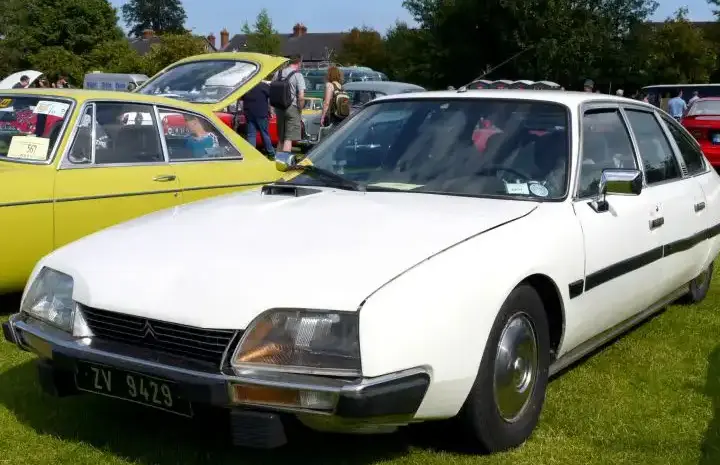
The Citroën CX I Break 25 Automatic, produced between 1983 and 1985, represents a unique blend of Citroën’s innovative hydropneumatic suspension technology and a relatively powerful engine option within the CX Break (estate) range. Positioned as a mid-to-upper trim level, it offered a more refined driving experience and increased practicality compared to the base models. This variant was part of the first series (Phase I) of the CX Break, built on the CX platform, known internally as the G series. The CX Break, in general, aimed to provide the comfort and distinctive styling of the CX saloon in a more versatile body style, appealing to families and those requiring additional cargo space.
Technical Specifications
| Brand | Citroen |
| Model | CX |
| Generation | CX I Break (Phase I, 1982) |
| Type (Engine) | 25 (138 Hp) Automatic |
| Start of production | 1983 |
| End of production | 1985 |
| Powertrain Architecture | Internal Combustion engine |
| Body type | Station wagon (estate) |
| Seats | 5 |
| Doors | 5 |
| Fuel Type | Petrol (Gasoline) |
| Acceleration 0 – 100 km/h | 12.4 sec |
| Acceleration 0 – 62 mph | 12.4 sec |
| Acceleration 0 – 60 mph | 11.8 sec |
| Maximum speed | 190 km/h (118.06 mph) |
| Weight-to-power ratio | 10.6 kg/Hp, 94.2 Hp/tonne |
| Weight-to-torque ratio | 6.9 kg/Nm, 144 Nm/tonne |
| Power | 138 Hp @ 5000 rpm |
| Power per litre | 55.2 Hp/l |
| Torque | 211 Nm @ 4000 rpm (155.63 lb.-ft. @ 4000 rpm) |
| Maximum engine speed | 6000 rpm |
| Engine layout | Front, Transverse |
| Engine Model/Code | M25.659 |
| Engine displacement | 2499 cm3 (152.5 cu. in.) |
| Number of cylinders | 4 |
| Engine configuration | Inline |
| Cylinder Bore | 93 mm (3.66 in.) |
| Piston Stroke | 92 mm (3.62 in.) |
| Compression ratio | 8.75:1 |
| Number of valves per cylinder | 2 |
| Fuel injection system | Multi-port manifold injection |
| Engine aspiration | Naturally aspirated engine |
| Engine oil capacity | 5 l (5.28 US qt | 4.4 UK qt) |
| Coolant | 9.6 l (10.14 US qt | 8.45 UK qt) |
| Kerb Weight | 1465 kg (3229.77 lbs.) |
| Max. weight | 2165 kg (4773.01 lbs.) |
| Max load | 700 kg (1543.24 lbs.) |
| Fuel tank capacity | 68 l (17.96 US gal | 14.96 UK gal) |
| Length | 4950 mm (194.88 in.) |
| Width | 1770 mm (69.69 in.) |
| Height | 1465 mm (57.68 in.) |
| Wheelbase | 3095 mm (121.85 in.) |
| Front track | 1514 mm (59.61 in.) |
| Rear (Back) track | 1390 mm (54.72 in.) |
| Drag coefficient (Cd) | 0.40 |
| Minimum turning circle | 12.5 m (41.01 ft.) |
| Drivetrain Architecture | The Internal combustion engine (ICE) drives the front wheels of the vehicle. |
| Drive wheel | Front wheel drive |
| Number of gears and type of gearbox | 3 gears, automatic transmission |
| Front brakes | Ventilated discs |
| Rear brakes | Disc |
| Steering type | Steering rack and pinion |
Powertrain & Engine Architecture
The CX I Break 25 Automatic was powered by the Peugeot-Citroën (PRV) V6 engine, specifically the M25.659 variant. This 2.5-liter, naturally aspirated engine featured an inline-six configuration, though often referred to as a V6 due to its layout. It produced 138 horsepower at 5000 rpm and 211 Nm (155.63 lb-ft) of torque at 4000 rpm. The engine utilized multi-port fuel injection, a relatively advanced system for the early 1980s, contributing to improved fuel efficiency and smoother power delivery. The engine’s valvetrain consisted of two valves per cylinder. The automatic transmission was a three-speed unit, designed to provide comfortable and effortless cruising. While not known for its sporty performance, it was well-suited to the CX’s emphasis on ride comfort.
Driving Characteristics
The 138 hp engine coupled with the three-speed automatic transmission resulted in a driving experience focused on refinement rather than outright speed. Acceleration from 0 to 60 mph took approximately 11.8 seconds, and the top speed was around 118 mph. The automatic transmission, while providing convenience, did slightly diminish the engine’s potential. Gear changes were not particularly quick, and the limited number of gears meant the engine could sometimes feel strained during hard acceleration. However, the CX’s legendary hydropneumatic suspension system largely masked any powertrain shortcomings. The ride quality remained exceptionally smooth, even over rough surfaces, and the car offered a level of composure rarely found in vehicles of that era. The steering, also hydraulically assisted, was light and precise.
Equipment & Trim Levels
The CX I Break 25 Automatic typically included features such as power steering, central locking, and electric windows. Interior upholstery was generally cloth, though leather was available as an optional extra. The dashboard layout was characteristically Citroën, featuring a unique combination of analog gauges and switches. Optional extras included air conditioning, a sunroof, and upgraded audio systems. The Break estate body style itself added to the practicality, offering a generous cargo capacity. The trim level sat above the base CX Break models, offering a more comprehensive equipment list and a more luxurious feel.
Chassis & Braking
The CX I Break featured independent suspension on all four wheels, utilizing Citroën’s innovative hydropneumatic system. This system allowed for self-leveling, variable ride height adjustment, and exceptional ride comfort. The front brakes were ventilated discs, providing good stopping power, while the rear brakes were solid discs. The steering was a rack and pinion system with hydraulic assistance. The CX’s chassis was designed to prioritize comfort and stability, rather than sporty handling. Stabilizer bars were fitted to both the front and rear axles to reduce body roll.
Market Reception & Comparison
The CX I Break 25 Automatic was generally well-received by automotive critics, who praised its ride comfort, spacious interior, and distinctive styling. However, some criticized its relatively slow acceleration and the somewhat dated three-speed automatic transmission. Compared to other CX Break variants, the 25 Automatic offered a significant power upgrade over the smaller-engined models, but it was less sporty than the versions equipped with a manual transmission. Fuel economy was reasonable for the time, but not exceptional. Reliability was a mixed bag, with the hydropneumatic suspension system requiring regular maintenance and occasional repairs.
Legacy
The Citroën CX I Break 25 Automatic remains a sought-after classic car, particularly among enthusiasts of Citroën’s innovative engineering. The hydropneumatic suspension system, while complex, is still highly regarded for its ability to deliver an unparalleled ride quality. The PRV V6 engine, while not known for its longevity, is relatively straightforward to maintain. Today, finding a well-maintained example can be challenging, as many have succumbed to rust or neglect. However, those that remain offer a unique and rewarding driving experience, representing a high point in Citroën’s history of automotive innovation. The car’s distinctive styling and comfortable ride continue to appeal to collectors and enthusiasts alike, ensuring its place as a significant vehicle in automotive history.